
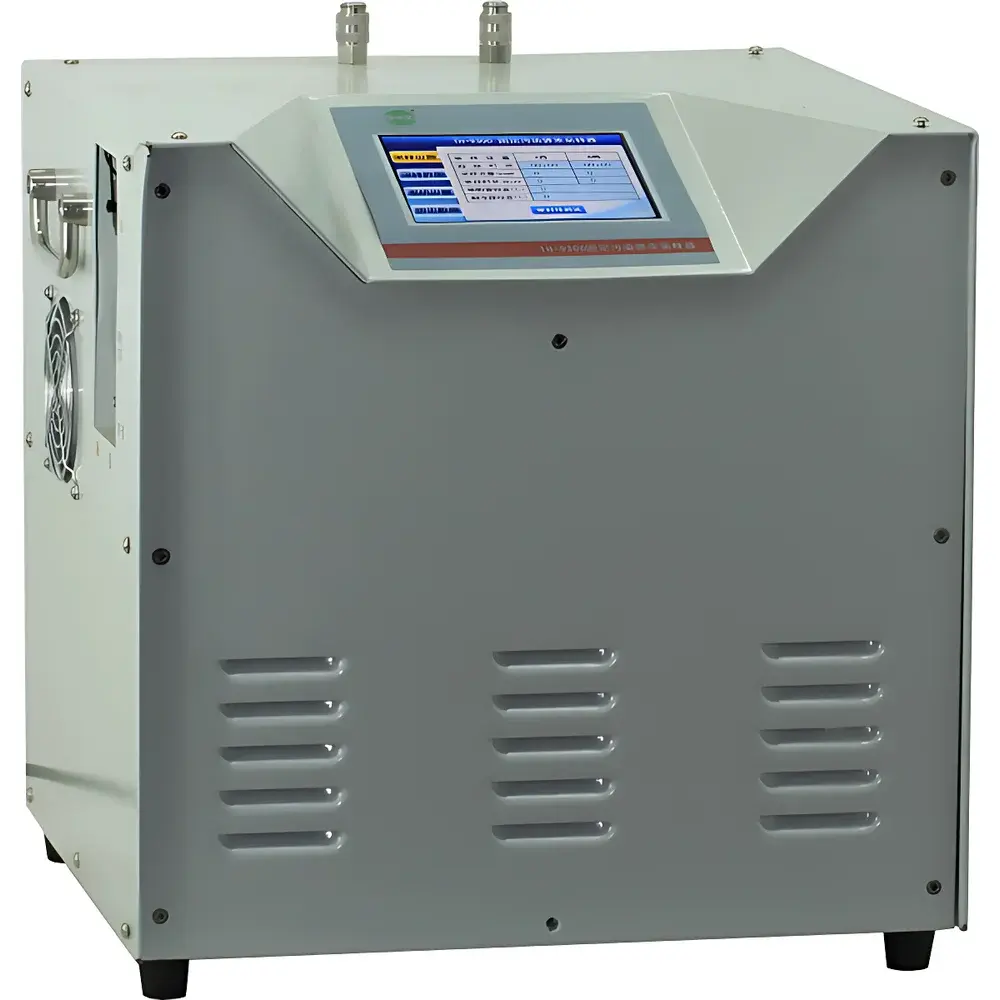
Tianhong TH-9300 Fixed Source Gaseous Mercury Sampling System
| Brand | Tianhong |
|---|---|
| Origin | Hubei, China |
| Model | TH-9300 |
| Instrument Type | Flue Gas Mercury Sampler |
| Sampling Flow Rate | 0–2.0 L/min |
| Flow Accuracy | ±2% |
| Flue Gas Velocity Range | 5–40 m/s |
| Compliance | EPA Method 30B, HJ/T 374–2007, Q/WTH 19–2014 |
Overview
The Tianhong TH-9300 Fixed Source Gaseous Mercury Sampling System is an engineered solution for regulatory-compliant mercury emission monitoring from stationary combustion sources—primarily coal-fired power plants, waste incinerators, and industrial boilers. Designed in strict accordance with U.S. EPA Method 30B (Determination of Total Gaseous Mercury Emissions from Coal-Fired Sources Using Sorbent Trap Sampling), the system implements a dual-channel, isokinetic sampling architecture based on S-type Pitot tube velocity profiling and active flow control. It enables quantitative collection of total gaseous mercury (TGM) on certified activated carbon or speciated sorbent traps—supporting subsequent analysis by Cold Vapor Atomic Absorption Spectrometry (CVAAS) or Cold Vapor Atomic Fluorescence Spectrometry (CVAFS). The system’s core function is to deliver volumetrically accurate, temperature- and humidity-stabilized flue gas samples under real-time isokinetic conditions, ensuring representative capture across variable stack velocities (5–40 m/s) and minimizing adsorption artifacts.
Key Features
- Dual independent sampling channels with fully decoupled flow control—enabling parallel, comparative sampling under identical thermal and dynamic conditions for enhanced data reliability and method validation.
- Precise flow regulation from 0 to 2.0 L/min with ±2% accuracy, achieved via closed-loop feedback control using mass flow sensors and proportional solenoid valves; flow calibration is supported through built-in zero/span adjustment routines.
- Integrated S-type Pitot tube assembly for real-time flue gas velocity, static/total pressure, and differential pressure measurement—essential for isokinetic probe positioning and flow rate correction per ISO 9096 and EPA PS-1 guidelines.
- Active thermoelectric (Peltier) cooling and condensate separation upstream of the sample train—reducing moisture content to <10% RH before sorbent trap entry, thereby preventing trap breakthrough, oxidation artifacts, and sensor drift.
- Programmable touchscreen HMI with intuitive navigation, multilayer parameter configuration (flow setpoint, probe/line temperature, sampling duration), and real-time graphical display of velocity, temperature, pressure, and flow trends.
- Modular mechanical design: detachable heated sampling probe (up to 180 °C), insulated flexible heated tubing (120 °C operational rating), and field-serviceable internal components—optimized for transport, rapid setup, and maintenance in remote stack environments.
Sample Compatibility & Compliance
The TH-9300 is validated for use with standard EPA-certified sorbent traps—including gold-coated quartz, iodated carbon, and dual-bed configurations for Hg⁰/Hg²⁺ speciation. Its sampling protocol satisfies the physical and metrological requirements of EPA Method 30B, including isokinetic deviation ≤10%, trap temperature stability ±2 °C, and post-sampling blank integrity verification. The system also conforms to Chinese national standard HJ/T 374–2007 for suspended particulate samplers and enterprise standard Q/WTH 19–2014, which specifies performance thresholds for gaseous mercury sampling systems—including response time (<30 s), data logging resolution (1 Hz), and thermal uniformity across the heated sampling path. All firmware and data handling modules support audit-ready operation under GLP-aligned workflows.
Software & Data Management
Data acquisition is performed at 1 Hz resolution and stored internally in non-volatile memory with timestamped metadata (date, time, channel ID, ambient temperature, battery voltage). Three data tiers are maintained: real-time live view (refreshed every 2 s), hourly summary statistics (mean, min, max, SD of flow, velocity, temp), and full raw logs. Export is executed via standard USB 2.0 interface in CSV format—compatible with LIMS integration and third-party statistical packages (e.g., R, Python pandas). No proprietary software installation is required. All data files include embedded calibration coefficients and operator ID fields to satisfy traceability requirements per ISO/IEC 17025 and FDA 21 CFR Part 11 (when used with electronic signature add-ons).
Applications
- Regulatory compliance monitoring of Hg emissions from coal-fired utility boilers under MATS (U.S.) or GB 13223–2011 (China).
- Source testing and performance evaluation of mercury control technologies (e.g., ACI injection, SCR modifications, wet FGD upgrades).
- Method validation studies comparing sorbent trap performance across different Hg speciation profiles and flue gas matrices (Cl⁻, SO₂, NOₓ).
- Stack testing campaigns requiring paired sampling for uncertainty quantification and QA/QC cross-checking.
- Field deployment in mobile labs or temporary monitoring trailers where portability, low power draw (<120 W), and ruggedized housing (IP54-rated enclosure) are critical.
FAQ
Does the TH-9300 support speciated mercury sampling (Hg⁰ vs. Hg²⁺)?
Yes—when equipped with dual-bed sorbent traps (e.g., KCl-coated front bed for oxidized Hg, Au-coated rear bed for elemental Hg), the system maintains thermal and flow stability required for valid speciation according to ASTM D6784–22 Annex A3.
Is external power required, or does it operate on battery?
The unit operates on 220 VAC input but includes an optional 24 VDC battery pack for up to 4 hours of uninterrupted field operation—ideal for locations without stable grid access.
How is flow calibration performed in the field?
A built-in calibration mode guides users through dry calibrator (e.g., Bios DryCal) integration; the system accepts user-entered reference flow values and auto-adjusts control parameters to maintain ±2% accuracy across the full 0–2.0 L/min range.
Can the instrument log flue gas moisture content?
While the TH-9300 actively removes moisture via Peltier cooling and condensate trapping, it does not quantify absolute moisture content; users must pair it with a standalone dew point meter or extract moisture data from co-located CEMS if required for stoichiometric correction.
What is the maximum allowable stack temperature for probe insertion?
The standard heated probe is rated for continuous operation up to 200 °C; optional high-temp probes (300 °C rating) are available upon request with reinforced ceramic insulation and Inconel sheathing.
Related Products







