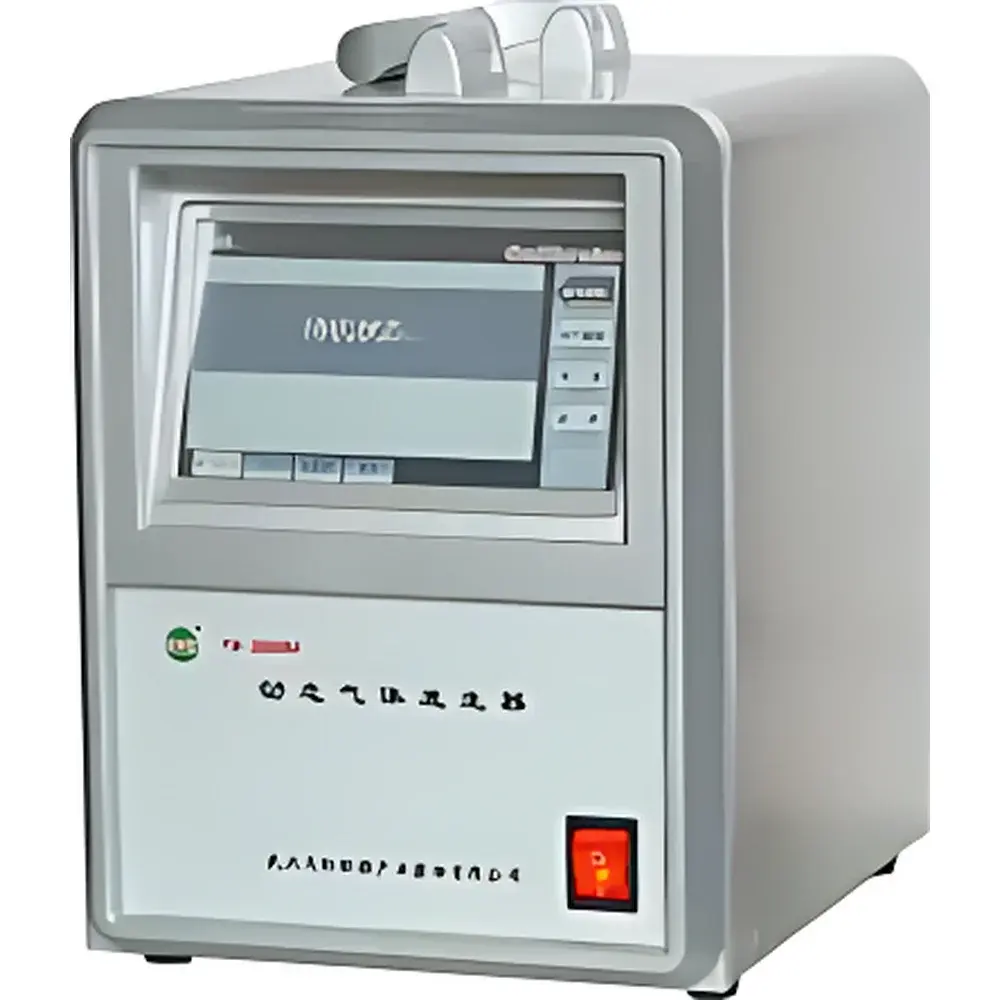
Tianhong TH-2008M Dynamic Gas Generator
| Brand | Tianhong |
|---|---|
| Origin | Hubei, China |
| Model | TH-2008M |
| Application | Calibration of SO₂ analyzers per HJ 57–2017 |
| Display | 7-inch full-touch color LCD |
| Interface | Bilingual (Chinese/English) menu system |
| Programmability | Up to 99 programmable segments and sequence steps |
| Flow control | Triple-channel high-accuracy mass flow controllers (imported), expandable |
| Compensation | Automatic temperature & pressure compensation |
| Connectivity | RS232, RS485, USB |
| Power options | AC/DC dual-mode (field-deployable) |
| Compliance | Designed for traceable calibration in accordance with HJ 57–2017 |
Overview
The Tianhong TH-2008M Dynamic Gas Generator is a precision-engineered calibration standard generator designed specifically for the dynamic dilution and delivery of certified reference gas mixtures—primarily sulfur dioxide (SO₂) in nitrogen—to environmental monitoring instruments. It operates on the principle of gravimetrically traceable, real-time mass flow-controlled blending, enabling accurate, repeatable generation of low-concentration gas standards (ppb to ppm range) under variable ambient conditions. Unlike static permeation or cylinder-based calibration sources, the TH-2008M dynamically synthesizes target concentrations by precisely metering certified SO₂ standard gas and ultra-high-purity nitrogen through three independently controlled thermal mass flow controllers (MFCs). This architecture ensures metrological integrity across changing temperature and barometric pressure—critical for field-deployable calibration in stack emission testing, ambient air quality monitoring stations, and laboratory-based instrument verification. Its design fully aligns with the procedural and performance requirements specified in HJ 57–2017, the Chinese national standard for SO₂ determination in stationary source exhaust gas using the potentiostatic electrolysis method.
Key Features
- Triple-channel mass flow control architecture with imported high-stability thermal MFCs (±1% FS accuracy, repeatability < ±0.5%); configurable for up to six channels via optional expansion module
- Integrated automatic temperature and pressure compensation (ATPC) based on real-time sensor inputs (PT100 temperature sensor, piezoresistive pressure transducer), ensuring volumetric flow consistency across operational environments (10–40 °C, 80–106 kPa)
- 7-inch capacitive touch LCD with intuitive bilingual (English/Chinese) GUI; supports user-defined calibration sequences comprising up to 99 individual program segments and nested sequence steps
- Dual power architecture: standard 220 VAC input with optional 12–24 VDC battery-compatible operation, enabling uninterrupted use during mobile emissions audits or remote site calibrations
- Comprehensive digital I/O: native support for RS232 (ASCII protocol), RS485 (Modbus RTU), and USB 2.0 host/device modes for configuration export, firmware updates, and audit log retrieval
- Embedded non-volatile memory stores ≥10,000 calibration events with timestamp, operator ID, gas composition, and environmental metadata—fully compliant with GLP data integrity expectations
Sample Compatibility & Compliance
The TH-2008M is validated for use with certified SO₂/N₂ standard gases (certified to ISO 6141 or GB/T 5274) at concentrations ranging from 10 ppm to 10,000 ppm. It accommodates cylinder inlet pressures from 0.1 to 1.0 MPa and delivers stable output flows from 0.1 to 5.0 L/min. All wetted materials—including stainless steel 316L manifolds, EPDM-free fluoropolymer seals, and inert alumina-coated flow paths—are selected to prevent SO₂ adsorption or catalytic decomposition. The instrument meets electromagnetic compatibility (EMC) requirements per GB/T 18268.1–2010 (IEC 61326-1) and safety specifications per GB 4793.1–2007 (IEC 61010-1). While HJ 57–2017 is its primary regulatory anchor, its traceable dilution methodology supports alignment with ISO/IEC 17025–2017 clause 5.5.2 (calibration gas generation) and US EPA Method 205 verification protocols when paired with NIST-traceable parent gases.
Software & Data Management
The embedded firmware implements a deterministic real-time operating system (RTOS) with deterministic loop timing (<10 ms cycle resolution) for synchronized MFC actuation and sensor sampling. Configuration files (.cfg) and calibration logs (.csv) are exportable via USB mass storage mode. Optional PC software (Tianhong GasCal Suite v3.x) provides advanced features including: automated sequence validation against HJ 57–2017 multi-point linearity checks; electronic signature capture for 21 CFR Part 11-compliant audit trails; and integration with LIMS via OPC UA or RESTful API endpoints. All stored data include ISO 8601 timestamps, UTC/GMT synchronization capability, and SHA-256 checksums for integrity verification—meeting minimum ALCOA+ principles (Attributable, Legible, Contemporaneous, Original, Accurate, Complete, Consistent, Enduring, Available).
Applications
- On-site calibration and verification of fixed-source continuous emission monitoring systems (CEMS) for SO₂ per HJ 75–2017 and HJ 57–2017
- Periodic performance evaluation of portable electrochemical SO₂ analyzers used in industrial hygiene and stack testing
- Factory acceptance testing (FAT) and routine calibration of environmental air quality analyzers (e.g., UV fluorescence, pulsed fluorescence, and potentiostatic electrolytic platforms)
- Reference standard generation for metrology laboratories accredited to CNAS-CL01 (ISO/IEC 17025)
- Method validation studies requiring dynamic gas concentration ramps, step changes, or multi-level bracketing protocols
FAQ
Does the TH-2008M support calibration traceability to national standards?
Yes—the instrument’s MFCs are factory-calibrated against NIM (National Institute of Metrology, China)-certified flow standards, and its ATPC algorithm is verified per JJG 643–2003. Full calibration certificates with uncertainty budgets are provided upon request.
Can it generate gas mixtures other than SO₂/N₂?
It is optimized for SO₂ but can be configured for NO, NO₂, CO, O₃, or H₂S when paired with compatible certified standard gases and appropriate corrosion-resistant flow path upgrades (e.g., Hastelloy C-276 wetted parts).
Is remote monitoring or control possible?
Yes—via RS485 Modbus RTU, users can integrate the TH-2008M into SCADA or DCS systems for centralized calibration scheduling and status telemetry.
What maintenance intervals are recommended?
MFC zero calibration every 90 days; full system verification (including ATPC sensors) annually or after 500 operational hours—documented in the included maintenance log template.
How is data security ensured during USB transfers?
All exported files are write-protected post-generation; firmware enforces read-only access to internal logs unless authenticated via administrator credentials—supporting basic data governance requirements for ISO 17025 audits.