
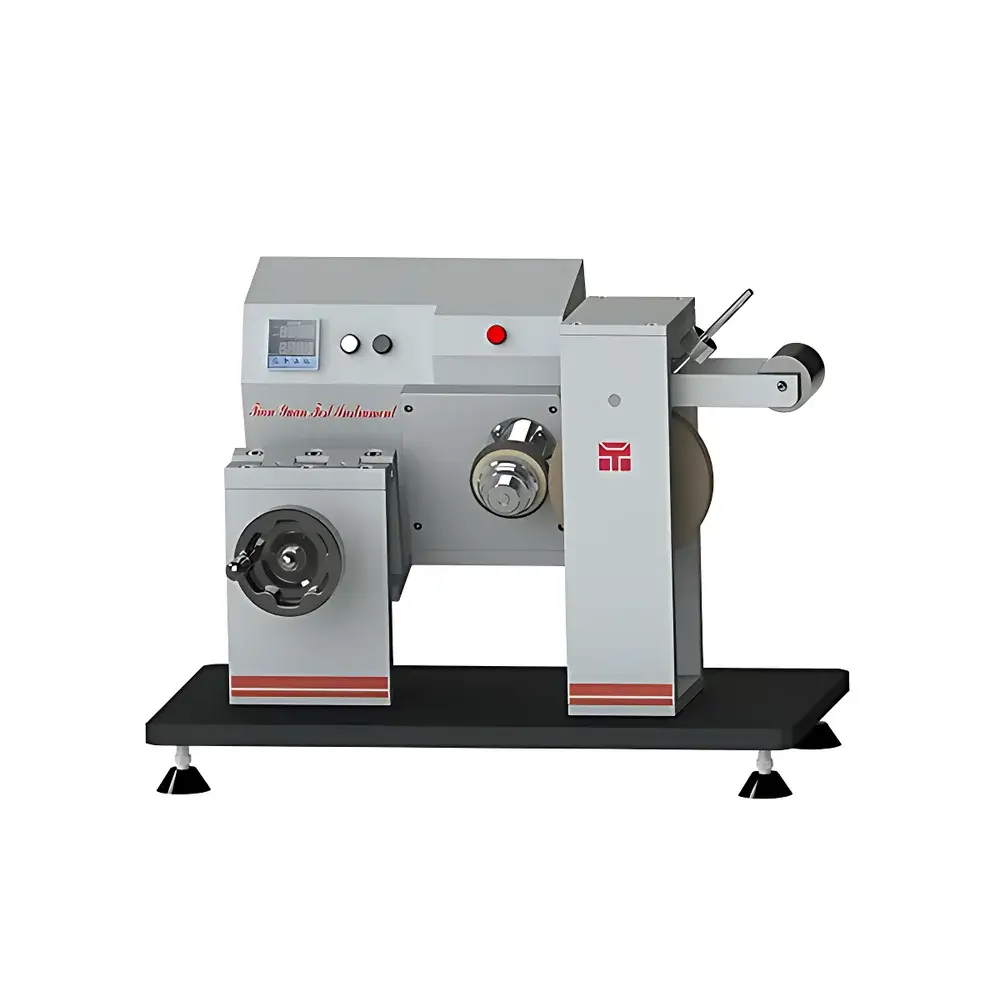
TianYuan TY-4069 Akron Abrasion Tester
| Key | Brand: TianYuan |
|---|---|
| Model | TY-4069 |
| Applied Force on Rubber Wheel | 26.7 N |
| Rubber Wheel Rotational Speed | 76 ± 2 rpm |
| Abrasive Wheel Rotational Speed | 33–35 rpm |
| Inter-Axial Angle Range | 0°–45° |
| Power Supply | AC 220 V ± 10% |
| Dimensions (L×W×H) | 600 × 480 × 400 mm |
| Weight | 60 kg |
Overview
The TianYuan TY-4069 Akron Abrasion Tester is a precision-engineered instrument designed for the quantitative evaluation of rubber compound wear resistance under controlled mechanical abrasion conditions. It operates on the principle of the Akron abrasion method—where a standardized rubber test specimen, mounted on a rotating wheel, is pressed at a defined angle and load against a rotating abrasive grinding wheel. The volumetric loss of the specimen after a specified number of revolutions (typically corresponding to a fixed travel distance, e.g., 1.61 km) is measured and reported as abrasion volume (cm³), providing a reproducible metric for comparative material performance. This method is widely adopted in rubber formulation development, quality control of elastomeric components, and supplier qualification processes across tire, conveyor belt, footwear, and industrial hose manufacturing sectors.
Key Features
- Stable mechanical architecture with rigid cast-iron base and precision-machined bearing housings ensures minimal vibration and high rotational repeatability over extended test cycles.
- Adjustable inter-axial angle mechanism (0°–45°) enables systematic investigation of wear anisotropy and directional dependence in rubber compounds.
- Dual independent speed control system maintains constant rubber wheel rotation at 76 ± 2 rpm and abrasive wheel rotation within 33–35 rpm—both verified via calibrated tachometric feedback.
- Fixed-load application system delivers consistent 26.7 N normal force to the rubber wheel via calibrated spring-loaded lever arm, traceable to national standards.
- Compliant power input (AC 220 V ± 10%) with internal thermal cutoff and overload protection safeguards operational continuity and user safety.
- Compact footprint (600 × 480 × 400 mm) and moderate mass (60 kg) facilitate integration into QC laboratories without requiring reinforced flooring or dedicated utility circuits.
Sample Compatibility & Compliance
The TY-4069 accommodates standard ASTM D1630 and GB/T 1689 test specimens—cylindrical rubber plugs (typically Ø16.0 ± 0.2 mm × 12.5 ± 0.2 mm) cured per ISO 34-1 or GB/T 6038 protocols. Specimen mounting uses a quick-release collet system compatible with both natural rubber (NR), styrene-butadiene rubber (SBR), nitrile rubber (NBR), and halogenated elastomers. All mechanical tolerances—including wheel parallelism, axial runout (< 0.05 mm), and angular indexing accuracy (±0.5°)—are validated during factory calibration. The instrument meets the dimensional, loading, and kinematic requirements stipulated in GB/T 1689-2014 and is functionally equivalent to ASTM D1630-17 for comparative abrasion testing. While not certified to ISO/IEC 17025, its design supports GLP-compliant operation when paired with documented calibration records and operator training logs.
Software & Data Management
The TY-4069 is a manually operated, analog-controlled instrument with no embedded microprocessor or digital interface. Test duration is tracked using a mechanical revolution counter; final abrasion volume is calculated manually from pre- and post-test specimen mass (measured on analytical balance, 0.1 mg resolution) and density (determined per ISO 2781). Users are expected to maintain test records in accordance with internal SOPs or regulatory frameworks such as FDA 21 CFR Part 11—requiring handwritten or electronically signed entries, version-controlled test sheets, and retention of raw mass data and calculation worksheets. Optional third-party lab information management systems (LIMS) may integrate TY-4069 results via manual data entry or CSV import following standardized template formatting.
Applications
- Formulation screening of reinforcing fillers (e.g., silica vs. carbon black) and curatives to optimize wear resistance in tread compounds.
- Batch-to-batch consistency verification for rubber extrusions used in automotive sealing systems.
- Accelerated wear benchmarking of recycled rubber blends intended for low-cost industrial matting.
- Comparative assessment of polymer-modified bitumen binders in pavement applications where elastomeric phase durability affects rutting resistance.
- Supporting technical documentation for ISO/TS 16949 or IATF 16949 audits through traceable wear index reporting.
FAQ
What standards does the TY-4069 comply with?
It is engineered to meet the mechanical and procedural requirements of GB/T 1689-2014 and is functionally aligned with ASTM D1630-17.
Is the abrasive wheel included with the instrument?
Yes—a standard 60-grit aluminum oxide abrasive wheel compliant with GB/T 1689 specifications is supplied with each unit.
Can the TY-4069 be used for non-rubber elastomers such as TPU or TPE?
While not explicitly validated for thermoplastic elastomers, users may adapt the method with prior correlation studies; note that modulus mismatch may affect contact mechanics and require revised load or angle settings.
What calibration documentation is provided?
Each unit ships with a factory calibration report covering applied force verification, rotational speed validation, and angular positioning accuracy—traceable to China National Institute of Metrology (CNIM) standards.
Is operator training available?
TianYuan offers optional on-site or remote training modules covering sample preparation, test execution, result calculation, and maintenance procedures—delivered in English upon request.





