
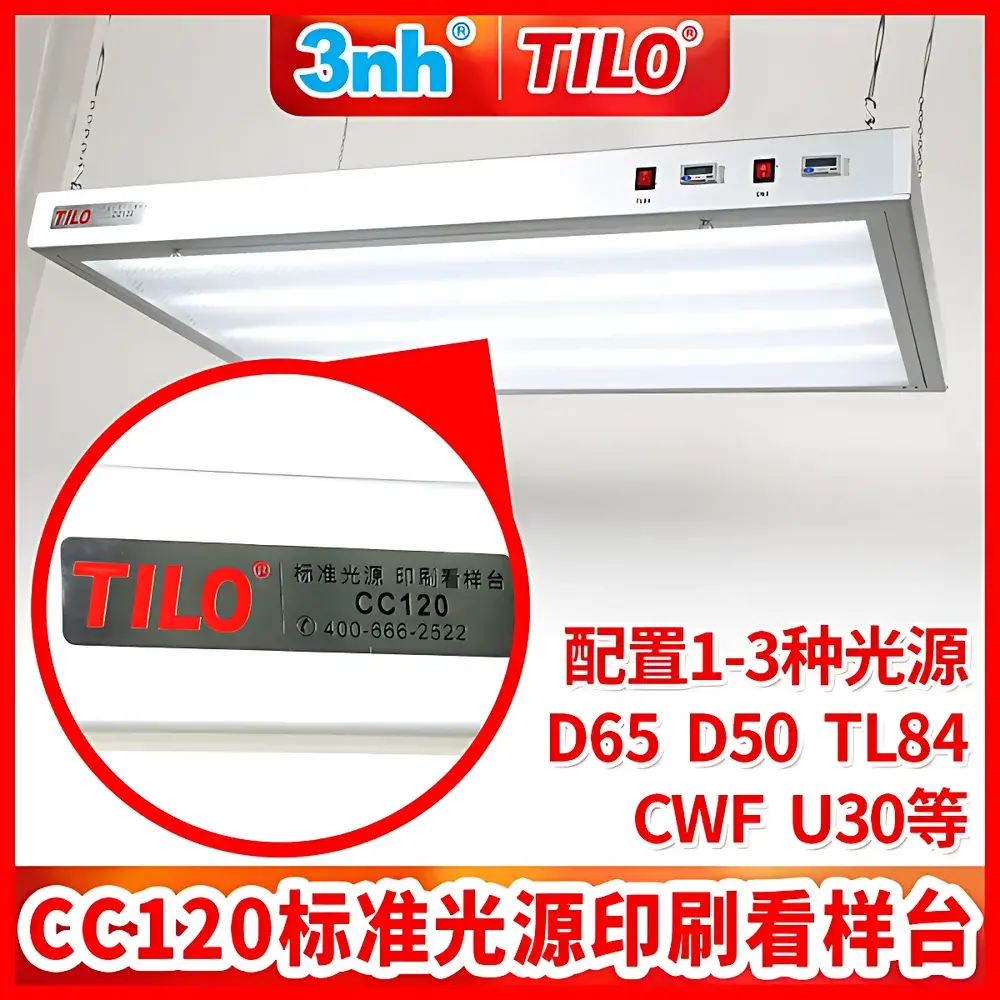
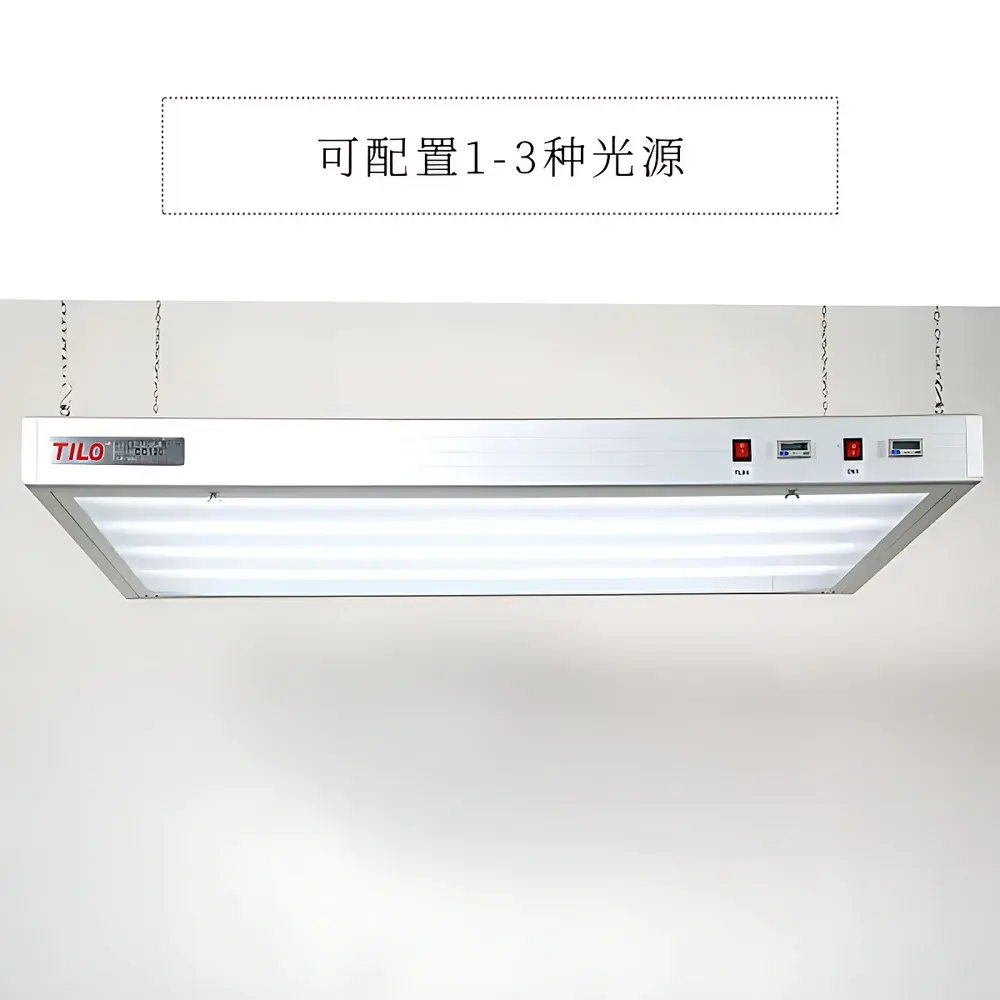
TILO CC120-W-2 Suspended Standard Light Booth
| Brand | TILO |
|---|---|
| Origin | Guangdong, China |
| Model | CC120-W-2 |
| Light Sources | D65, D50, TL84, CWF |
| Compliance | ISO 3664:2009, ASTM D1729, ISO 9001 |
| Lamp Life | 2000–3000 h |
| Power Input | AC 220 V ±10%, 50/60 Hz |
| Dimensions (W×D×H) | 1200 × 600 × 600 mm |
| Viewing Area | 1100 × 500 mm |
| Illuminance Uniformity | ≥85% across viewing area |
| CRI (Ra) | ≥95 for D65 and D50 lamps |
Overview
The TILO CC120-W-2 Suspended Standard Light Booth is an engineered solution for color-critical evaluation in print, textile, packaging, paint, and plastic industries. Designed in strict accordance with ISO 3664:2009 and ASTM D1729 standards, it provides controlled, repeatable illumination environments essential for detecting metamerism and assessing color fidelity under standardized lighting conditions. Unlike ambient or uncalibrated office lighting—where spectral power distribution (SPD) varies unpredictably—the CC120-W-2 integrates high-CRI fluorescent lamps with precisely defined correlated color temperatures (CCT) and spectral profiles to replicate key industrial illuminants: D65 (6500 K daylight), D50 (5000 K prepress standard), TL84 (cool white fluorescent, common in retail), and CWF (cool white fluorescent, used in North American commercial settings). Its suspended configuration eliminates shadow interference from overhead structures and ensures uniform vertical illumination across the full viewing surface—critical for side-by-side comparison of multiple samples under identical geometric and photometric conditions.
Key Features
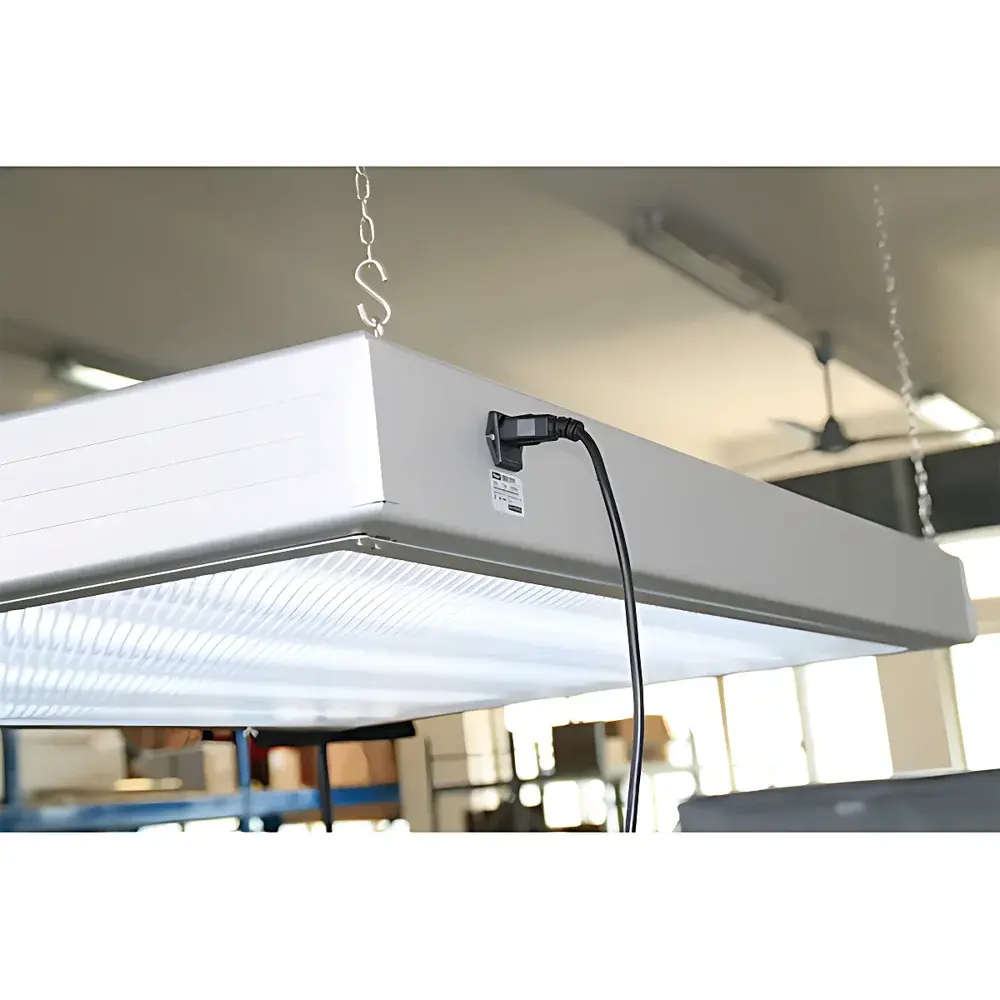
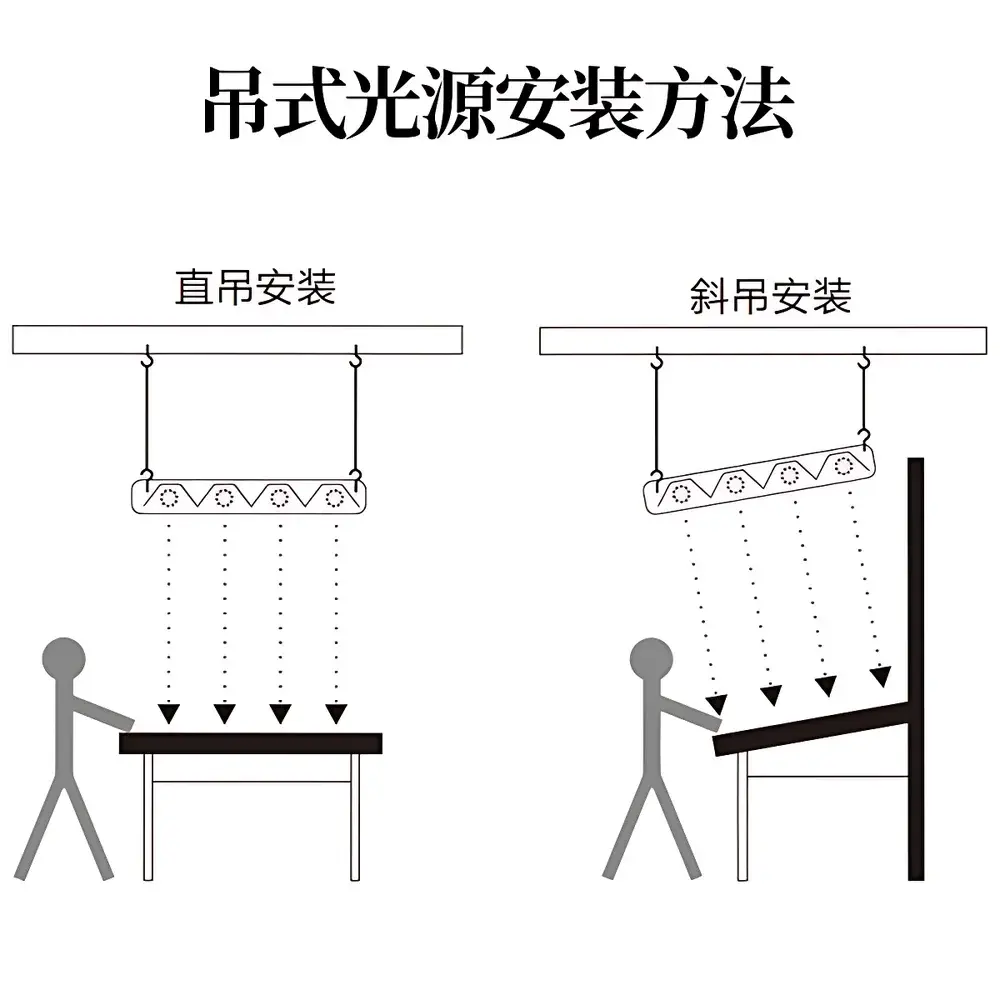
- Suspended mounting design minimizes ambient light intrusion and eliminates shadow distortion from ceiling fixtures or operator posture.
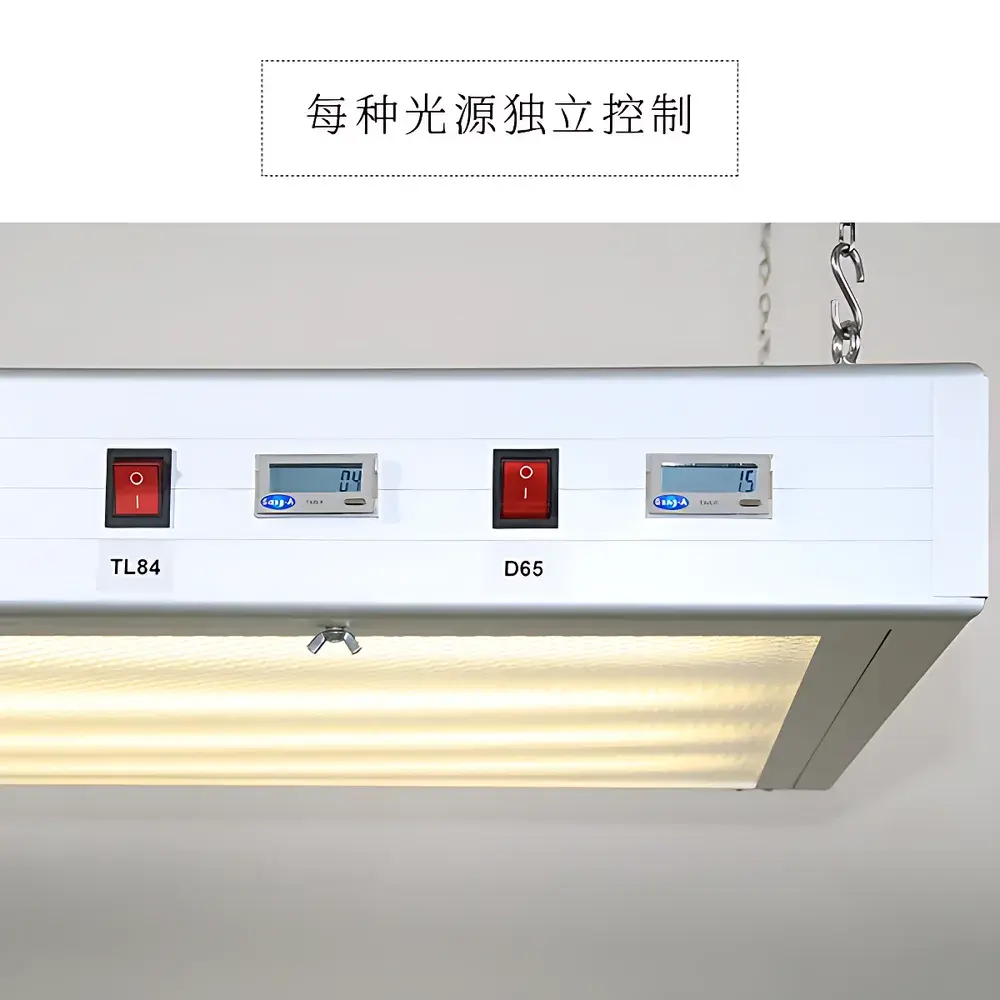
- Four independently switchable standard light sources: D65 (ISO/CIE reference daylight), D50 (graphic arts standard), TL84 (retail lighting simulation), and CWF (U.S. department store lighting).
- High-color-rendering fluorescent lamps with Ra ≥ 95 ensure accurate chromatic perception and reliable detection of metameric failure.
- Digital timer integrated per light channel enables precise exposure control and supports GLP-compliant documentation of viewing duration.
- Uniform illumination field (≥85% uniformity across 1100 × 500 mm viewing area) verified per ISO 3664 Annex B requirements.
- Front-access lamp compartment with quick-release white cap screws allows tool-free lamp replacement without disassembly.
- Stable thermal management system maintains CCT and irradiance stability after 30-minute warm-up—consistent with ISO 3664 operational protocol.
Sample Compatibility & Compliance
The CC120-W-2 accommodates rigid and flexible substrates up to 10 mm thickness, including printed sheets, fabric swatches, coated panels, injection-molded parts, and laminated packaging. Its viewing chamber meets ISO 3664:2009 Class A specifications for illuminant geometry, surround reflectance (Munsell N5 neutral gray interior), and background luminance ratio. The booth supports dual-illuminant comparison mode—enabling real-time visual assessment of metamerism by toggling between D65 and TL84 or D50 and CWF. It complies with quality management system requirements under ISO 9001 and is routinely deployed in facilities operating under ISO/IEC 17025, IATF 16949, and GMP frameworks where documented lighting validation is mandatory. Lamp aging protocols align with ISO 3664 recommendations: lamps are replaced after 2000–3000 hours of cumulative operation or when spectroradiometric verification indicates >5% deviation in CCT or <90 Ra.
Software & Data Management
While the CC120-W-2 operates as a hardware-only evaluation station, its design supports integration into traceable color workflows. Each light channel’s activation timestamp is logged internally via the digital timer—providing auditable evidence of viewing sequence and duration. For laboratories requiring electronic records, the booth interfaces seamlessly with third-party color management platforms (e.g., X-Rite Color iMatch, Datacolor TOOLS) via external camera-based imaging systems calibrated under the same illuminants. Full audit trail compliance—including user ID, lamp type, viewing time, and environmental notes—can be maintained through LIMS or QMS modules when paired with barcode-scanned sample IDs and structured SOPs. The unit itself contains no embedded firmware or network interface, preserving electromagnetic compatibility and eliminating cybersecurity exposure vectors common in connected instrumentation.
Applications
- Prepress proof verification against contract proofs under D50 illumination.
- Final inspection of offset, flexo, and digital prints prior to shipment—evaluated under D65 for daylight matching and TL84 for retail shelf simulation.
- Textile dye lot approval across global supply chains, ensuring consistency under both European (D65) and U.S. (CWF) retail lighting conditions.
- Pigment formulation validation in coatings and plastics R&D labs, where metamerism must be ruled out before scale-up.
- Quality assurance audits in automotive interiors, where trim components are assessed under multiple illuminants to verify batch-to-batch color stability.
- Calibration verification of spectrophotometers and imaging colorimeters using certified ceramic tiles or BCRA II reference sets.
FAQ
What is the recommended warm-up time before conducting color assessments?
The lamps require a minimum 30-minute stabilization period to reach thermal equilibrium, during which CCT, CRI, and irradiance converge within ISO 3664 tolerance limits.
Can multiple light sources be activated simultaneously?
Yes—the control panel allows concurrent activation of any combination of light sources to facilitate direct side-by-side metameric evaluation.
How often should the lamps be replaced?
Lamps must be replaced after 2000–3000 hours of cumulative use or when spectroradiometric validation shows measurable degradation in CRI or CCT—whichever occurs first.
Is the interior surface spectrally neutral?
Yes—the chamber walls and base are finished with Munsell N5 matte gray paint (L* ≈ 50), conforming to ISO 3664 requirements for surround reflectance.
Does the unit support calibration certificates or factory verification reports?
TILO provides optional third-party photometric validation reports upon request, including spectral power distribution (SPD) plots, CCT, CRI, and illuminance uniformity maps—traceable to NIM (China National Institute of Metrology).




