
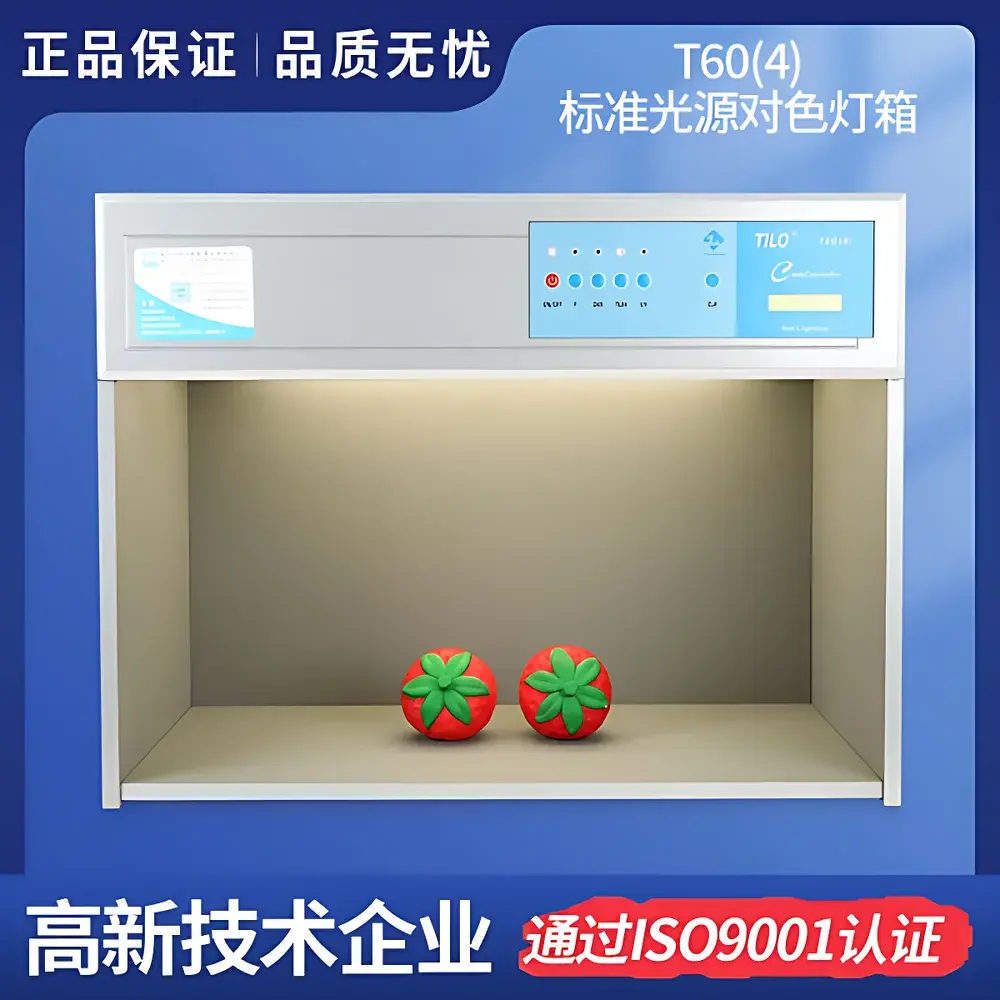
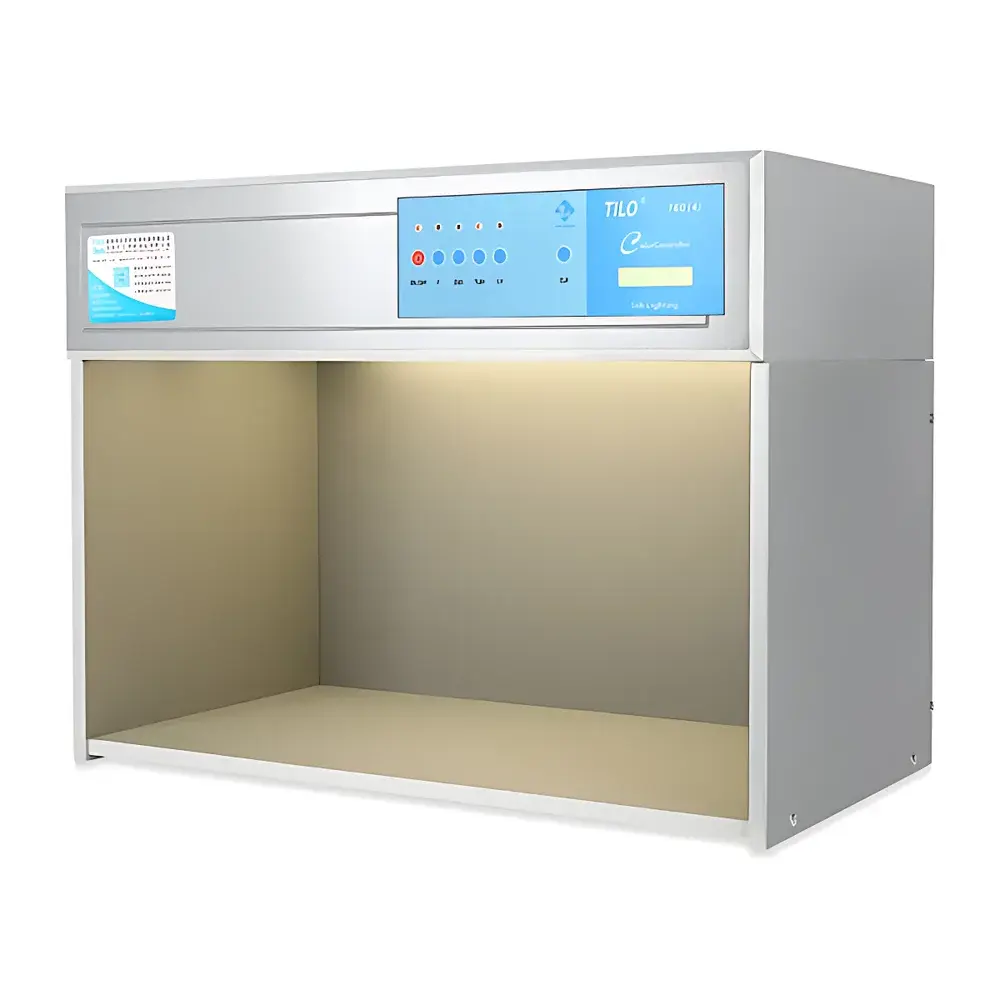
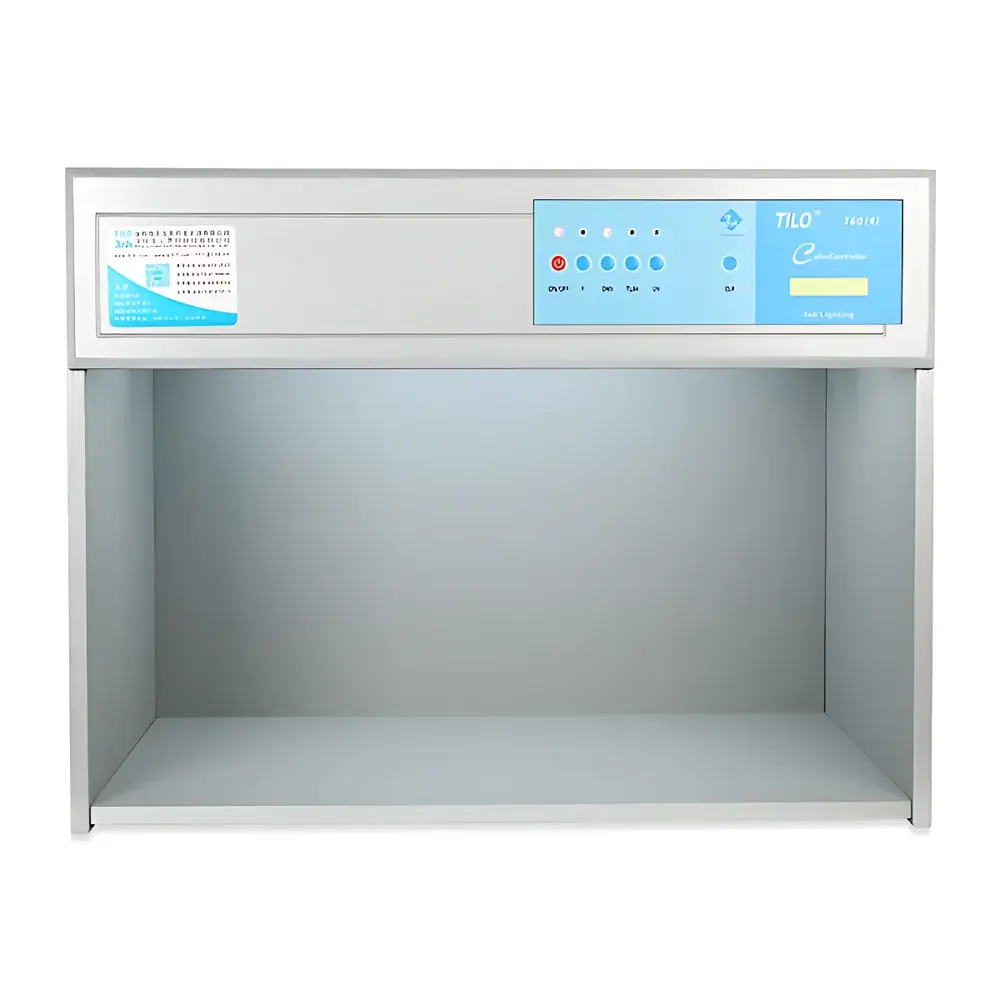
TILO T60(4) Quad-Source Standard Light Booth
| Brand | TILO |
|---|---|
| Origin | Guangdong, China |
| Model | T60(4) |
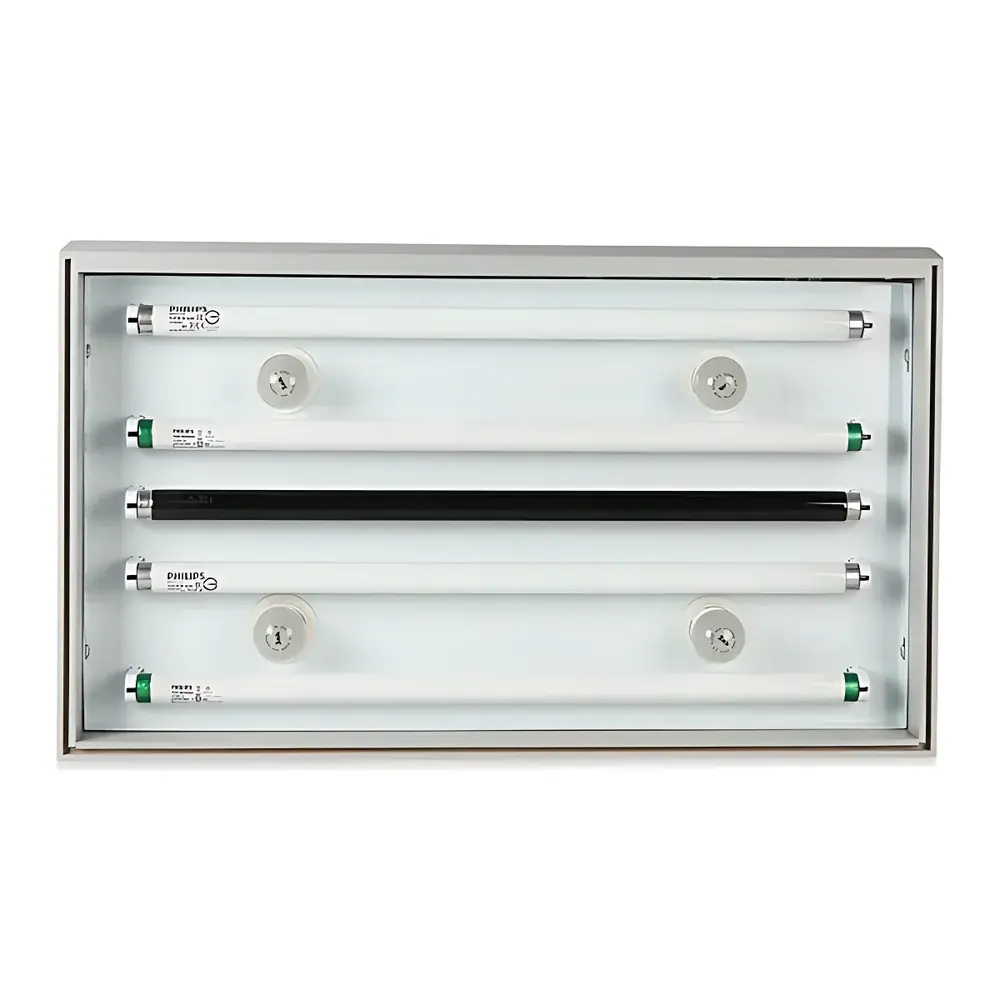
| Light Sources | D65 (6500K, 18W), TL84 (4000K, 18W), F (2700K, 40W), UV (365 nm, 18W) |
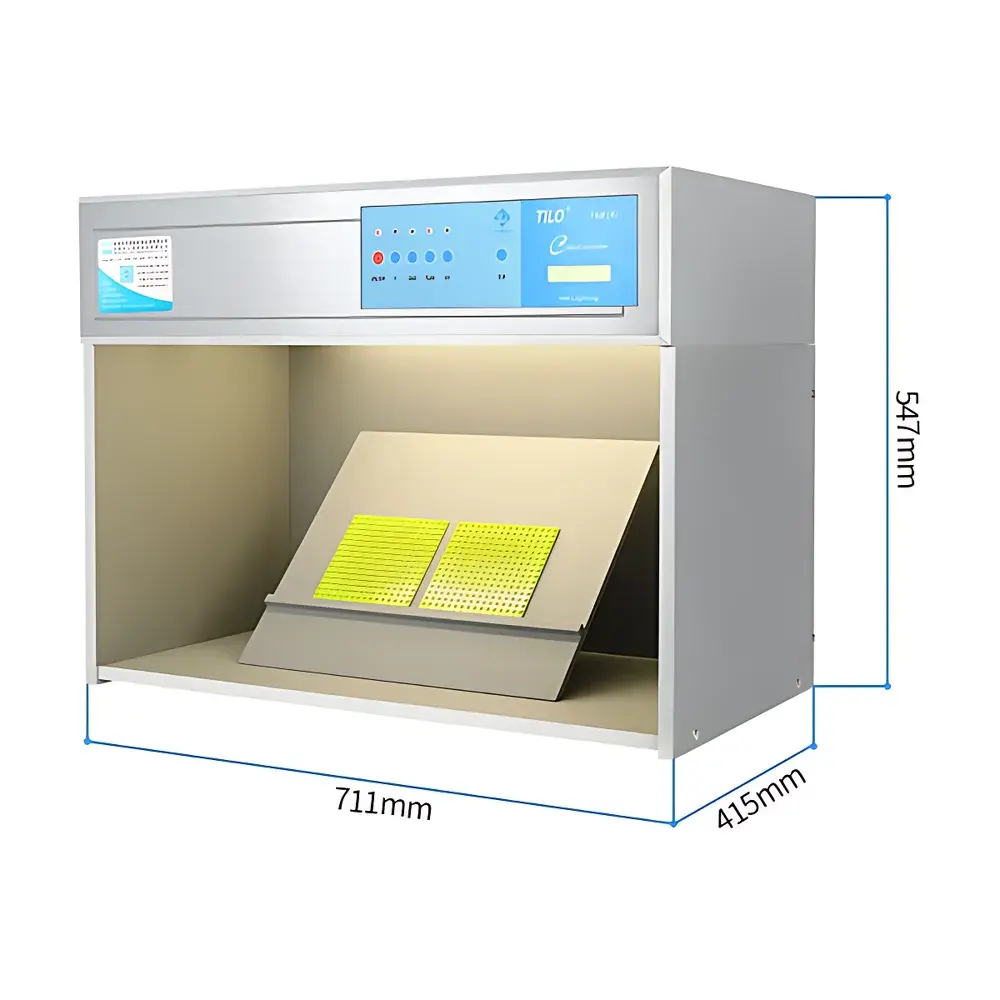
| Dimensions (W×D×H) | 710 × 405 × 570 mm |
| Weight | 22.5 kg |
| Power Efficiency | Low thermal output, no forced cooling required |
| Control | Automatic source switching, cumulative usage time tracking |
| Optional Accessory | 45° Standard Viewing Table |
Overview
The TILO T60(4) Quad-Source Standard Light Booth is an engineered optical evaluation instrument designed for consistent, repeatable color assessment under controlled illumination conditions. It operates on the principle of standardized photometric simulation—reproducing defined CIE standard illuminants to eliminate ambient light interference and enable objective inter-laboratory color matching. Unlike broadband or uncalibrated lighting systems, the T60(4) integrates four spectrally distinct, factory-aligned light sources: D65 (simulating average daylight), TL84 (representing typical retail fluorescent lighting in Europe, Japan, and mainland China), F (modeling incandescent/hotel-grade warm white lighting), and UV (365 nm peak wavelength) for fluorescence excitation and whiteness evaluation. Its solid-state lamp architecture eliminates warm-up delays and flicker, ensuring immediate operational readiness and measurement stability—critical for QC workflows in textiles, paints, plastics, printing, and packaging industries where metamerism detection and spectral sensitivity are essential.
Key Features
- Four precisely calibrated CIE-compliant light sources: D65 (6500K), TL84 (4000K), F (2700K), and UV (365 nm), each with rated power and spectral output verified per ISO 3664:2009 and ASTM D1729.
- Real-time digital display showing individual source usage hours and total operational time—supporting preventive maintenance scheduling and GLP traceability.
- Microprocessor-controlled automatic source switching with zero cross-fade delay; enables rapid side-by-side comparison under multiple illuminants without manual intervention.
- Low-thermal LED-compatible ballast design (where applicable) and optimized heat dissipation path—no active cooling fans required, reducing acoustic noise and mechanical failure points.
- Compact footprint (710 × 405 × 570 mm) and ergonomic height alignment—facilitates integration into constrained lab benches or production-line inspection stations.
- Matte-black interior finish with ≥90% non-reflective surface treatment to minimize stray light and enhance chromatic contrast perception.
Sample Compatibility & Compliance
The T60(4) accommodates flat, rigid, or flexible samples up to 600 mm × 400 mm in planar dimension, with vertical sample placement supported by optional 45° viewing table (sold separately). Its optical geometry conforms to ISO 3664:2009 requirements for color viewing environments—including uniformity of illumination (≥80% across central 2/3 area), spatial uniformity tolerance (±5% lux), and spectral power distribution fidelity. The booth meets the photometric criteria specified in ASTM D1729 (Standard Practice for Visual Appraisal of Colors and Color Differences of Objects), ISO 9417 (Color Matching Under Controlled Illumination), and GB/T 3979–2008 (Chinese national standard for color-matching cabinets). All light sources are certified for spectral stability over ≥2000 hours of operation under continuous duty cycles, supporting long-term repeatability in GMP-regulated environments.
Software & Data Management
While the T60(4) operates as a standalone hardware platform, its usage logs—including cumulative runtime per source—are stored locally in non-volatile memory and accessible via front-panel interface. For laboratories requiring electronic records compliance (e.g., FDA 21 CFR Part 11 or EU Annex 11), TILO provides optional RS-232/USB data export firmware modules enabling timestamped log transfer to LIMS or QMS platforms. Audit trail functionality supports user-defined access levels and change history logging for calibration events and source replacements—aligning with ISO/IEC 17025:2017 clause 7.7 on equipment records and traceability.
Applications
- Textile dye lot approval and shade banding verification across global supply chains.
- Automotive interior trim color consistency checks under D65 and TL84 for OEM Tier-1 suppliers.
- Printing ink formulation validation using F-source to simulate point-of-purchase retail lighting.
- Fluorescent brightener quantification in paper and detergent products via UV-excited reflectance assessment.
- Metamerism index screening in cosmetic packaging and pharmaceutical blister foil laminates.
- Educational use in color science curricula for hands-on demonstration of illuminant-dependent hue shifts.
FAQ
Does the T60(4) require warm-up time before color evaluation?
No—the integrated lamp drivers deliver stable photometric output within 1 second of activation, eliminating warm-up drift and enabling immediate visual or instrumental assessment.
Can the UV source be used for quantitative fluorescence measurement?
The 365 nm UV source is calibrated for qualitative fluorescence detection and comparative whiteness grading; for quantitative fluorimetry, a spectroradiometer-coupled setup is recommended.
Is the T60(4) compliant with ISO/IEC 17025 accreditation requirements?
Yes—when operated with documented calibration certificates (available upon request), usage logs, and maintenance records, it satisfies Clause 6.4 (Equipment) and Clause 7.7 (Traceability) of ISO/IEC 17025:2017.
What is the expected service life of each lamp type?
D65, TL84, and UV lamps maintain ≥90% initial luminous flux after 2000 hours; the F-source (incandescent-based) has a rated life of 1000 hours per IEC 60064 standards.
Is third-party calibration available for the T60(4)?
Yes—accredited metrology labs offer annual photometric verification against NIST-traceable reference standards, including spectral irradiance, illuminance uniformity, and CCT deviation testing.





