
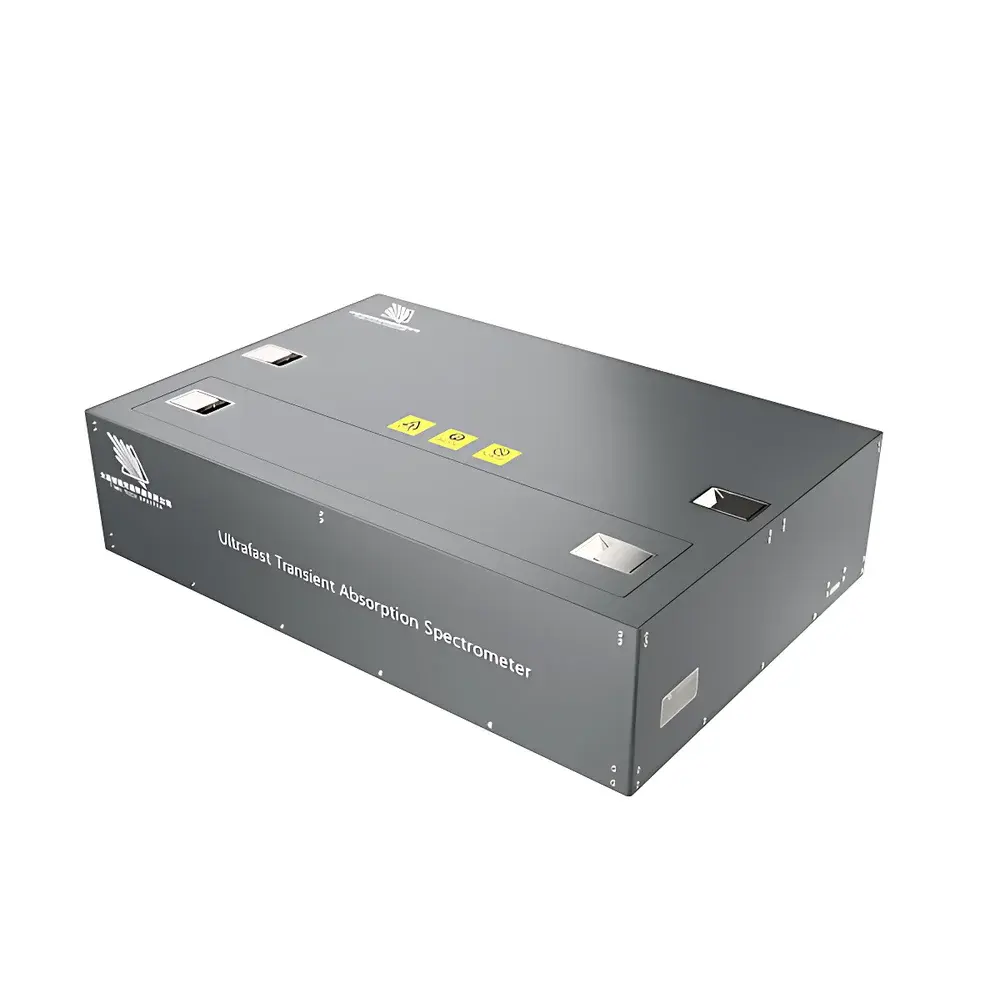
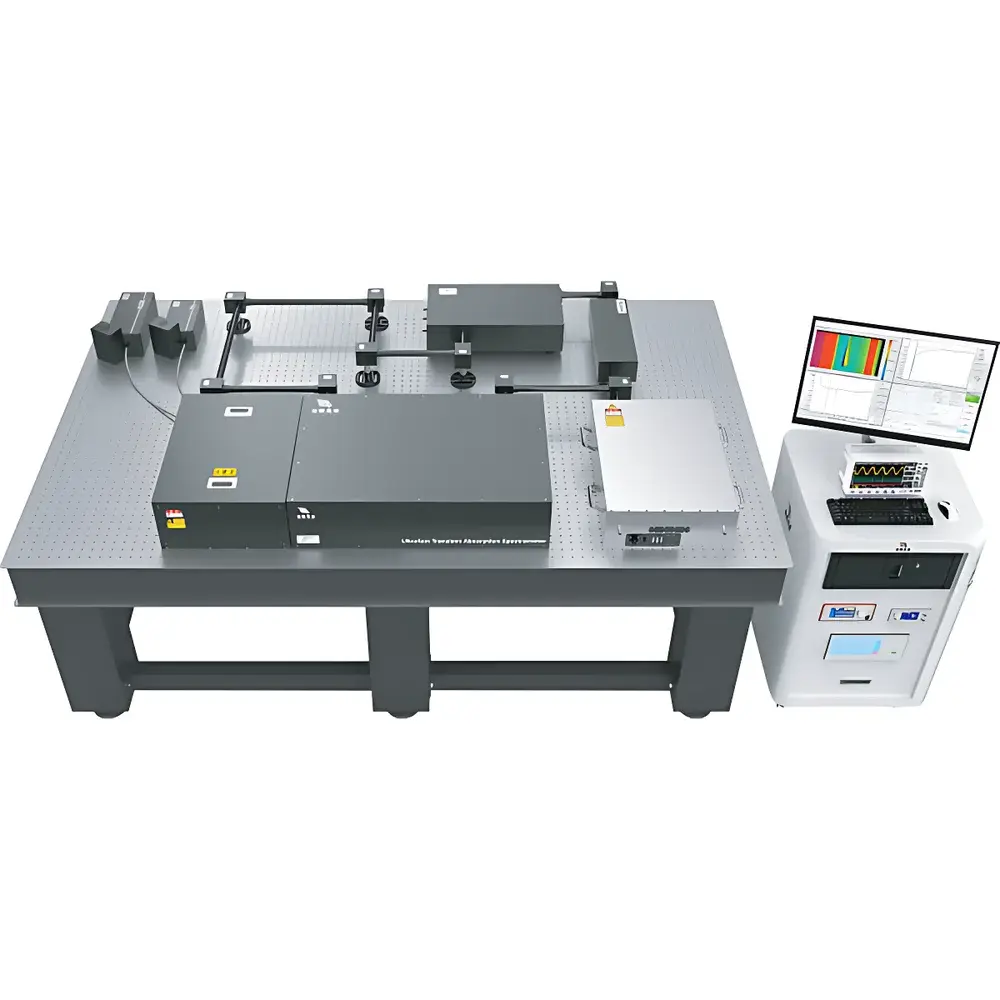
TIME-TECH SPECTRA Femto-TA100 Series Ultrafast Transient Absorption Spectrometer
| Brand | TIME-TECH SPECTRA |
|---|---|
| Origin | Liaoning, China |
| Manufacturer Type | Direct Manufacturer |
| Instrument Category | Femtosecond Pump-Probe Spectroscopy System |
| Model | Femto-TA100 Series |
| Spectral Range | 320–1650 nm (configurable sub-ranges: UV-Vis 320–1000 nm, NIR 900–1650 nm) |
| Spectral Resolution | 1024-pixel CCD array detector |
| Temporal Resolution | ≤8 ns (extendable to millisecond range via delay line reconfiguration) |
| Data Acquisition Rate | Up to 8 kHz full-spectrum acquisition |
| Optical Delay Line Speed | 400 mm/s, positional accuracy ±0.1 µm |
| Instrument Response Function (IRF) | ≤1.5 × laser pulse duration |
| Pre-zero Signal-to-Noise Ratio | ≤0.1 mOD |
Overview
The TIME-TECH SPECTRA Femto-TA100 Series Ultrafast Transient Absorption Spectrometer is a fully integrated, turnkey pump-probe platform engineered for quantitative investigation of ultrafast photophysical and photochemical dynamics in condensed-phase and thin-film systems. Based on the principle of femtosecond time-resolved transient absorption spectroscopy, the system employs a split-beam geometry wherein a tunable pump pulse initiates non-equilibrium electronic or vibrational excitation, while a broadband probe pulse—generated via white-light continuum generation—monitors spectrally resolved differential absorbance (ΔA) as a function of optical delay. This enables direct observation of excited-state relaxation pathways, charge carrier migration, energy transfer, intersystem crossing, and trap-assisted recombination with high temporal fidelity and broad spectral coverage.
Key Features
- Modular Pump-Probe Architecture: Compatible with commercial Ti:sapphire, Yb-based, and optical parametric amplifier (OPA) systems operating at 1 kHz–10 MHz repetition rates; supports dual-pump configurations for multi-pulse excitation schemes.
- Simultaneous Broadband Detection: Dual-channel spectrometer design covers 320–1000 nm (UV-Vis) and 900–1650 nm (NIR) with synchronized 1024-pixel CCD detectors; no moving grating required for full-spectrum acquisition.
- High-Precision Motorized Delay Line: Linear stage with 0.1 µm resolution, 400 mm/s maximum speed, and active beam-path compensation to maintain collimation across >100 mm travel range—critical for long-term stability in kinetic measurements.
- Real-Time Kinetic Monitoring: Live visualization of ΔA(t, λ) maps during acquisition; on-the-fly baseline correction, dark-current subtraction, and dispersion compensation (chirp correction).
- Robust IRF Characterization: Built-in reference channel for instrument response function calibration using second-harmonic generation (SHG) or two-photon absorption (TPA) signals from nonlinear crystals.
- Zero-Point Calibration Protocol: Automated time-zero alignment via cross-correlation of pump-induced signal with SHG reference; pre-zero noise floor maintained at ≤0.1 mOD (rms) over 1000-shot averages.
Sample Compatibility & Compliance
The Femto-TA100 accommodates diverse sample geometries—including cuvettes (1–10 mm pathlength), thin films on transparent substrates, microcrystals, and vacuum-compatible solid-state devices. Integrated mounting interfaces support coupling with cryogenic cryostats (4–300 K), variable-temperature probe stations, magnetic field coils (up to 9 T), and electrical biasing stages for in situ optoelectronic characterization. All optical components comply with ISO 10110 surface quality standards; mechanical enclosures meet IP54 dust/moisture resistance requirements. Software architecture supports audit trails and electronic signatures per FDA 21 CFR Part 11 guidelines when operated in GLP/GMP environments.
Software & Data Management
Acquisition and analysis are performed using TAStudio v4.x—a native C++ application with Python API extension capability. Core functions include real-time spectral averaging, global target analysis (SVD-assisted), multi-exponential decay fitting (mono-, bi-, tri-exponential, stretched exponential), and wavelength-dependent lifetime mapping. The software implements standardized data export formats (HDF5, ASCII, .mat) compliant with FAIR principles. Raw data files embed metadata per NeXus standard (NXtransient_absorption), enabling seamless integration with institutional data repositories and third-party tools such as OriginLab, MATLAB, or Igor Pro. Optional modules support TCSPC synchronization, hyperspectral imaging stitching, and machine-learning–assisted feature extraction (e.g., PCA-guided kinetic component separation).
Applications
- Charge transfer kinetics in metal–organic frameworks (MOFs) and covalent organic frameworks (COFs) for photocatalytic CO2 reduction.
- Carrier cooling, intervalley scattering, and interfacial recombination in perovskite solar cells and quantum dot heterostructures.
- Triplet energy transfer dynamics in colloidal nanocrystal–molecule hybrid systems.
- Exciton valley polarization and interlayer coupling in 2D transition metal dichalcogenide (TMD) heterobilayers (e.g., WSe2/MoS2).
- Photoinduced proton-coupled electron transfer (PCET) in biomimetic catalysts and enzymatic analogues.
FAQ
Is the Femto-TA100 compatible with third-party femtosecond laser systems?
Yes—it accepts free-space input beams from commercially available oscillators and amplifiers without proprietary interface restrictions. Standard beam diameters (6–12 mm), divergence (<1 mrad), and polarization states are supported.
Can the system be upgraded for microscale spatial resolution?
Yes—optional confocal microspectroscopy module integrates with inverted or upright research microscopes, achieving ≤500 nm lateral resolution using high-NA objectives and precision XYZ piezo stages.
What level of technical support is provided post-installation?
TIME-TECH SPECTRA offers 7×24 remote diagnostics, on-site commissioning, and dedicated application scientist support—including data interpretation workshops and custom script development for advanced kinetic modeling.
Does the system support regulatory-compliant data handling?
Yes—TAStudio includes role-based user access control, electronic signature capture, change history logging, and exportable audit trails aligned with ISO/IEC 17025 and ASTM E2500-18 requirements for analytical instrument qualification.
Are there published benchmark studies validating system performance?
Yes—peer-reviewed applications appear in Journal of the American Chemical Society, ACS Nano, and Nature Communications, covering MOF photocatalysis, perovskite photophysics, and 2D material heterostructure dynamics under controlled environmental conditions.
Related Products





