
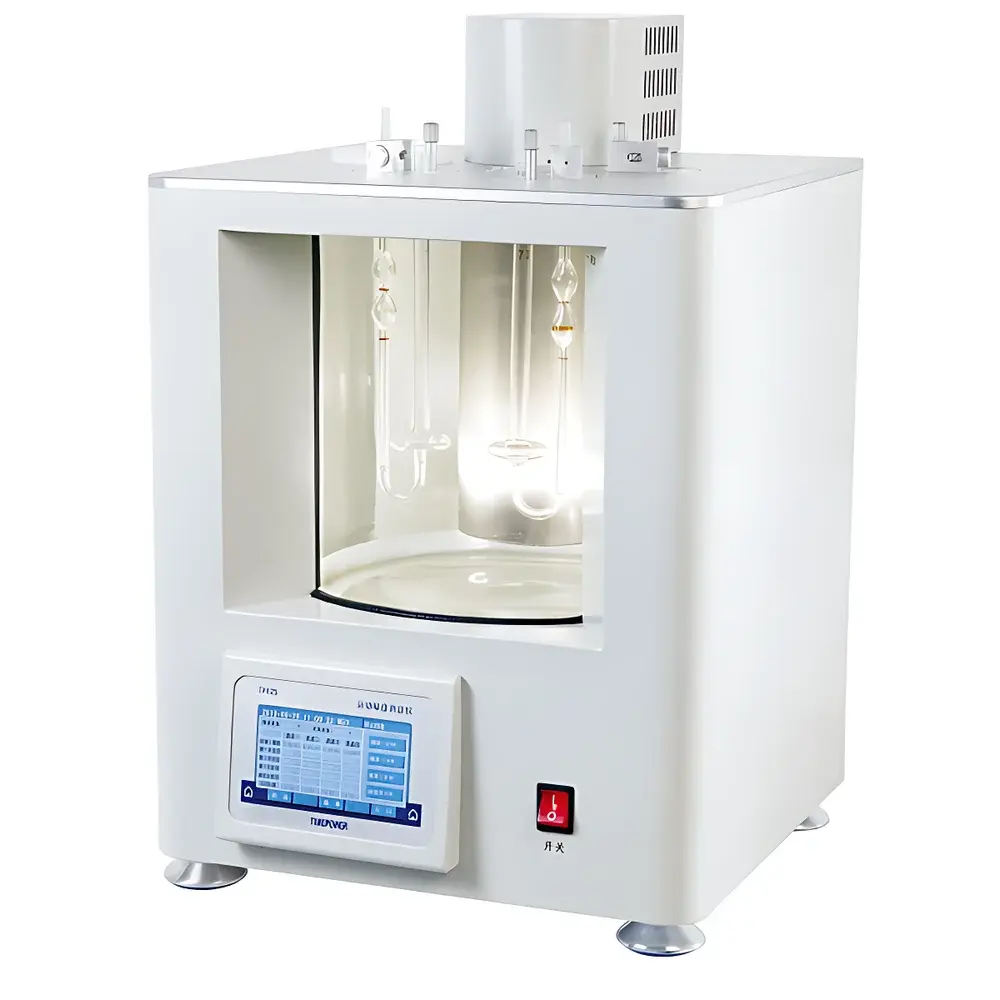

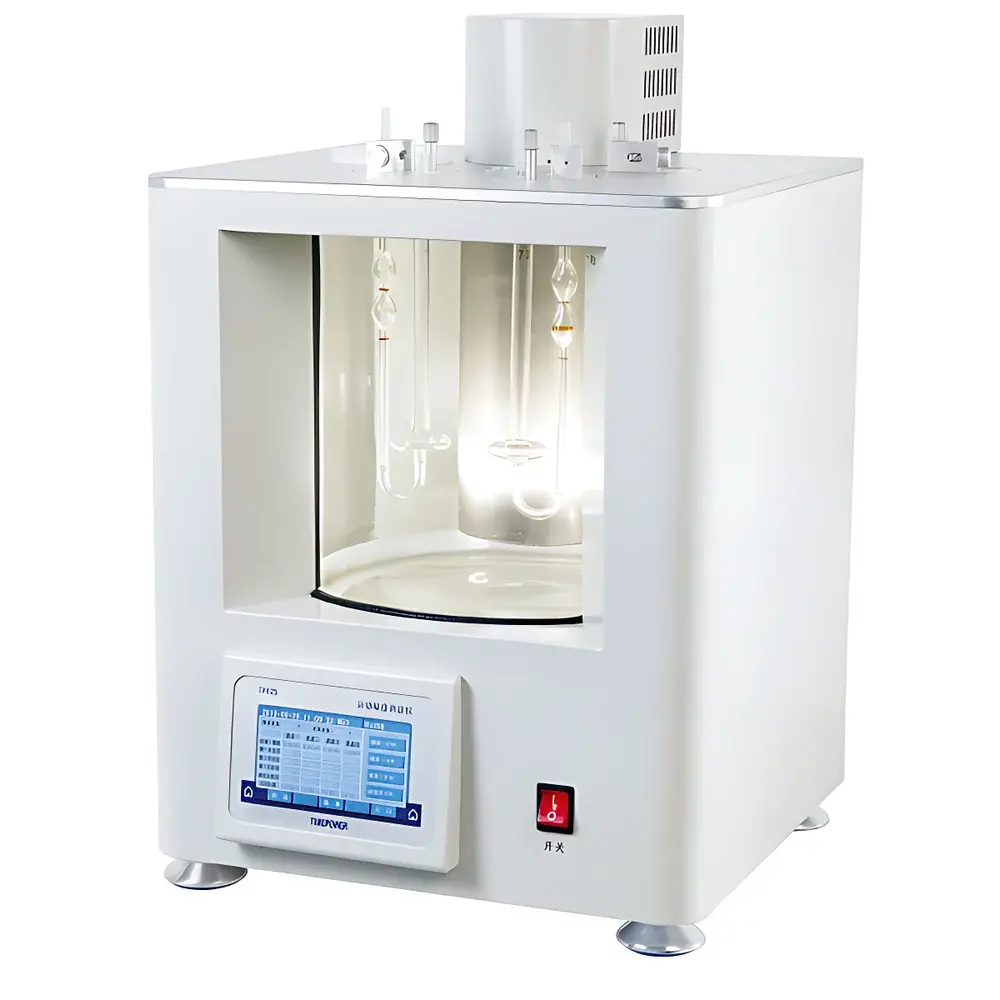
TimePower TP-625 Kinematic Viscosity Tester
| Brand | TimePower |
|---|---|
| Origin | Beijing, China |
| Manufacturer Type | Direct Manufacturer |
| Country of Origin | China |
| Model | TP-625 |
| Pricing | Available Upon Request |
| Temperature Control Range | 0–100 °C (with optional chiller for sub-ambient operation) |
| Temperature Accuracy | ±0.05 °C |
| Temperature Resolution | 0.01 °C |
| Bath Capacity | 4 test positions |
| Display | 5.0-inch capacitive touchscreen LCD |
| Control System | Microprocessor-based PID temperature regulation |
| Sensor | Imported high-stability platinum RTD (PT100) |
| Illumination | Integrated LED backlighting for capillary observation |
| Power Supply | AC 220 V ±10%, 50 Hz ±5 Hz |
| Heating Power | 1500 W |
| Dimensions (W×D×H) | 400 mm × 400 mm × 620 mm |
| Weight | 20 kg |
| Compliance | Designed and validated per ASTM D445, ISO 3104, and GB/T 265–1988 |
Overview
The TimePower TP-625 Kinematic Viscosity Tester is a microprocessor-controlled, multi-position bath system engineered for precise determination of kinematic viscosity in transparent and opaque petroleum liquids—including lubricating oils, transformer oils, diesel fuels, jet fuels, and base stocks—according to standardized capillary flow principles. It operates on the fundamental physical relationship defined by kinematic viscosity (ν), where ν = η/ρ (dynamic viscosity divided by density), measured indirectly via efflux time through calibrated glass capillary viscometers immersed in a thermally stabilized liquid bath. The instrument implements the classical Ubbelohde or Cannon-Fenske (Ostwald-type) capillary method under strictly regulated thermal equilibrium conditions, ensuring traceable, repeatable results aligned with international reference methods. Its architecture supports both routine QC testing in refinery laboratories and method validation workflows in R&D environments requiring GLP-compliant data integrity.
Key Features
- Four independent test positions enabling parallel analysis of multiple samples or replicate measurements within a single thermal cycle
- PID-driven temperature control with ±0.05 °C stability over the full 0–100 °C range, verified using NIST-traceable PT100 sensors
- 5.0-inch industrial-grade capacitive touchscreen interface with intuitive navigation, real-time bath temperature monitoring, and timestamped run logging
- Integrated LED illumination system optimized for visual alignment and meniscus detection during manual timing (optional auto-timing module available upon request)
- Modular thermal design supporting seamless integration of external refrigeration units for sub-ambient testing down to –20 °C (e.g., for low-temperature multigrade engine oils per SAE J300)
- Non-volatile clock memory retaining date/time settings during power interruption; automatic calibration prompts for periodic verification against certified reference thermometers
Sample Compatibility & Compliance
The TP-625 accommodates standard ASTM D445-compliant viscometers—including Cannon-Fenske Routine, Ubbelohde dilution, and reverse-flow types—with bore diameters ranging from 0.4 mm to 1.2 mm. It is validated for use with hydrocarbon-based fluids meeting IP 71, ISO 3104, and GB/T 265–1988 specifications. All thermal and timing parameters are programmable to match method-defined equilibration times (minimum 15 min at test temperature) and required immersion depth (±1 mm tolerance). The system’s mechanical stability and vibration-dampened bath platform minimize flow disturbance, critical for achieving <0.5% repeatability (r) per ASTM D445 Annex A1. Documentation packages include factory calibration certificates, IQ/OQ protocols, and compliance matrices for ISO/IEC 17025-accredited labs.
Software & Data Management
While the TP-625 operates as a standalone benchtop instrument with embedded firmware, its RS-232 and optional USB interfaces support bidirectional communication with LIMS or laboratory informatics platforms. Test records—including efflux time, calculated kinematic viscosity (mm²/s), temperature setpoint, actual bath reading, operator ID, and timestamp—are stored internally for ≥10,000 runs and exportable in CSV format. Audit trails log all parameter modifications, calibration events, and user logins. For regulated environments, optional 21 CFR Part 11-compliant software modules provide electronic signatures, role-based access control, and immutable record retention—fully compatible with GMP/GLP documentation requirements.
Applications
- Transformer oil condition monitoring per IEEE C57.106 and IEC 60429 for insulating fluid aging assessment
- Jet fuel (Jet A-1, JP-8) viscosity verification prior to aircraft refueling per ASTM D1655
- Lubricant formulation development and batch release testing across ISO VG grades (e.g., ISO 3448)
- Crude assay laboratories performing cut-point characterization and distillation residue analysis
- Third-party certification bodies conducting conformity assessments against national standards (e.g., CNAS accreditation scopes)
- University research groups studying temperature-dependent rheological behavior of biofuels and synthetic esters
FAQ
What capillary viscometers are compatible with the TP-625?
Standard ASTM D445 viscometers—including Cannon-Fenske Routine, Ubbelohde, and reverse-flow types—are supported. Calibration constants must be entered manually or imported via CSV.
Does the instrument meet ISO/IEC 17025 requirements for accredited testing?
Yes—the TP-625 includes traceable calibration documentation, environmental monitoring logs, and configurable uncertainty budgets suitable for method validation per ISO/IEC 17025 Clause 7.7.
Can it be used for opaque or dark-colored oils?
Yes, provided the selected viscometer type allows optical detection (e.g., reverse-flow designs) or when paired with an external automated timing sensor (sold separately).
Is firmware upgradable in the field?
Yes—updates are delivered via USB flash drive with version-controlled release notes and rollback capability.
What maintenance is required for long-term accuracy?
Biannual verification using certified reference oils (e.g., NIST SRM 2786 series) and annual sensor recalibration by an accredited metrology lab are recommended.





