
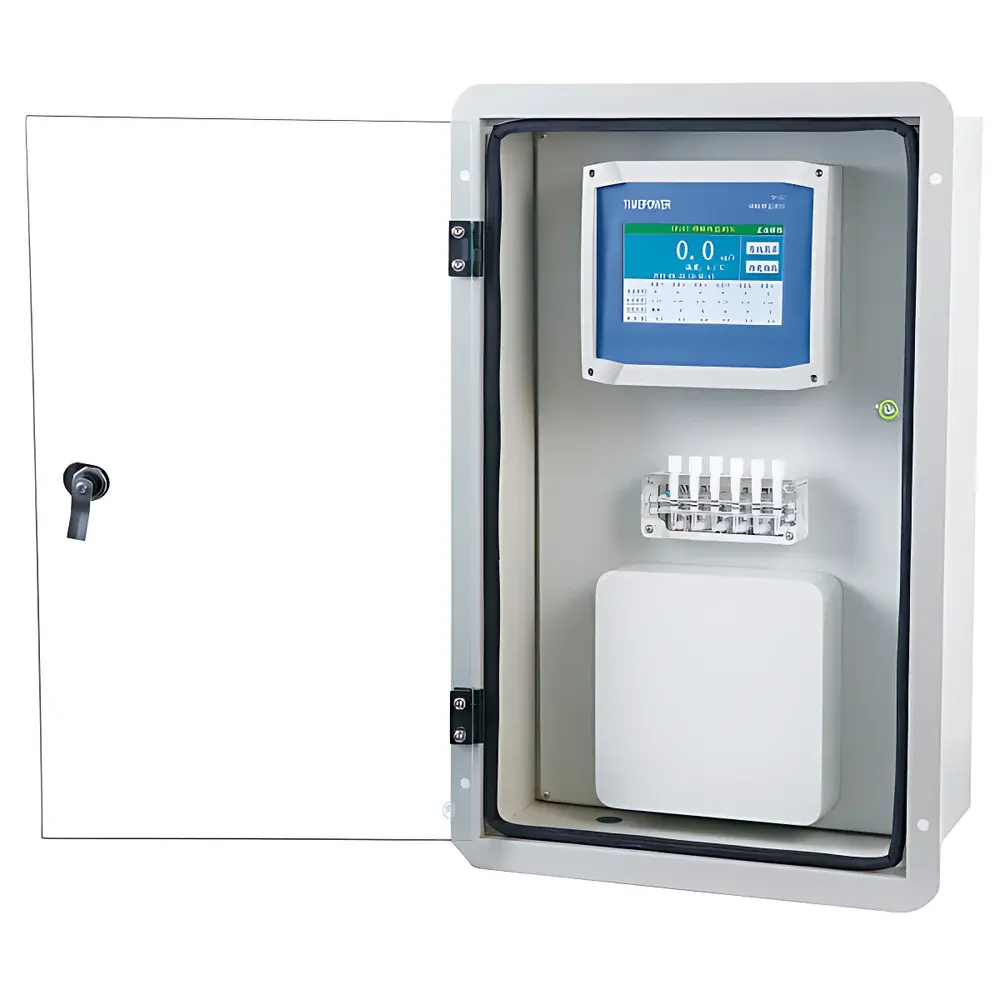
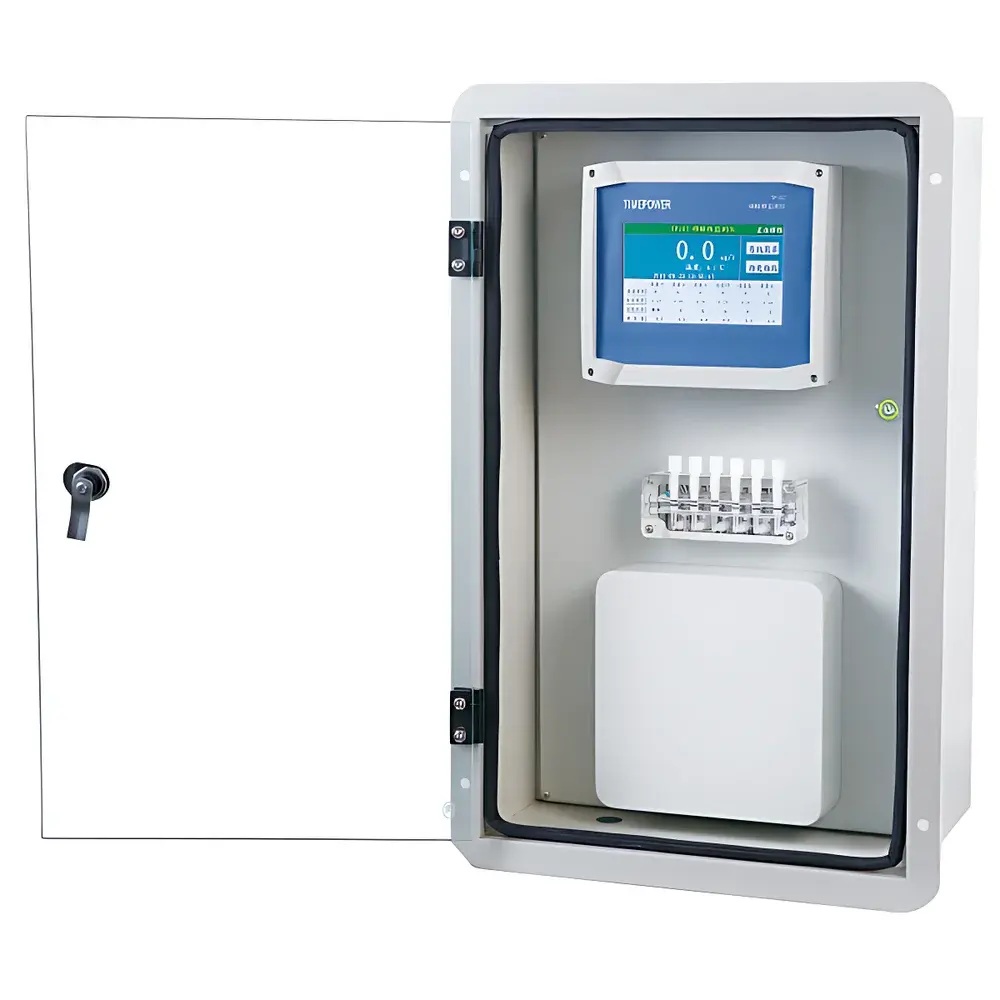
TimePower TP107 Online Phosphate Analyzer
| Brand | TimePower |
|---|---|
| Origin | Beijing, China |
| Manufacturer Type | Manufacturer |
| Regional Category | Domestic (China) |
| Model | TP107 |
| Instrument Type | Online Analyzer |
| Pricing | Upon Request |
Overview
The TimePower TP107 Online Phosphate Analyzer is a dedicated photometric analyzer engineered for continuous, real-time quantification of orthophosphate (PO₄³⁻) in aqueous process streams. It operates on the principle of vanadomolybdophosphoric yellow colorimetry — a standardized spectrophotometric method in which orthophosphate reacts with ammonium metavanadate and ammonium molybdate under acidic conditions to form a stable yellow heteropoly acid complex (phosphovanadomolybdate). The absorbance of this complex at ~420 nm is measured using a monochromatic cold light source and high-stability photodetector. Quantification follows the Lambert–Beer law, ensuring linear correlation between absorbance and phosphate concentration within the calibrated range. Designed for unattended operation in demanding industrial environments, the TP107 complies with GB/T 6913–2008 “Methods for analysis of boiler water and cooling water — Determination of phosphate”, and supports long-term stability required for regulatory monitoring, process control, and corrosion prevention in closed-loop water systems.
Key Features
- Multi-channel configuration: Supports 1–6 independent measurement channels in a single cabinet, enabling cost-effective parallel monitoring of multiple sample points without redundant hardware.
- High-reliability fluidic system: Incorporates imported solenoid valves with >500,000-cycle service life; precise peristaltic pumping and metered reagent dosing ensure reproducible sample handling and minimal carryover.
- Automated calibration protocol: Programmable dual-point standard calibration (zero and span) at user-defined intervals (e.g., every 6–24 hours), reducing manual intervention while maintaining traceable accuracy over extended deployment periods.
- Data integrity and traceability: Onboard non-volatile memory stores up to 30 days of timestamped measurement records (including raw absorbance, calculated concentration, calibration logs, and alarm events) with millisecond-level resolution.
- Optical architecture: Cold LED light source (420 ± 5 nm) with thermal stabilization ensures minimal drift (<0.5% intensity variation over 1,000 h), eliminating lamp replacement downtime common in tungsten-based systems.
- Industrial I/O integration: Six isolated 4–20 mA analog outputs (configurable as 0–20 mA or 0–10 mA), each assignable to individual channels or diagnostic parameters (e.g., flow status, reagent level, error codes); supports HART-compatible signal conditioning.
- Human-machine interface: 7-inch capacitive touch LCD with full Chinese/English bilingual UI; real-time overlay of up to four channel trends (concentration vs. time), color-coded alarms, and intuitive maintenance prompts.
Sample Compatibility & Compliance
The TP107 is validated for use with clarified, low-turbidity water samples meeting the following physical specifications: suspended solids <5 µm particle diameter, absence of colloidal silica or polyphosphate interference, and free of oil or emulsified organics. Sample temperature must remain between 5–50 °C, with flow rate maintained at 10–40 L/h via integrated flow sensor feedback. The analyzer meets electromagnetic compatibility requirements per IEC 61326-1 (industrial environment) and carries CE marking for EMC and LVD. Its analytical methodology aligns with ISO 6878:2004 (Water quality — Determination of phosphorus — Ammonium molybdate spectrometric method) and provides data suitable for internal QA/QC reporting under ISO/IEC 17025-accredited laboratories. While not FDA 21 CFR Part 11-certified out-of-the-box, audit trails and user-access controls support alignment with GLP/GMP documentation practices when deployed in pharmaceutical or biotech utility water systems.
Software & Data Management
The embedded firmware implements a deterministic real-time operating system (RTOS) with cyclic redundancy check (CRC)-protected data logging. All measurements are tagged with UTC timestamps synchronized via optional NTP client mode (Ethernet interface). Historical data export is supported via USB mass storage (CSV format) or Modbus TCP (register map provided in technical manual). Remote diagnostics include live valve actuation test, optical path self-check, and reagent depletion warning. No proprietary software installation is required for basic operation; configuration and trend review are fully accessible through the local touchscreen. For enterprise integration, optional OPC UA server module enables seamless connection to SCADA, DCS, or cloud-based asset performance management (APM) platforms.
Applications
The TP107 serves critical monitoring functions across regulated and industrial water circuits: boiler feedwater and condensate systems (to prevent phosphate hideout and caustic gouging); circulating cooling water in thermal power plants (for scale inhibition control); effluent discharge compliance in municipal wastewater treatment plants (meeting national total phosphorus limits); ultrapure water loops in semiconductor fabrication facilities; and process water in fertilizer production where orthophosphate stoichiometry directly impacts product yield. Its robust design and minimal reagent consumption (~3 L/month per channel) make it suitable for remote or unmanned sites, including offshore platforms and distributed water distribution networks.
FAQ
What reagents are required for routine operation?
Ammonium molybdate, ammonium metavanadate, and concentrated sulfuric acid — supplied as pre-formulated, stabilized kits (e.g., 60 mL vials of 1 mg/mL phosphate standard for calibration).
Can the TP107 measure condensed phosphate species (e.g., pyrophosphate, tripolyphosphate)?
No. The vanadomolybdate method measures only orthophosphate (PO₄³⁻). Total phosphorus determination requires prior acid hydrolysis, which is not supported by the TP107’s onboard chemistry.
Is field calibration possible without factory service tools?
Yes. All calibration steps — zero adjustment with deionized water and span verification with certified standard — are executable via the front-panel menu without external hardware or password-protected engineering modes.
How is sample filtration handled?
A 5-µm inline filter cartridge (included) is installed upstream of the analyzer inlet; replacement interval depends on particulate load but is typically every 3–6 months under normal operation.
What happens during a power interruption?
Non-volatile memory retains all configuration settings and the last 72 hours of measurement data; upon power restoration, the system resumes scheduled cycles without manual reset.
Related Products







