
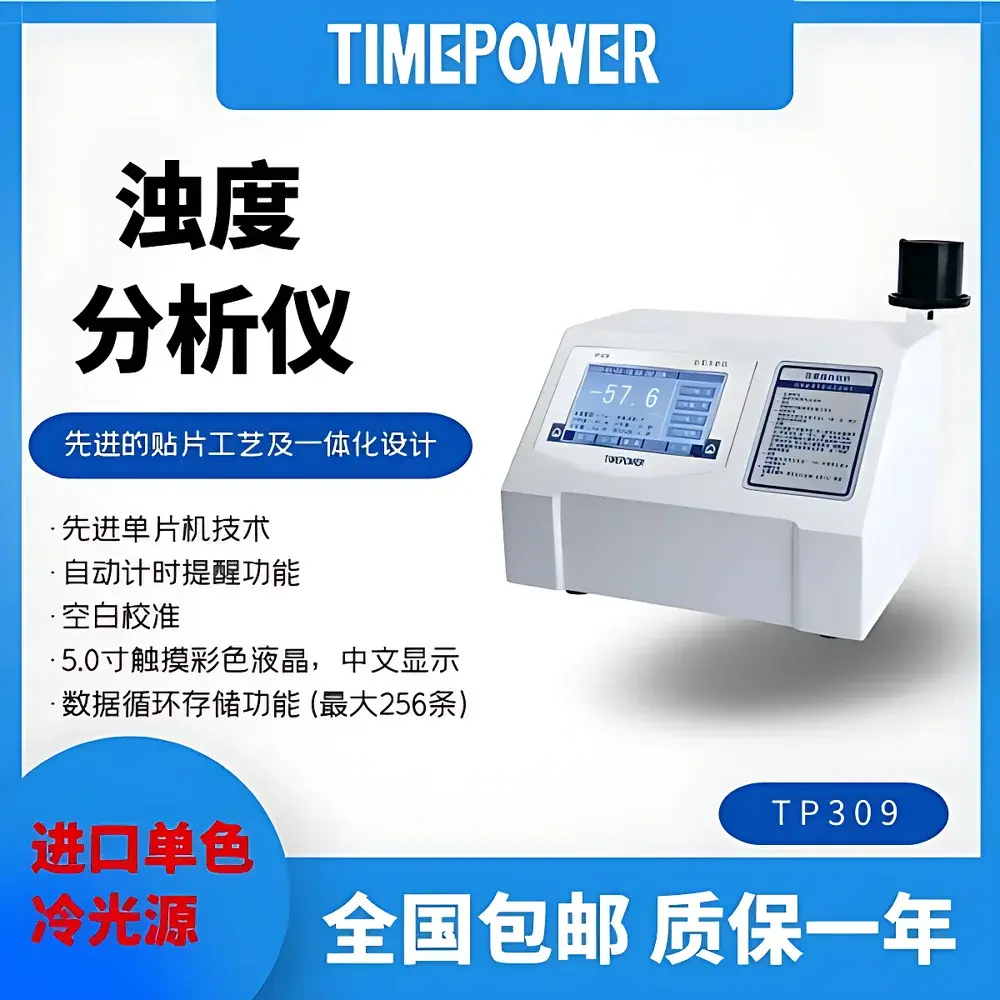
TimePower TP309 Benchtop Turbidimeter
| Brand | TimePower |
|---|---|
| Model | TP309 |
| Type | Benchtop Laboratory Turbidimeter |
| Measurement Range | 20–200 NTU |
| Resolution | 0.1 NTU |
| Accuracy | ±2 % |
| Operating Temperature | 0–25 °C |
| Light Source | Imported Monochromatic Cold Light LED |
| Calibration Method | Formazin-Based Zero Calibration |
| Data Storage Capacity | Up to 256 Records (circular buffer) |
| Display | 5.0-inch Color Touchscreen LCD with Chinese UI |
| Compliance | Formazin Turbidity Standard (ISO 7027 / EPA Method 180.1) |
Overview
The TimePower TP309 Benchtop Turbidimeter is a precision optical instrument engineered for reliable, repeatable turbidity measurement in laboratory and quality control environments. It operates on the principle of nephelometry—measuring the intensity of light scattered at 90° from a collimated incident beam—as standardized in ISO 7027 and U.S. EPA Method 180.1. The instrument employs a high-stability monochromatic cold-light LED source, ensuring minimal thermal drift and long-term photometric consistency. Designed specifically for applications requiring compliance with drinking water standards (e.g., WHO Guidelines, GB 5749-2022, and EPA 180.1), the TP309 delivers traceable, formazin-referenced turbidity quantification across its 20–200 NTU range. Its benchtop architecture integrates optical path optimization, temperature-controlled sample chamber positioning, and electronic signal conditioning to maintain metrological integrity under routine laboratory conditions.
Key Features
- 5.0-inch full-color capacitive touchscreen display with intuitive Chinese-language interface—designed for rapid method selection, real-time graphing, and parameter configuration without external software.
- Monolithic optical assembly with imported monochromatic LED light source (peak wavelength 860 nm), optimized for reduced stray light and enhanced signal-to-noise ratio in low-turbidity matrices.
- Integrated zero-point calibration using formazin-based blank reference, compensating for both optical zero drift and electronic baseline offset—critical for maintaining accuracy over extended operation cycles.
- Embedded microcontroller architecture with low-power consumption design, supporting continuous operation up to 8 hours on standby and stable measurement performance within 0–25 °C ambient range.
- Robust printed circuit board layout utilizing surface-mount technology (SMT) and conformal coating, delivering EMI resilience and mechanical durability in shared lab environments.
- Circular data buffer storing up to 256 measurement records with automatic overwrite—enabling audit-ready traceability without manual export or external storage dependency.
Sample Compatibility & Compliance
The TP309 is validated for use with standard 25-mm round glass cuvettes (10 mm path length) and accepts samples ranging from clarified potable water to moderately turbid process effluents. It complies with international turbidity measurement protocols including ISO 7027 (nephelometric mode, 860 nm), EPA Method 180.1 (formazin calibration traceability), and relevant clauses of ASTM D6508 for wastewater characterization. While not certified for GLP/GMP production environments out-of-the-box, its calibration log, timestamped data records, and zero-reference functionality support alignment with internal QA/QC procedures and regulatory documentation requirements under ISO/IEC 17025-accredited laboratories.
Software & Data Management
No proprietary PC software is required for basic operation; all configuration, calibration, and data review occur locally via the onboard touchscreen interface. Measurement records include date/time stamp, operator ID field (manually entered), NTU value, and calibration status flag. Data export is supported via USB host port (FAT32-formatted flash drive) in CSV format—compatible with LIMS integration, Excel-based trending, or statistical process control (SPC) platforms. The firmware implements write-protected system memory to prevent unauthorized configuration changes, and supports password-protected access levels for calibration and setup functions—facilitating role-based operational control in multi-user labs.
Applications
- Drinking water quality verification at intake, filtration, and distribution points in municipal utilities.
- Coagulation/flocculation optimization studies in pilot- and full-scale water treatment plants.
- Process monitoring of ultrapure water (UPW) systems used in semiconductor manufacturing and pharmaceutical cleanrooms—where turbidity serves as an early indicator of particulate breach.
- Effluent compliance testing per national discharge permits (e.g., China’s GB 8978-1996, EU Urban Wastewater Treatment Directive).
- Educational use in environmental engineering and analytical chemistry curricula for method validation and inter-laboratory comparison exercises.
FAQ
Does the TP309 support calibration with non-formazin standards such as AMCO AEPA or StablCal?
No—the optical and firmware architecture is configured exclusively for formazin-based calibration per ISO 7027 and EPA 180.1. Substitution with alternative standards requires third-party validation and is not covered under factory calibration warranty.
Can the instrument operate outside the specified 0–25 °C ambient range?
Operation below 0 °C risks condensation inside the optical chamber; above 25 °C may induce thermal lensing in the detector pathway, leading to measurable drift (>±3 %). Ambient temperature control is recommended for metrological continuity.
Is the data storage buffer compliant with FDA 21 CFR Part 11 requirements?
The TP309 does not implement electronic signatures, audit trails, or user authentication beyond password-protected menus. For Part 11 compliance, integration with validated LIMS or ELN systems is required.
What maintenance intervals are recommended for long-term accuracy?
Annual verification against NIST-traceable formazin standards and biannual cleaning of cuvette holder optics with lint-free isopropyl alcohol wipes are advised per manufacturer guidelines.



