
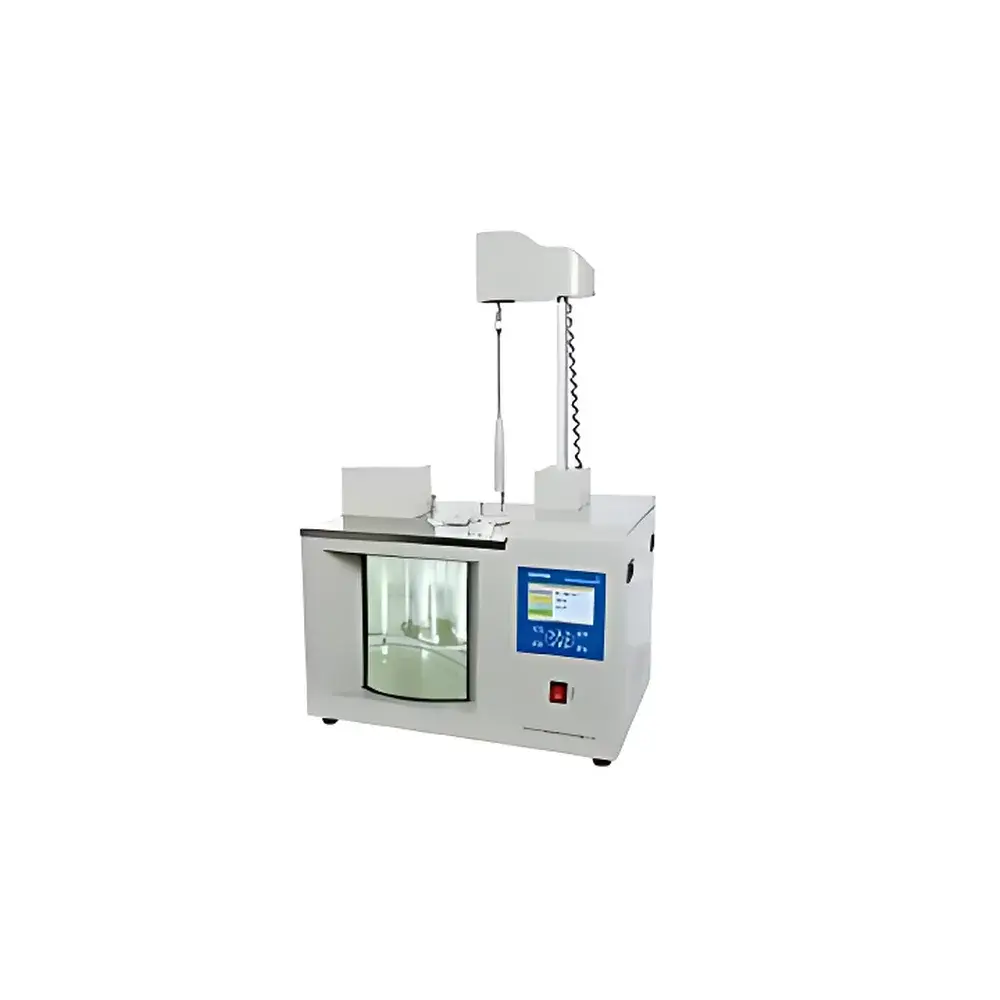
Timepower TP651 Petroleum and Synthetic Fluid Demulsibility Tester
| Brand | Timepower |
|---|---|
| Model | TP651 |
| Origin | Beijing, China |
| Manufacturer Type | Direct Manufacturer |
| Country of Origin | China |
| Power Supply | AC 220 V ±10%, 50 Hz ±10% |
| Power Consumption | ≤ 1600 W |
| Dimensions (W×D×H) | 510 mm × 360 mm × 580 mm |
| Weight | 23.5 kg |
| Temperature Range | Ambient to 100 °C |
| Temperature Accuracy | ±2 °C |
| Temperature Repeatability | ≤ 4 °C |
| Temperature Resolution | 0.1 °C |
| Operating Environment | 5–40 °C, RH ≤ 85% |
| Sample Vessel | 100 mL graduated cylinder |
| Standard Compliance | GB/T 7305 |
| Stirring Duration | 5 min (automated) |
| Stirrer Positioning | 6 mm above cylinder bottom |
| Heating Setpoints | 54 °C ±1 °C (standard), 82 °C ±1 °C (for viscous oils) |
Overview
The Timepower TP651 Petroleum and Synthetic Fluid Demulsibility Tester is an automated benchtop instrument engineered for precise evaluation of demulsification performance in lubricating oils, turbine oils, hydraulic fluids, and synthetic base stocks. It operates in strict accordance with the methodology defined in GB/T 7305—China’s national standard equivalent to ASTM D1401 (Standard Test Method for Determining the Separability of Oil and Water by Agitation). The instrument quantifies the time required for an oil–water emulsion to separate into distinct, visually discernible layers under controlled thermal and mechanical agitation conditions. This measurement directly reflects the fluid’s resistance to stable emulsion formation—a critical parameter for power generation turbines, industrial gearboxes, and aviation hydraulic systems where water ingress poses risks of corrosion, oxidation acceleration, and loss of film strength.
Key Features
- Fully automated test sequence: integrated microcontroller manages water bath temperature control, stirrer vertical positioning, timed 5-minute agitation, and post-agitation separation timing—all without manual intervention.
- Precision temperature regulation: digital PID-controlled water bath maintains setpoints at 54 °C ±1 °C (standard) or 82 °C ±1 °C (for high-viscosity samples), with resolution of 0.1 °C and repeatability ≤ 4 °C.
- Electromechanical lift system: linear actuator-driven stirrer arm ensures smooth, repeatable descent to a fixed position 6 mm above the bottom of the 100 mL calibrated cylinder—critical for standardized shear input and interfacial dynamics.
- Intuitive human–machine interface: 480 × 272 pixel color LCD display with full Chinese menu navigation, contextual prompts, and real-time status feedback during test execution.
- Robust mechanical architecture: stainless-steel water bath tank, reinforced cylinder holder with alignment detents, and vibration-damped base minimize operational drift and improve inter-laboratory reproducibility.
- Safety-integrated design: automatic power cutoff during water filling, overflow margin control (3–4 cm below tank rim), and mechanical travel lock to prevent stirrer overtravel or cylinder impact.
Sample Compatibility & Compliance
The TP651 accommodates petroleum-based mineral oils, polyalphaolefins (PAOs), phosphate esters, polyol esters, and other synthetics used in turbine, compressor, and transformer applications. It accepts standard 100 mL graduated cylinders conforming to GB/T 7305 dimensional specifications. All operational parameters—including temperature tolerance, agitation geometry, and timing logic—are traceable to GB/T 7305 requirements. While not certified to ISO/IEC 17025 out-of-the-box, the instrument’s deterministic control architecture supports GLP-compliant documentation when paired with external audit-ready lab notebooks or LIMS integration. Its thermal and mechanical consistency enables correlation studies with ASTM D1401 and ISO 6614 datasets.
Software & Data Management
The TP651 employs embedded firmware—not PC-dependent software—ensuring deterministic behavior across operating environments. All test events (start time, temperature stabilization, stirrer activation/deactivation, separation confirmation) are timestamped and stored locally in non-volatile memory. Up to 99 test records can be recalled with full metadata: date/time stamp, setpoint, actual bath temperature profile (averaged per minute), and final separation time. Data export is manual via on-screen review and transcription; no USB or network interface is included. For regulated environments requiring electronic records, users may integrate the TP651 into broader QA workflows using external validation protocols aligned with FDA 21 CFR Part 11 principles—e.g., documented operator authentication, audit trail logging, and data integrity verification prior to report generation.
Applications
- Quality control of new turbine oils prior to commissioning in power plants and combined-cycle facilities.
- Condition monitoring of in-service lubricants exposed to steam leakage or condensation in bearing housings.
- R&D screening of demulsifier additive packages for formulation optimization.
- Third-party testing for customs clearance and import compliance in petrochemical trade (e.g., CNCA-certified labs).
- Academic research on interfacial rheology and coalescence kinetics in oil–water dispersions.
FAQ
What standards does the TP651 comply with?
It is designed and validated for GB/T 7305, which is technically harmonized with ASTM D1401 and functionally comparable to ISO 6614.
Can the instrument accommodate alternative cylinder sizes?
No—it is mechanically calibrated for 100 mL cylinders only; deviation compromises shear rate uniformity and violates standard-defined geometry.
Is calibration certification provided with the unit?
The TP651 ships with a factory calibration report covering temperature sensor linearity and timer accuracy; user-performed periodic verification against NIST-traceable references is recommended annually.
How is stirrer depth consistency ensured between tests?
A mechanical stop limits downward travel to exactly 6 mm above the cylinder base; the cylinder holder includes tactile alignment guides to eliminate positional variance.
Does the instrument support unattended batch testing?
No—it is single-sample, single-cycle per run; sequential testing requires manual reset and sample replacement between cycles.
Related Products





