
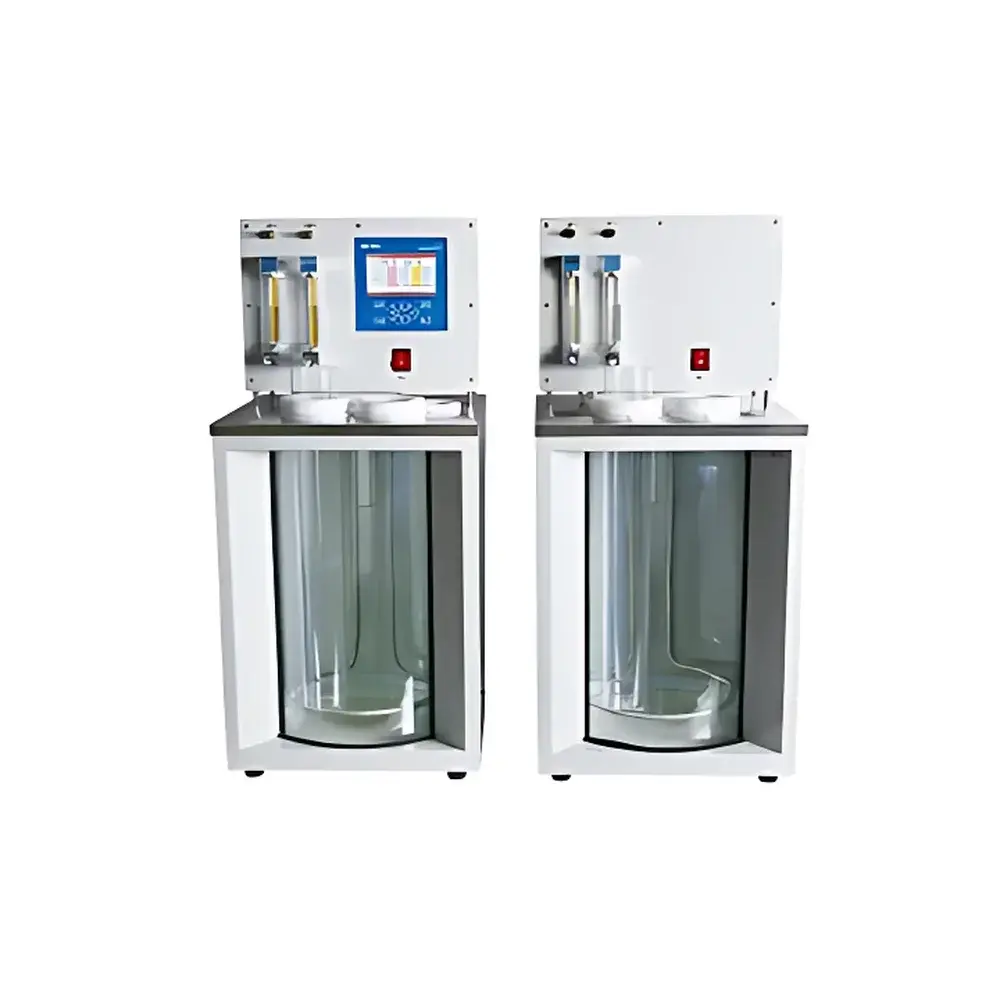
TimePower TP652 Foam Characteristic Tester for Lubricating Oils
| Brand | TimePower |
|---|---|
| Origin | Beijing, China |
| Manufacturer Type | Direct Manufacturer |
| Country of Origin | China |
| Model | TP652 |
| Pricing | Upon Request |
| Temperature Control Range | 0–100 °C |
| Temperature Accuracy | ±0.5 °C |
| Air Flow Rate | 16–160 mL/min (adjustable via rotameter) |
| Air Source | Integrated quiet air pump (3 L/min) |
| Gas Diffusion Head Capacity | 3000–6000 mL/min at 2.45 kPa |
| Timing Resolution | ±1 s (automated) |
| Display | LCD interface |
| Power Supply | AC 220 V ±10%, 50 Hz ±10% |
| Max Power Consumption | ≤2300 W |
| Dimensions (W×D×H) | 340 × 340 × 740 mm |
| Net Weight | 23 kg |
| Operating Ambient | 5–40 °C, ≤85% RH |
| Printer | Thermal, 36-character Chinese/English output |
Overview
The TimePower TP652 Foam Characteristic Tester is a precision-engineered instrument designed to quantify the foaming behavior of lubricating oils under standardized thermal and aerodynamic conditions. It operates on the principle of controlled air sparging through a calibrated gas diffusion head into a defined volume of oil sample, followed by volumetric measurement of foam height at specified time intervals. This methodology directly implements the physical test protocols defined in GB/T 12579 (China), ISO 6247 (International Organization for Standardization), and ASTM D892 (American Society for Testing and Materials). The instrument evaluates two critical parameters: foam tendency (FT), measured as the initial foam volume after 5 minutes of air introduction at 24 °C; and foam stability (FS), assessed as the residual foam volume after a prescribed drainage period—first at elevated temperature (93.5 °C) and subsequently re-evaluated upon return to ambient (24 °C). These metrics are essential for predicting real-world performance issues such as pump cavitation, reduced heat transfer efficiency, oil starvation in gearboxes, and accelerated oxidation due to increased air-oil interfacial area.
Key Features
- High-precision PID temperature control system with ±0.5 °C stability across the full 0–100 °C operating range—enabling accurate replication of both low- and high-temperature test phases per ASTM D892 Procedure A and B.
- Dual-temperature bath architecture with independent thermal zones: one for the 24 °C reference test and another for the 93.5 °C stabilization phase, each equipped with immersion-type heating elements and optional external chiller compatibility for ambient temperatures exceeding 24 °C.
- Four independently adjustable air flow channels, each fitted with a calibrated rotameter (16–160 mL/min range), ensuring consistent and traceable gas delivery rates across multiple samples or parallel testing configurations.
- Integrated low-noise air supply (3 L/min capacity) eliminating reliance on external compressors—reducing laboratory infrastructure requirements and operational variability.
- Microprocessor-based control unit with backlit LCD display providing real-time monitoring of temperature, elapsed time, airflow status, and test stage progression.
- Thermal printer module supporting 36-character Chinese/English output for immediate hardcopy generation of test reports—including date/time stamp, setpoints, measured foam volumes, and operator ID fields.
Sample Compatibility & Compliance
The TP652 accommodates standard 100-mL graduated glass cylinders (ASTM D892-compliant dimensions) and accepts a wide range of mineral-, synthetic-, and semi-synthetic-based lubricants—including engine oils, hydraulic fluids, turbine oils, and gear oils. Its mechanical design conforms to ISO/IEC 17025-relevant hardware robustness criteria for routine QC laboratories. All temperature and timing functions are traceably calibrated against NIST-traceable references, and the instrument supports documented calibration verification procedures required under GLP and ISO 9001 quality management systems. While not inherently 21 CFR Part 11 compliant, audit trails and electronic records may be generated externally via RS232/USB data export for integration into validated LIMS environments.
Software & Data Management
The TP652 operates via embedded firmware without dependency on PC-hosted software. All test parameters—including target temperatures, airflow setpoints, dwell times, and sequence logic—are configured directly via the front-panel interface. Measurement data (foam volume in mL, temperature readings, timestamp) are stored internally for up to 100 test cycles and exported via serial interface (RS232) or USB to CSV-compatible formats. Optional data logging modules enable continuous temperature/flow trending for method validation studies. Calibration logs, maintenance records, and user access timestamps can be manually annotated and printed, fulfilling basic record-keeping requirements aligned with ASTM E2500 and ISO/IEC 17025 clause 7.7.
Applications
- Quality control release testing of finished lubricants prior to shipment in petroleum refining and additive manufacturing facilities.
- Formulation development support for anti-foam additive packages (e.g., silicone-based or polyacrylate polymers) in R&D laboratories.
- Root-cause analysis of field failures linked to foaming—such as servo valve sticking in hydraulic systems or bearing overheating in wind turbine gearboxes.
- Regulatory compliance verification for OEM specifications (e.g., GEK 32568, Siemens TLV 9013, or Caterpillar EC-1 series).
- Third-party certification testing accredited under CNAS (China National Accreditation Service) or equivalent international bodies.
FAQ
What standards does the TP652 fully support?
The instrument is engineered to execute all procedural requirements of GB/T 12579, ISO 6247, and ASTM D892, including temperature ramp profiles, airflow tolerances, cylinder geometry, and foam volume reading methodology.
Is external cooling required for 24 °C testing in warm ambient environments?
An optional immersion-type refrigeration unit is available for installations where ambient lab temperature exceeds 24 °C—ensuring thermal stability without external chiller plumbing.
How often must the gas diffusion head be cleaned?
The sintered stainless-steel diffusion head must be rinsed with solvent (e.g., naphtha or xylene) and dried after every test sequence to prevent pore clogging from oxidized oil residues.
Can the instrument store calibration offsets for temperature sensors?
Yes—user-accessible calibration correction fields allow input of deviation values derived from independent thermometer verification, maintaining metrological integrity over extended service life.
What maintenance is required for the integrated air pump?
The brushless DC motor and diaphragm assembly require no scheduled lubrication; periodic inspection of inlet filtration and replacement of desiccant (indicating silica gel) every 6 months ensures consistent airflow purity and pressure stability.




