
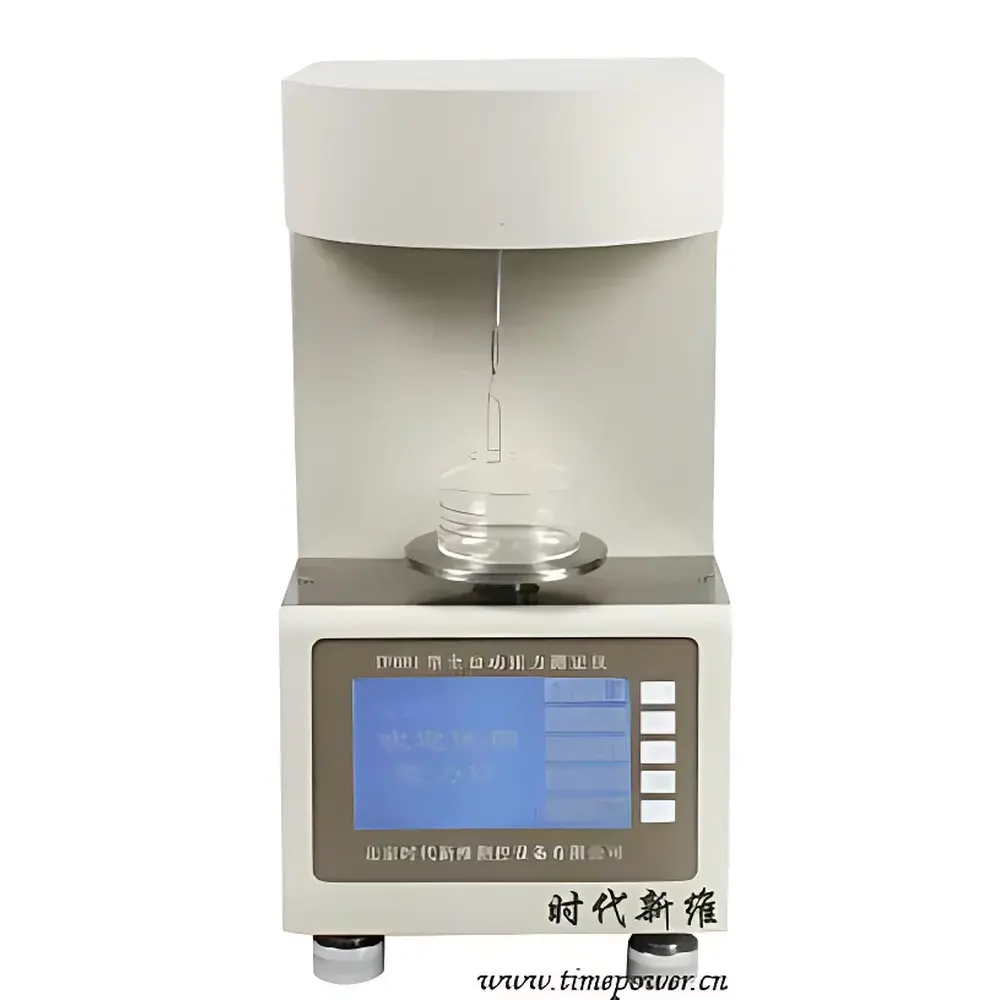
TimePower TP681 Automatic Surface Tensiometer
| Brand | TimePower |
|---|---|
| Model | TP681 |
| Measurement Principle | Du Noüy Ring Method (Electromagnetic Force Compensation) |
| Full Scale Range | 5–100 mN/m (Insulating Oil), 5–200 mN/m (Other Petroleum Products) |
| Accuracy | ±0.5% of full scale |
| Resolution & Sensitivity | 0.1 mN/m |
| Temperature Compensation | Automatic, real-time ambient temperature acquisition |
| Data Storage Capacity | 255 test records with timestamp (RTC-backed, 10-year power-loss retention) |
| Interface | RS-232 serial port |
| Display | LCD with Chinese character support |
| Printer | Thermal, 36-character width, native Chinese output |
| Power Supply | AC 220 V ±20%, 40 W max |
| Operating Environment | 10–30 °C, ≤85% RH |
| Ring Immersion Speed | 0.3–0.4 mm/s |
| Dimensions | 265 × 190 × 375 mm |
| Weight | 8.84 kg |
Overview
The TimePower TP681 Automatic Surface Tensiometer is a precision laboratory instrument engineered for reliable and repeatable surface tension measurement of liquids—particularly insulating oils, transformer oils, lubricants, petroleum distillates, and other industrial fluids. It operates on the classical Du Noüy ring method, where a platinum-iridium ring is vertically immersed into and withdrawn from the liquid surface; the maximum force required to detach the ring is quantified via an electromagnetic force compensation transducer. This principle, standardized in ASTM D971 and ISO 6295, ensures traceable, gravimetrically referenced measurements aligned with international testing protocols. The TP681 integrates dual-CPU microcontroller architecture to decouple real-time motor control from data processing, minimizing timing jitter and enhancing measurement stability. Its embedded temperature sensor continuously monitors ambient chamber temperature and applies empirically validated correction coefficients to raw force values—critical for compliance with ASTM D1250 and ISO 3104, where thermal drift directly impacts interfacial energy reporting.
Key Features
- Dual-CPU architecture enabling synchronized control of ring immersion kinetics and high-fidelity analog signal acquisition
- Multi-point linearization calibration routine across the full measurement span, correcting inherent nonlinearity of the electromagnetic force sensor without reliance on single-point offset adjustments
- Integrated real-time temperature sensing with automatic compensation algorithms compliant with standard reference tables for hydrocarbon-based liquids
- Non-volatile memory storing up to 255 complete test records—including surface tension value (mN/m), date/time stamp (via built-in calendar clock), and ambient temperature—retained for ≥10 years after power loss
- RS-232 serial interface supporting bidirectional communication with external PCs for automated report generation, LIMS integration, or remote parameter configuration
- Thermal printer with native Chinese character support, delivering audit-ready hardcopy reports with 36-character line width and embedded metadata (sample ID, operator, calibration status)
- Low-power LCD with screen-saver mode to extend display lifetime under continuous operation in QC laboratories
Sample Compatibility & Compliance
The TP681 is optimized for Newtonian and weakly non-Newtonian liquids with surface tensions between 5 and 200 mN/m. It is routinely deployed in transformer oil quality assurance per IEC 60429 and ASTM D877, where surface tension serves as an early indicator of oxidation byproducts and polar contaminant accumulation. The instrument meets general electrical safety requirements per IEC 61010-1 and environmental operating specifications outlined in ISO/IEC 17025:2017 clause 5.3. While not intrinsically rated for hazardous areas, its design supports use in Class 1, Division 2 laboratory environments when operated within specified humidity (≤85% RH) and temperature (10–30 °C) limits. All firmware logic and data handling pathways are structured to support GLP-compliant documentation workflows, including immutable timestamps and operator-agnostic record storage.
Software & Data Management
Although the TP681 operates autonomously with onboard firmware, its RS-232 interface enables interoperability with third-party laboratory software platforms. ASCII-formatted output includes tab-delimited fields: [YYYY-MM-DD], [HH:MM:SS], [T(°C)], [γ(mN/m)], [Status Flag]. This format facilitates direct ingestion into Excel-based QA templates or SQL-backed LIMS databases. No proprietary drivers are required—standard Windows COM port configuration suffices. Audit trail integrity is preserved through hardware-enforced write-once timestamps and absence of editable metadata fields in stored records. For regulated environments requiring electronic record validation (e.g., FDA 21 CFR Part 11), supplementary PC-based middleware may be deployed to enforce user authentication, digital signatures, and change logs during data export.
Applications
- Quality control of dielectric fluids in power transformer manufacturing and maintenance
- Monitoring oxidative degradation of turbine and hydraulic oils per ASTM D2440
- Surfactant concentration verification in metalworking fluid formulations
- Batch release testing of pharmaceutical excipients where interfacial activity affects emulsion stability
- Educational demonstrations of capillary phenomena and intermolecular forces in physical chemistry laboratories
- Research on temperature-dependent surface thermodynamics of biofuels and synthetic esters
FAQ
What surface tension measurement method does the TP681 employ?
It uses the Du Noüy ring method with electromagnetic force compensation, fully compliant with ASTM D971 and ISO 6295.
Can the instrument measure samples below 5 mN/m?
No—the validated dynamic range begins at 5 mN/m; lower values require Wilhelmy plate or pendant drop instrumentation.
Is temperature calibration traceable to NIST standards?
The internal sensor is factory-calibrated against reference thermistors with documented uncertainty; end-user recalibration is not supported, but ambient temperature logging meets ISO/IEC 17025 metrological requirements.
Does the device support automated cleaning cycles between samples?
No—manual rinsing and drying of the platinum ring is required prior to each measurement to prevent cross-contamination.
How is data integrity ensured during power interruption?
All test records are written to EEPROM with CRC-16 checksums; the real-time clock maintains time/date accuracy for 10 years without backup battery replacement.



