
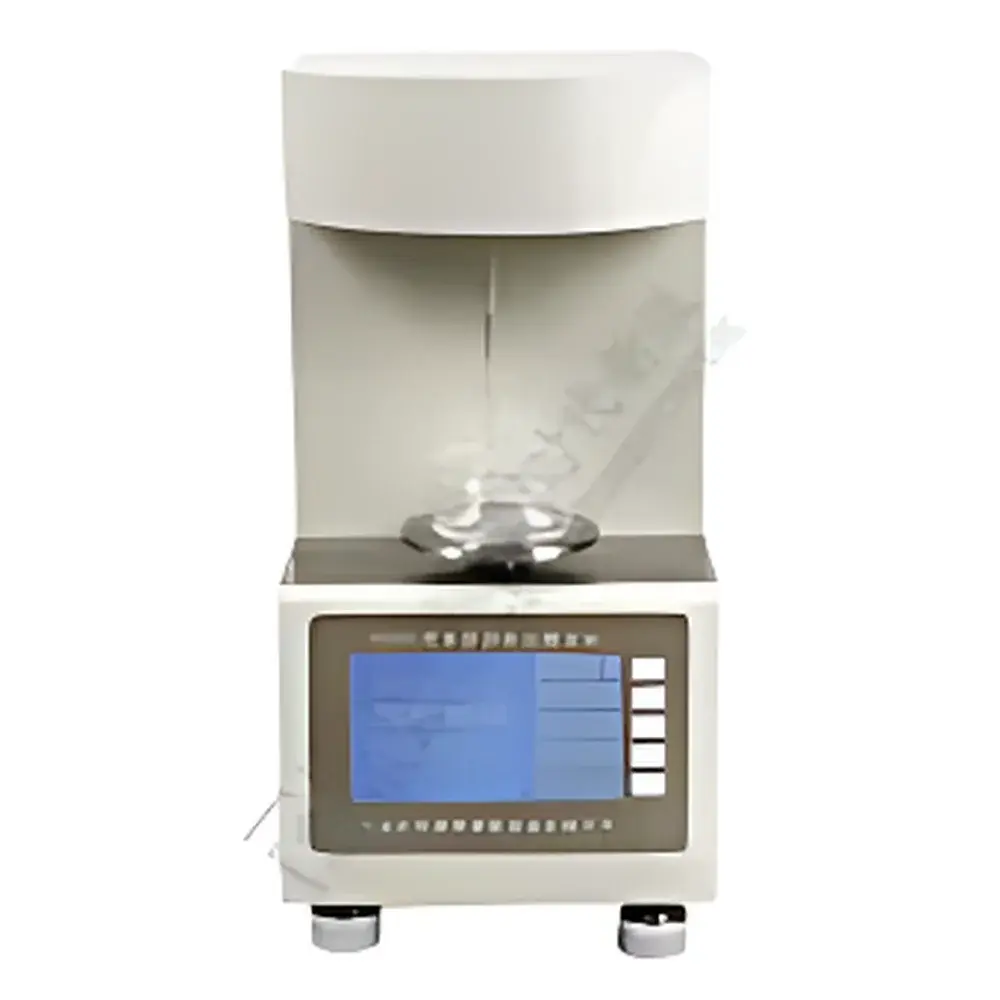
Timepower TP681 Surface Tension Analyzer
| Brand | Timepower |
|---|---|
| Origin | Beijing, China |
| Manufacturer Type | Direct Manufacturer |
| Model | TP681 |
| Compliance | GB 6541, ISO 6295 |
| Measurement Principle | Du Noüy Ring Method (Non-equilibrium) |
| Full Scale Range | 5–100 mN/m (insulating oils), 5–200 mN/m (other petroleum products) |
| Accuracy | ±0.5% of full scale |
| Resolution | 0.1 mN/m |
| Sensitivity | 0.1 mN/m |
| Temperature Compensation | Automatic, real-time |
| Data Storage | Up to 255 test records with timestamp (RTC backup ≥10 years) |
| Interface | RS-232 serial port |
| Display | LCD with Chinese character support |
| Printer | Thermal, 36-character width, native Chinese output |
| Power Supply | AC 220 V ±20%, 40 W max |
| Operating Environment | 10–30 °C, ≤85% RH |
| Lift Speed | 0.3–0.4 mm/s |
| Dimensions | 265 × 190 × 375 mm |
| Weight | 8.84 kg |
Overview
The Timepower TP681 Surface Tension Analyzer is a precision laboratory instrument engineered for the quantitative determination of surface tension and interfacial tension between immiscible liquid phases—particularly mineral oil and water—using the standardized Du Noüy ring method under non-equilibrium conditions. This gravimetric technique relies on measuring the maximum force required to detach a platinum-iridium ring from the liquid surface, directly correlating to surface energy per unit length (mN/m). Designed in strict accordance with GB 6541 (Chinese national standard for petroleum product interfacial tension) and ISO 6295 (international standard for petroleum products — determination of interfacial tension between hydrocarbon and water), the TP681 delivers metrologically traceable results essential for quality control in transformer oil processing, lubricant formulation, and refinery QC laboratories. Its dual-CPU architecture enables real-time signal conditioning, dynamic temperature acquisition, and automatic thermal compensation—ensuring consistent accuracy across ambient fluctuations within the specified 10–30 °C operating range.
Key Features
- Dual-CPU microcontroller system for synchronized data acquisition, sensor linearization, and error correction
- Electromagnetic force balance transducer with multi-point, equidistant calibration to correct inherent nonlinearity across the full measurement span
- Integrated Pt-Ir ring sensor compliant with ASTM D971 and ISO 6295 dimensional tolerances
- Automatic temperature sensing and real-time thermal compensation algorithm applied to all raw tension values
- Onboard non-volatile memory storing up to 255 test records with date/time stamps; RTC battery-backed retention (>10 years)
- LCD interface with native Chinese character rendering and screen-saver mode to extend display longevity
- RS-232 serial interface supporting bidirectional communication with external PCs for automated report generation or LIMS integration
- Thermal printer module (36-character width) providing immediate hardcopy output with bilingual labeling capability
Sample Compatibility & Compliance
The TP681 is validated for use with insulating oils (e.g., transformer oils per IEC 60296), diesel fuels, base oils, and aqueous electrolyte solutions. It reliably detects hydrophilic oxide contaminants in mineral oils—critical for assessing oxidation stability and predicting dielectric failure risk. All measurements conform to the procedural requirements of GB 6541 and ISO 6295, including ring cleaning protocol, immersion depth control (2–3 mm), and vertical withdrawal velocity (0.3–0.4 mm/s). While not certified for GLP or GMP environments out-of-the-box, its deterministic firmware logic, audit-ready timestamping, and uneditable local storage make it suitable for regulated settings when paired with documented SOPs and periodic verification per ISO/IEC 17025.
Software & Data Management
Data export occurs via ASCII-formatted RS-232 transmission, compatible with common spreadsheet and laboratory informatics platforms. Each record includes sample ID (user-defined), measured tension value (mN/m), ambient temperature (°C), test date/time, and instrument serial number. The embedded firmware implements write-once memory allocation for test logs—preventing post-acquisition modification—and supports time-stamped firmware version tracking. Though no proprietary PC software is bundled, the ASCII protocol allows seamless ingestion into custom QA/QC dashboards or enterprise systems requiring FDA 21 CFR Part 11–compliant audit trails when deployed with validated third-party middleware.
Applications
- Quality assurance of transformer and turbine oils per IEC 60156 and ASTM D971
- Monitoring oxidative degradation in hydrocarbon-based lubricants during accelerated aging tests
- Interfacial tension screening for emulsion stability assessment in fuel additives and demulsifier development
- Research-grade characterization of surfactant adsorption kinetics at oil-water interfaces
- In-process verification of solvent purity in pharmaceutical excipient manufacturing
- Educational use in physical chemistry laboratories for surface thermodynamics experiments
FAQ
What standards does the TP681 comply with?
GB 6541 and ISO 6295 for interfacial tension measurement of petroleum products.
Can the instrument measure interfacial tension between crude oil and brine?
Yes—within the 5–200 mN/m range and provided the ring is thoroughly cleaned between samples using chromic acid or equivalent protocol.
Is temperature compensation applied automatically during measurement?
Yes—the integrated sensor acquires ambient temperature continuously and applies correction coefficients derived from NIST-traceable calibration curves.
How many test results can be stored internally?
Up to 255 complete records, each with date, time, tension value, and temperature.
Does the device support USB or Ethernet connectivity?
No—it features RS-232 only; USB-to-serial adapters may be used with appropriate drivers.
What maintenance is required for long-term accuracy?
Monthly verification with certified reference liquids (e.g., distilled water at 20 °C = 72.75 mN/m) and annual recalibration of the force transducer by an accredited lab.
Related Products







