
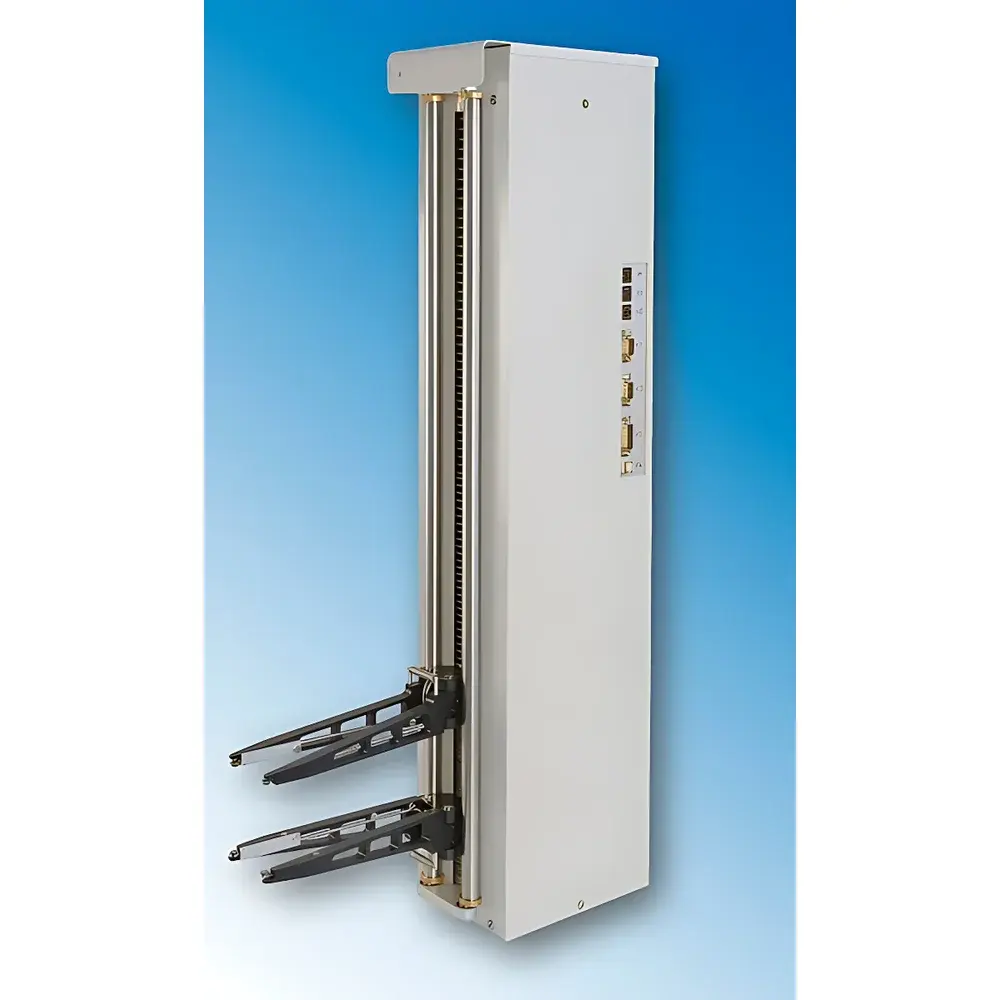
Tinius Olsen AE Series Automatic Variable-Gauge Extensometer
| Brand | Tinius Olsen |
|---|---|
| Origin | USA |
| Model | AE300 / AE500 |
| Gauge Length Range | 10 mm to max travel (300 mm for AE300 |
| Travel Compensation | Motor-driven, ball-bearing transmission |
| Measurement Principle | Optical incremental encoder with zero-backlash linear guidance |
| Arm Configuration | Four-arm symmetrical design with full-bridge strain gauge springs |
| Compliance | ASTM E8/E21, ISO 6892-1, ISO 527-1, EN 10002-1, GB/T 228.1 |
Overview
The Tinius Olsen AE Series Automatic Variable-Gauge Extensometer is a precision-engineered displacement transducer designed for high-fidelity strain measurement during uniaxial tensile and compression testing of metallic, polymeric, composite, and elastomeric materials. Based on a robust four-arm kinematic architecture and driven by closed-loop DC motor actuation, the AE system dynamically maintains optimal grip position throughout the entire deformation cycle — from initial elastic response through plastic yielding to final fracture. Its core measurement principle relies on optical incremental encoding coupled with zero-backlash linear guidance, eliminating angular misalignment errors inherent in traditional knife-edge or pivot-based extensometers. This architecture ensures traceable, repeatable strain data compliant with international standards governing mechanical testing of engineering materials, including ASTM E8/E21 (tensile testing of metals), ISO 6892-1 (metallic materials), ISO 527-1 (plastics), and EN 10002-1 (metallic tensile testing). The device is fully integrated into Tinius Olsen’s Horizon test control and data acquisition platform, enabling synchronized hardware control, real-time strain feedback, and audit-ready data logging.
Key Features
- Automatic gauge length adjustment: Programmable L₀ setting from 10 mm up to maximum travel (300 mm for AE300; 500 mm for AE500), with ±190 mm symmetric positioning range for rapid specimen alignment
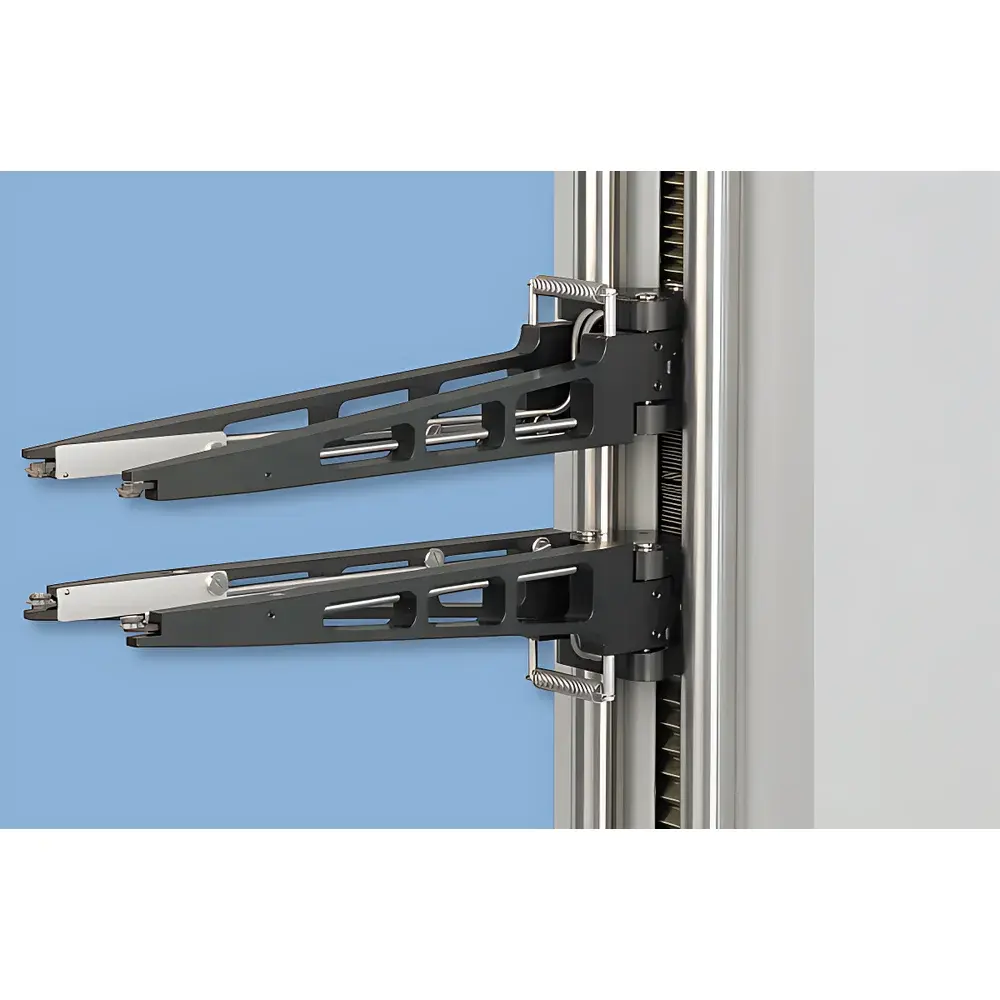
- Four-arm symmetrical design: Dual left/right measurement arms each equipped with full-bridge strain gauge springs; parallel connection of paired arms delivers averaged strain signal — critical for non-uniform deformation zones such as necked regions or notched specimens
- Motorized travel compensation: Precision ball-bearing transmission system actively repositions measuring heads in real time to track specimen elongation, maintaining constant contact force and minimizing perturbation
- Zero-backlash linear guidance: All measuring heads move in strict parallelism along hardened linear guides, eliminating cosine error and tilt-induced measurement drift common in rotary-joint systems
- Digital calibration workflow: On-the-fly calibration via optical reference marks prior to test initiation ensures traceability and repeatability across multiple operators and test sessions
- Universal interface compatibility: RS232 and USB communication protocols support integration with Horizon software as well as third-party test controllers meeting standard SCPI or Modbus RTU requirements
Sample Compatibility & Compliance
The AE Series accommodates a broad spectrum of specimen geometries and material classes — including miniature coupons (e.g., ASTM E345 micro-tensile bars), thin-sheet metals (for deep-drawing characterization when used with lateral extensometer configurations), fiber-reinforced composites, thermoplastic films, and brittle ceramics. Its low-clamping-force design (< 0.5 N per jaw) prevents surface damage or premature failure initiation in notch-sensitive or low-stiffness materials. All mechanical and electrical subsystems are engineered to meet CE marking requirements and operate within Class I safety standards. Data integrity complies with GLP/GMP-aligned workflows: Horizon software supports 21 CFR Part 11–compliant electronic signatures, audit trails, and user-access-level controls. Test reports generated include full metadata (gauge length, calibration date, operator ID, environmental conditions) and are exportable in PDF/A-1b or CSV formats for regulatory submission.
Software & Data Management
Control and configuration of the AE extensometer occur exclusively through Tinius Olsen’s Horizon software — a Windows-based, modular test environment certified for ISO/IEC 17025-compliant laboratories. Horizon provides direct access to all extensometer parameters: gauge length initialization, arm opening/closing sequences, travel limits, calibration offset registration, and real-time strain channel monitoring. Strain data is acquired at up to 1 kHz sampling rate, synchronized with load and crosshead displacement channels using hardware-level triggering. Raw encoder counts and processed engineering strain (ε = ΔL/L₀) are stored in binary .tdms format with embedded metadata, ensuring long-term readability and interoperability with MATLAB, Python (via PyTDM), or LabVIEW. Export modules support ASTM E122-22–compliant statistical reporting, trend analysis across batch runs, and automated pass/fail evaluation against specification limits.
Applications
- Tensile property mapping of advanced high-strength steels and aluminum alloys under quasi-static loading per ASTM E8
- Strain-controlled cyclic testing of shape-memory alloys and superelastic NiTi wires
- Fracture mechanics studies requiring precise J-integral or CTOD determination using clip-gauge-compatible specimen geometries
- Creep and stress-relaxation characterization of thermoplastics and elastomers per ISO 899-1 and ISO 3387
- Deep-drawing behavior analysis of automotive-grade steel sheets using combined axial/lateral extensometry
- Quality assurance testing of medical device components (e.g., stent struts, suture anchors) where sub-millimeter strain resolution is mandatory
FAQ
What is the minimum gauge length supported by the AE Series?
The AE extensometer supports gauge lengths starting at 10 mm, making it suitable for miniature and micro-scale specimens.
Can the AE be used on non-metallic materials such as polymers or composites?
Yes — its low-clamping-force design and symmetrical four-arm geometry ensure reliable performance on low-modulus and heterogeneous materials without inducing localized stress concentrations.
Is calibration traceable to national standards?
Calibration is performed using certified optical reference marks; users may perform in-house verification with NIST-traceable length standards, and full calibration certificates are available upon request.
Does the AE require manual intervention during a test?
No — once initialized, the motorized system autonomously tracks specimen elongation without operator input, and automatically retracts after test completion.
How does the AE handle specimen necking or non-uniform deformation?
By averaging signals from two independently instrumented arm pairs, the AE mitigates localized strain bias and delivers representative engineering strain values even in highly localized deformation zones.



