
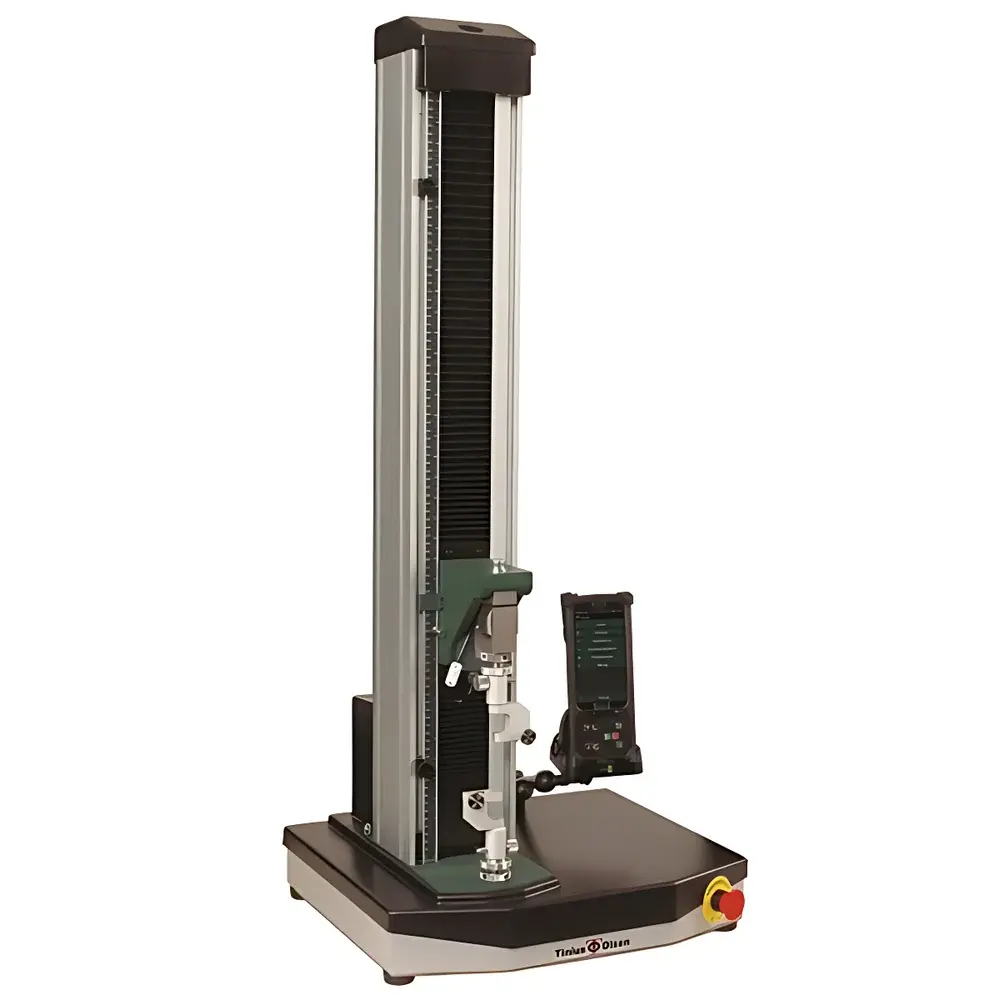
Tinius Olsen F012 Single-Fiber Tensile Tester
| Brand | Tinius Olsen |
|---|---|
| Origin | United Kingdom |
| Manufacturer Status | Authorized Distributor |
| Origin Category | Imported |
| Model | F012 |
| Price Range | USD 14,000 – 70,000 |
| Load Cell Capacity | 10 N (1000 g) |
| Test Speed Range | 0.001–1000 mm/min |
| Maximum Travel | 755 mm |
| Extension Resolution | 0.001 mm |
| Controller | HMC Wireless Bluetooth Handheld Controller |
| Optional Accessories | Tension Grips, PC-Based Testing Software |
Overview
The Tinius Olsen F012 Single-Fiber Tensile Tester is a precision-engineered electromechanical testing system specifically designed for the mechanical characterization of individual textile fibers under uniaxial tension. Built upon the proven architecture of the Tinius Olsen 1ST universal testing platform, the F012 variant integrates low-force metrology, sub-micron displacement resolution, and fiber-specific gripping mechanics to meet the stringent requirements of ISO 5079, ASTM D3822, and GB/T 14337 standards. Unlike general-purpose tensile testers, the F012 employs a dedicated 10 N load cell with high signal-to-noise ratio and temperature-compensated strain gauge technology—enabling accurate measurement of breaking force, elongation at break, initial modulus, and load-elongation curve linearity across natural (e.g., cotton, wool, silk) and synthetic (e.g., polyester, nylon, PPTA) fiber types. Its closed-loop servo-controlled actuation ensures consistent strain rate application per ISO 5079 Annex A, critical for inter-laboratory reproducibility in QC and R&D environments.
Key Features
- High-resolution displacement measurement with 0.001 mm extension resolution, compliant with ISO 5079’s requirement for ≤0.01 mm accuracy in elongation determination
- Adjustable test speed range from 0.001 to 1000 mm/min—covering quasi-static fiber conditioning (e.g., 2 mm/min for standard breaking strength) to dynamic loading protocols (e.g., 500 mm/min for high-speed yarn precursor evaluation)
- Pneumatic lightweight grips with adjustable clamping pressure (0.05–0.5 MPa), minimizing fiber slippage and localized crushing during specimen engagement
- HMC wireless Bluetooth handheld controller enabling real-time parameter adjustment, manual jog control, and immediate pass/fail status feedback without PC dependency
- Modular frame design supporting optional accessories including torsion grips for crimp analysis, environmental chamber integration (−20 °C to +80 °C), and video extensometry for non-contact strain tracking
- Compliance-ready firmware architecture supporting audit trails, user-level access control, and electronic signature functionality aligned with FDA 21 CFR Part 11 and GLP/GMP documentation workflows
Sample Compatibility & Compliance
The F012 accommodates single filaments and staple fibers ranging from 10 mm to 750 mm in gauge length, with diameters spanning 5 µm (spider silk) to 500 µm (coarse jute or sisal). Specimen mounting utilizes standardized fiber holders compatible with ASTM D3822 Type I (flat-grip) and Type II (loop-grip) configurations. All mechanical and software subsystems are validated against ISO/IEC 17025 calibration traceability requirements. Factory-installed verification includes NIST-traceable load cell calibration (±0.5% full scale) and encoder linearity certification per ISO 7500-1 Class 0.5. The system supports automated report generation compliant with ISO 10545-12 (ceramic tile fiber reinforcement testing) and AATCC TM20 (fiber tenacity reporting format).
Software & Data Management
The optional PC-based Horizon™ Testing Software provides ISO-compliant test method templates, real-time stress–strain visualization, and statistical post-processing (Weibull modulus, coefficient of variation, confidence intervals per ASTM D2524). Raw data export is supported in CSV, XML, and PDF/A-2 formats—ensuring long-term archival integrity. Role-based user accounts enforce separation of duties: operators execute tests, supervisors approve methods, and QA managers review electronic records with immutable timestamps. Audit logs record all configuration changes, calibration events, and result modifications—meeting ALCOA+ principles (Attributable, Legible, Contemporaneous, Original, Accurate, Complete, Consistent, Enduring, Available) for regulatory submissions.
Applications
- Quality control of virgin and recycled synthetic fibers in spinning mills
- Research on moisture-dependent tensile behavior of cellulose-based fibers (e.g., lyocell, modal) under controlled RH conditions
- Evaluation of surface-modified fibers for medical textiles (e.g., antimicrobial coating adhesion impact on breaking strength)
- Development of high-performance aramid and UHMWPE fibers for ballistic and composite reinforcement applications
- Validation of enzymatic or plasma treatment efficacy on natural fiber tensile integrity
- Interlaboratory round-robin studies coordinated under ITMA or IWTO technical working groups
FAQ
What fiber types can be tested on the F012 without modification?
Natural fibers (cotton, wool, flax, silk), regenerated cellulose (viscose, lyocell), synthetics (polyester, nylon 6/6, acrylic), and high-performance fibers (aramid, polyethylene) — provided gauge length exceeds 10 mm and linear density falls within 0.1–10 dtex.
Is the system compliant with ISO 5079:2018?
Yes. The F012’s displacement resolution (0.001 mm), speed control accuracy (±0.2% setpoint), and load cell class (0.5 per ISO 7500-1) satisfy all mandatory metrological clauses in ISO 5079:2018 Annex B.
Can the HMC controller operate independently of a PC?
Yes. The HMC enables full test execution—including method selection, start/stop, and real-time curve display—without any connected computer. Data sync occurs automatically upon Bluetooth reconnection.
Are calibration certificates included with shipment?
Each unit ships with a factory-issued calibration certificate traceable to UKAS-accredited standards, covering load cell, encoder, and controller timing subsystems.
What is the recommended maintenance interval for pneumatic grips?
Inspection and seal replacement every 12 months or after 50,000 test cycles—whichever occurs first—using Tinius Olsen OEM part kit #GK-F012-PNEU-MAINT.






