
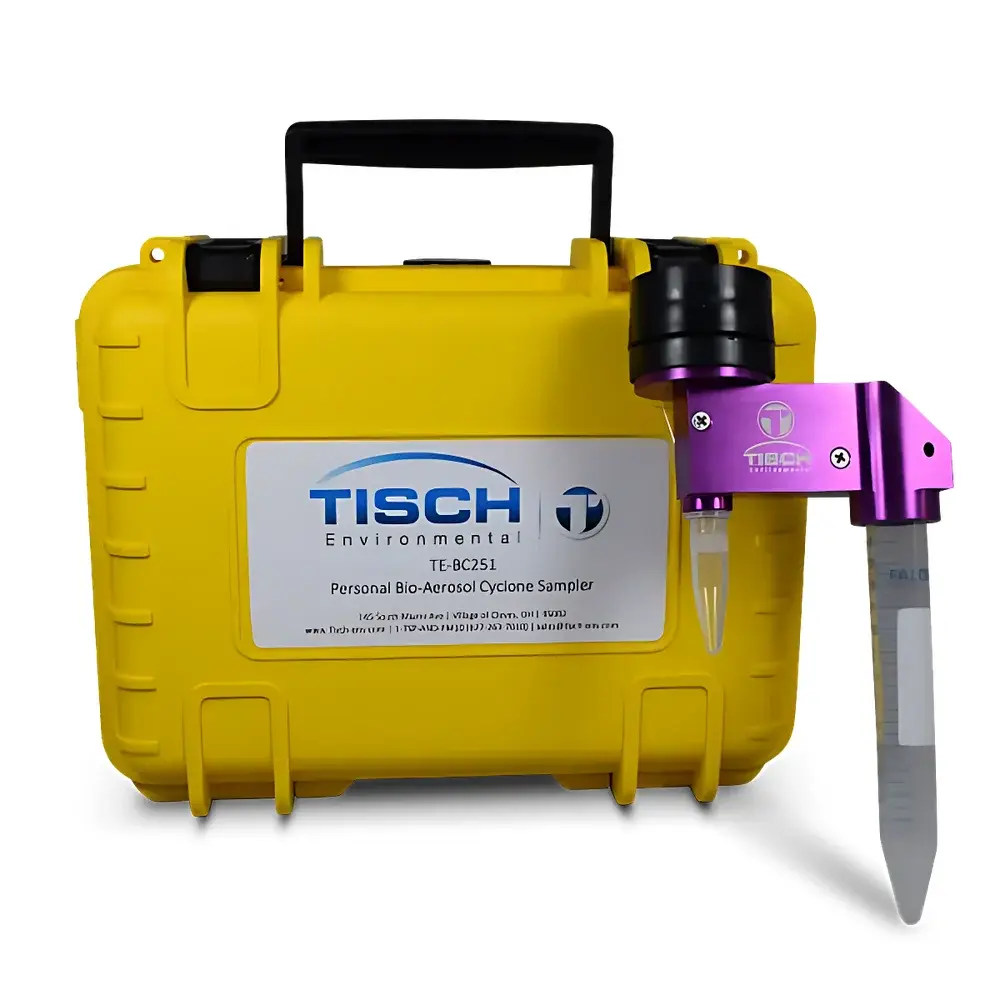
Tisch BC 251 Two-Stage Bioaerosol Cyclone Sampler
| Brand | Tisch |
|---|---|
| Origin | USA |
| Model | BC 251 |
| Flow Rate | 3.5 L/min |
| Collection Media | 15 mL centrifuge tube + 1.5 mL centrifuge tube + backup filter |
| Particle Separation Standard | ACGIH/ISO 7708 (Inhalable & Thoracic Fractions) |
| Compliance | NIOSH-developed personal sampler |
| Application | Viral aerosol collection (e.g., influenza, SARS-CoV-2) |
Overview
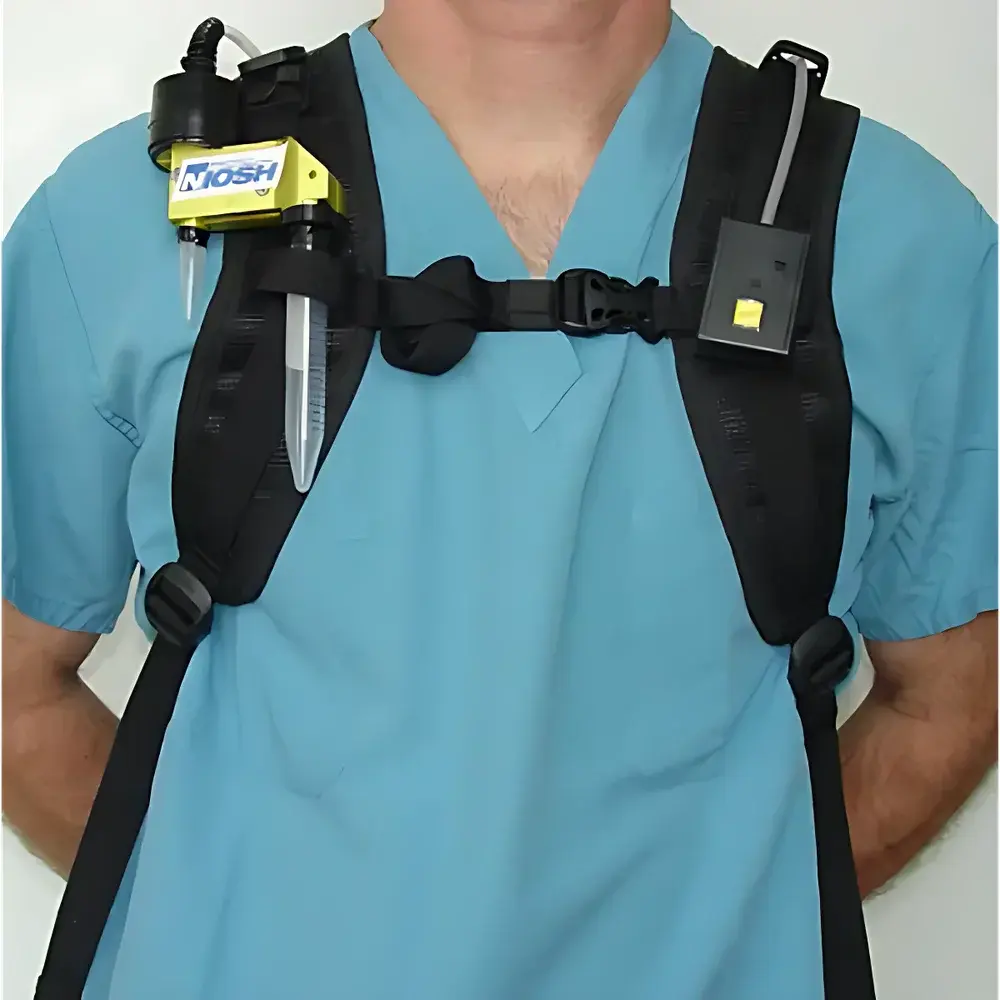
The Tisch BC 251 Two-Stage Bioaerosol Cyclone Sampler is a NIOSH-developed, wearable personal sampling device engineered for the selective collection of airborne biological particles—including viruses, bacteria, fungal spores, and allergenic bioaerosols—according to anatomically relevant deposition fractions. Based on inertial impaction and cyclonic separation principles, the BC 251 physically segregates inhaled aerosol mass into thoracic (respirable) and inhalable fractions across two sequential stages, enabling fraction-specific downstream molecular analysis. Its design adheres strictly to ACGIH/ISO 7708:1995 definitions for inhalable and thoracic particulate mass, making it suitable for occupational health exposure assessment, clinical environmental surveillance, and outbreak investigation where quantitative aerosol partitioning is required. Unlike culture-dependent methods, the BC 251 preserves nucleic acid integrity and antigenic structure, supporting high-sensitivity detection via RT-qPCR, digital PCR, ELISA, and next-generation sequencing workflows.
Key Features
- Two-stage cyclonic separation architecture optimized for particle size discrimination between inhalable (≤100 µm aerodynamic diameter) and thoracic (≤10 µm) fractions
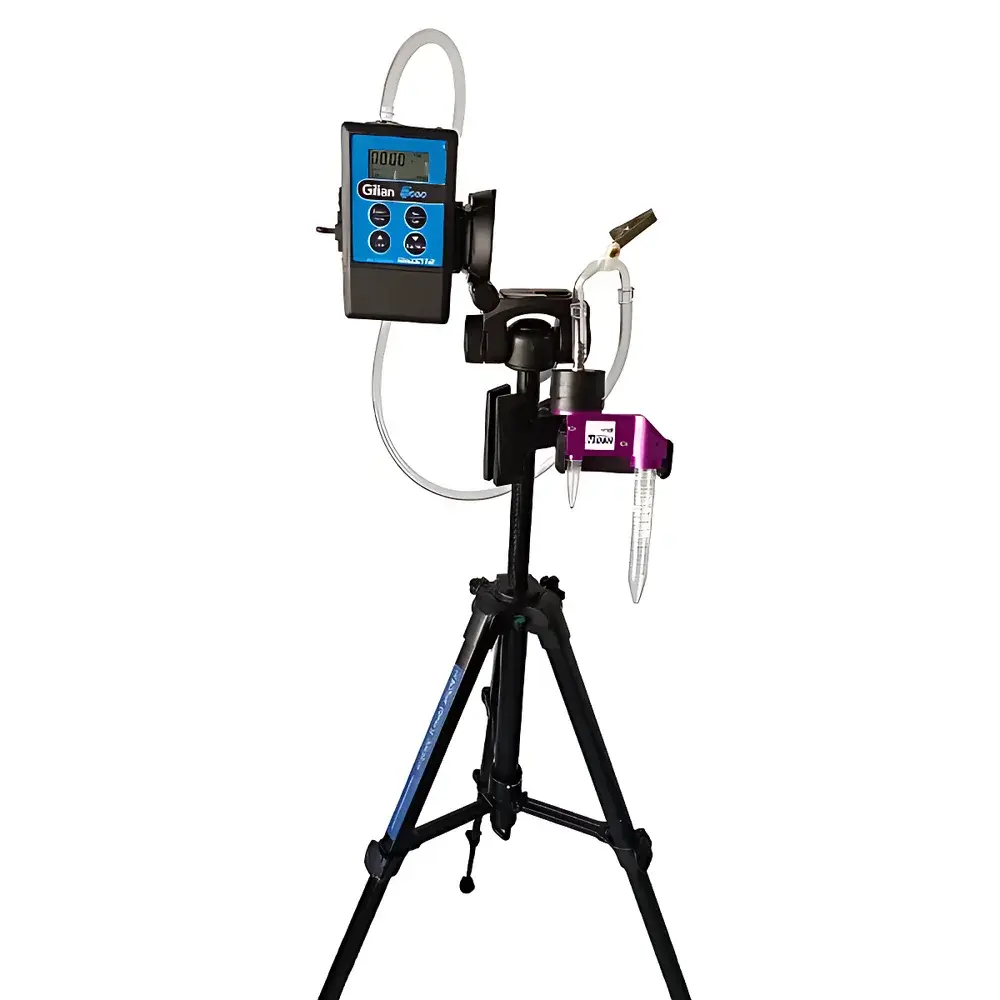
- Standardized flow rate of 3.5 L/min—calibrated and validated for compatibility with widely deployed personal sampling pumps (e.g., SKC AirCheck Touch, Gilian GilAir series)
- Dual-collection configuration: primary stage deposits larger particles into a 15 mL conical centrifuge tube; secondary stage captures finer aerosols in a 1.5 mL microcentrifuge tube; optional backup filter provides retention verification and mass balance validation
- Chemically inert, autoclavable polycarbonate housing with low surface adsorption characteristics to minimize sample loss and cross-contamination
- Compact, lightweight (<250 g) form factor designed for extended wear during field or clinical monitoring without compromising mobility or worker compliance
- No internal moving parts or power requirements—passive operation ensures reliability under variable environmental conditions (temperature: −20 °C to 50 °C; RH: 10–95%)
Sample Compatibility & Compliance
The BC 251 is validated for use with molecular and immunoassay-based analytical platforms requiring intact biomolecular targets. Collected samples maintain RNA stability for ≥4 hours at ambient temperature and ≥72 hours at 4 °C—sufficient for transport to centralized laboratories. The device conforms to ISO 14644-1 (cleanroom classification), ISO 21501-4 (aerosol particle sizing calibration traceability), and ASTM D6245 (indoor air quality sampling protocols). It supports GLP-compliant documentation when integrated with calibrated flow measurement systems (e.g., dry gas meters traceable to NIST SRM 1660) and meets criteria for inclusion in OSHA Method ID-230 and NIOSH Manual of Analytical Methods (NMAM) Chapter 2. Its physical separation performance has been peer-reviewed in Aerosol Science and Technology and cited in CDC/NIOSH guidance for respiratory pathogen exposure assessment.
Software & Data Management
As a passive, hardware-only sampling platform, the BC 251 does not incorporate embedded firmware or onboard data logging. Sample metadata—including pump model, flow rate, duration, location, operator ID, and environmental conditions—is recorded externally using standardized electronic lab notebooks (ELNs) compliant with 21 CFR Part 11 (e.g., LabArchives, Benchling). Integration with LIMS systems is achieved via CSV or JSON export from pump controllers equipped with audit-trail-capable memory. For epidemiological traceability, each BC 251 unit carries a laser-etched serial number enabling full chain-of-custody tracking from deployment through nucleic acid extraction and sequencing library preparation.
Applications
- Occupational health monitoring in healthcare settings: real-time assessment of viral shedding from symptomatic patients (e.g., influenza A/H1N1, SARS-CoV-2) during coughing, speaking, or aerosol-generating procedures
- Evaluation of HVAC filtration efficiency against bioaerosol penetration in hospitals, laboratories, and cleanrooms
- Field-based surveillance of zoonotic pathogen dispersion near livestock facilities or wastewater treatment plants
- Validation of PPE performance (e.g., N95 respirators, surgical masks) under realistic breathing profiles using controlled challenge aerosols
- Longitudinal studies of indoor microbiome dynamics in schools, offices, and residential buildings
FAQ
What particle size ranges does the BC 251 separate according to ISO 7708?
The BC 251 separates aerosols into inhalable fraction (mass median aerodynamic diameter ≤100 µm) and thoracic fraction (≤10 µm), aligned with ISO 7708:1995 definitions.
Can the BC 251 be used for quantitative viral load estimation?
Yes—when paired with calibrated flow measurement and validated RNA extraction protocols, it enables calculation of airborne viral concentration (genome copies/m³) with inter-laboratory reproducibility CV <15% (per published NMAM interlab study).
Is the BC 251 compatible with automated nucleic acid extraction systems?
All collection tubes (15 mL and 1.5 mL) are standard polypropylene formats accepted by major robotic liquid handlers (e.g., QIAGEN QIAcube HT, Thermo KingFisher Flex).
Does the BC 251 require pre-sterilization before use?
Units are supplied non-sterile; autoclaving at 121 °C for 20 min is recommended prior to sterile-field applications. Ethanol wipe disinfection suffices for routine reuse.
How is flow rate verified during sampling?
A primary-certified rotameter or electronic flow calibrator (e.g., Bios International 4040) must be installed in-line upstream of the sampler; daily calibration checks are required per ISO 17025-accredited QA/QC protocols.







