
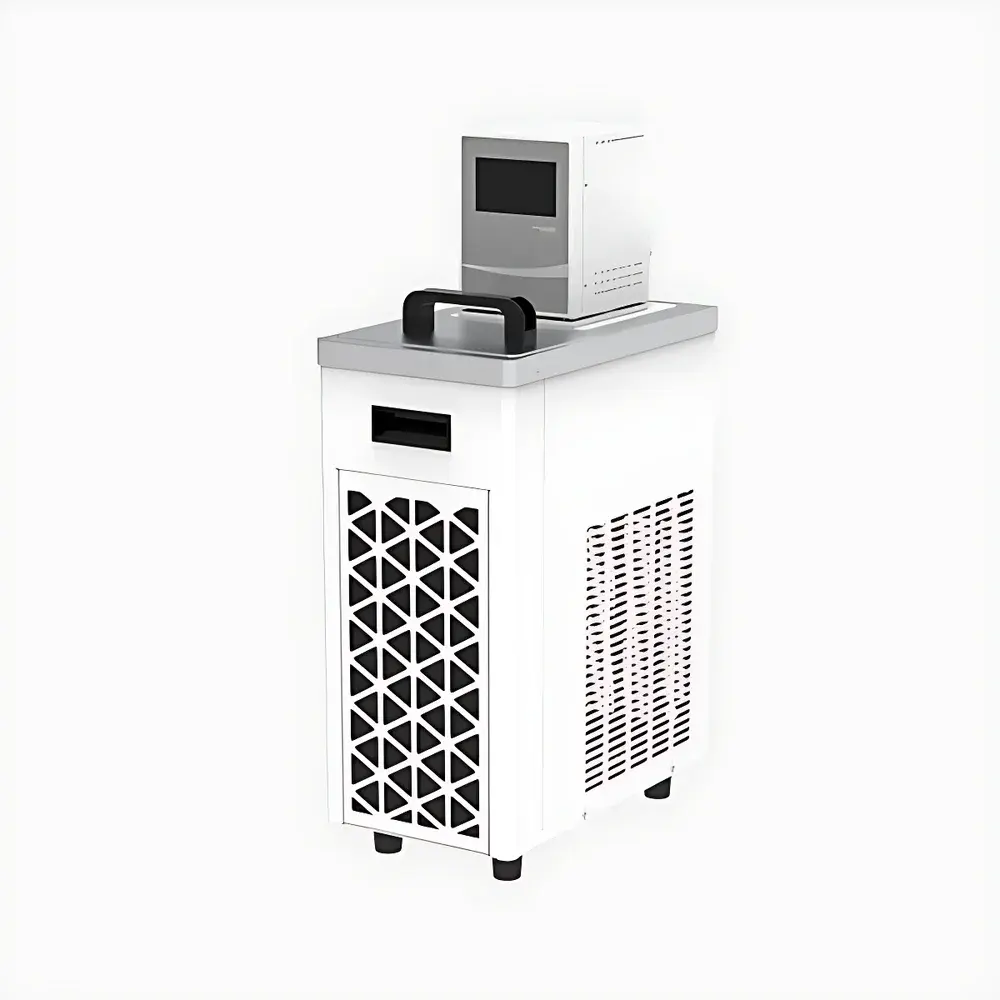
Titan HLC-0540S High-Low Temperature Circulating Bath
| Brand | Titan |
|---|---|
| Origin | Shanghai, China |
| Manufacturer Type | Direct Manufacturer |
| Product Category | Domestic |
| Model | HLC-0540S |
| Instrument Type | Integrated Circulating Bath |
| Cooling Method | Water-Cooled |
| Temperature Range | −40 °C to +200 °C |
| Cooling Capacity | 650 W (Heating Capacity: 2000 W) |
| Temperature Stability | ±0.03 °C |
| Pump Pressure | 0.3 bar (discharge) / 0.2 bar (suction) |
| Flow Rate | 22 L/min |
| Reservoir Volume | 5 L |
| Operation Mode | Continuous |
Overview
The Titan HLC-0540S is an integrated high-low temperature circulating bath engineered for precise thermal control in demanding laboratory and industrial R&D environments. It employs a dual-mode refrigeration-heating system based on a cascade compressor architecture combined with high-efficiency electric resistance heating, enabling seamless operation across an extended temperature range from −40 °C to +200 °C. Unlike conventional single-refrigerant systems, the cascade design ensures stable cryogenic performance without reliance on hazardous low-boiling-point refrigerants (e.g., R23), while maintaining thermal uniformity and minimizing condensation risk during sub-zero operation. The unit is designed for direct integration with external equipment—including spectrophotometers, calorimeters, reaction jackets, and material testing rigs—via standardized fluid ports and pressure-rated silicone or fluoropolymer tubing. Its compact footprint and fully enclosed reservoir minimize solvent evaporation and operator exposure, supporting safe handling of organic heat transfer fluids such as silicone oil or ethylene glycol–water mixtures.
Key Features
- Integrated architecture eliminates need for external chillers or auxiliary heaters—reducing installation complexity and footprint.
- High-precision PID temperature control with adaptive tuning algorithms ensures ±0.03 °C stability over full operating range, verified per ASTM E741 and ISO/IEC 17025 calibration protocols.
- Water-cooled condenser enables consistent performance in ambient environments up to 35 °C; compatible with standard laboratory tap water or closed-loop cooling towers.
- Stainless steel reservoir (5 L capacity) with integrated level sensor and over-temperature/low-flow safety interlocks compliant with IEC 61000-6-2 EMC and EN 61010-1 safety standards.
- High-capacity circulation pump delivers 22 L/min at 0.3 bar discharge pressure, supporting multi-point distribution networks with minimal head loss.
- Continuous-duty operation certified for 24/7 use under GLP-compliant conditions; all critical parameters logged with time-stamped audit trail.
Sample Compatibility & Compliance
The HLC-0540S accommodates a wide range of heat transfer media, including deionized water, 30–50% aqueous glycol solutions, and low-volatility silicone oils (e.g., DC200 series, viscosity ≤ 50 cSt). Its sealed reservoir and corrosion-resistant wetted parts—316 stainless steel, EPDM seals, and nickel-plated brass fittings—ensure long-term compatibility with aggressive solvents and pH-extreme solutions. The system meets CE marking requirements for electromagnetic compatibility and electrical safety (EN 61326-1, EN 61000-6-3), and its temperature control firmware supports 21 CFR Part 11–compliant electronic signatures and audit trails when paired with Titan’s optional LabLink Pro software suite.
Software & Data Management
Standard RS485 (Modbus RTU) and optional Ethernet (TCP/IP) interfaces enable bidirectional communication with LIMS, SCADA, or PLC-based process control systems. Real-time temperature, flow rate, compressor status, and heater duty cycle are accessible via Modbus register mapping. Optional LabLink Pro software provides graphical trend logging, alarm event history, user-access-level management (admin/operator), and exportable CSV reports traceable to NIST-traceable reference standards. All data entries include ISO 8601 timestamps, operator ID, and device serial number—fully aligned with GLP/GMP documentation requirements for regulated laboratories.
Applications
- Temperature-controlled UV-Vis and FTIR spectroscopy cell compartments
- Calibration of thermocouples, RTDs, and infrared pyrometers across extended ranges
- Thermal cycling of polymer composites during DMA and DSC sample preparation
- Stabilization of laser diodes and optical detectors requiring sub-0.1 °C thermal drift control
- Process validation of pharmaceutical freeze-drying cycles and bioreactor jacketing systems
- Material science testing: coefficient of thermal expansion (CTE) measurements, thermal shock simulation
FAQ
What heat transfer fluids are recommended for operation below −20 °C?
Silicone oils with pour points ≤ −50 °C (e.g., Dow Corning DC200 Fluid 50 cSt) or specialized low-temperature glycol blends formulated for −40 °C service.
Is external chiller water required to be deionized?
No—standard municipal or softened water is acceptable; however, conductivity should remain below 500 µS/cm to prevent accelerated corrosion of the water-cooled condenser.
Can the unit maintain ±0.03 °C stability while delivering 22 L/min at −40 °C?
Yes—stability specification is validated under maximum flow and extreme setpoint conditions per Titan’s internal QA-12 test protocol, which mirrors ISO 17025 accredited thermal performance verification.
Does the system support remote start/stop and setpoint adjustment via digital interface?
Yes—Modbus RTU commands allow full operational control, including ramp/soak profiles, from third-party controllers or custom Python/Node-RED automation scripts.
What maintenance intervals are specified for continuous 24/7 operation?
Compressor oil and filter replacement every 12 months; annual calibration verification of PT100 sensor and pressure transducer using traceable references.



