
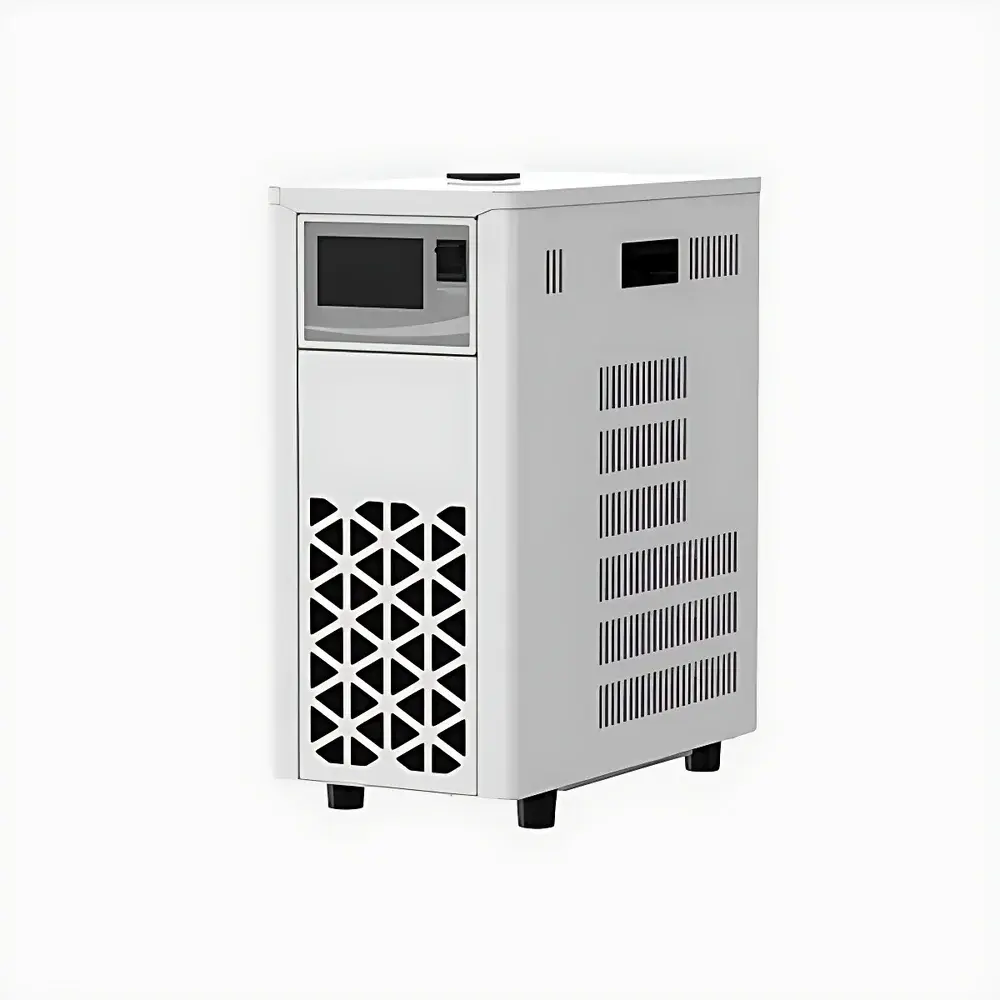
Titan HLT-0320 Integrated High-Low Temperature Circulating Chiller
| Brand | Titan |
|---|---|
| Origin | Shanghai, China |
| Manufacturer Type | Direct Manufacturer |
| Product Category | Domestic |
| Model | HLT-0320 |
| Instrument Type | Integrated Unit |
| Cooling Method | Water-Cooled |
| Temperature Range | −20 °C to +100 °C |
| Cooling Capacity | 450 W (Heating Capacity: 1500 W) |
| Temperature Stability | ±0.05 °C |
| Circulation Pump Pressure | 0.2 bar (discharge) / 0.1 bar (suction) |
| Flow Rate | 18 L/min |
| Reservoir Volume | 3 L |
| Operation Mode | Continuous Duty |
Overview
The Titan HLT-0320 is an integrated high-low temperature circulating chiller engineered for precise thermal control in demanding laboratory and analytical applications. It employs a dual-mode refrigeration-heating system based on a hermetically sealed compressor and PID-controlled electric heating elements, enabling seamless operation across a broad temperature span from −20 °C to +100 °C. Unlike modular or external-coil configurations, the HLT-0320 integrates the refrigeration circuit, expansion tank, circulation pump, and controller into a single compact chassis—minimizing footprint while maximizing thermal response consistency and operational reliability. Its design targets applications requiring stable heat exchange with external equipment such as rotary evaporators, spectrophotometers, calorimeters, and reaction jackets, where sustained temperature uniformity and low drift are critical to experimental integrity.
Key Features
- High-precision temperature regulation with ±0.05 °C stability over the full operating range, achieved via dual-sensor feedback (PT100 immersion probe + ambient reference) and adaptive PID tuning.
- Integrated water-cooled refrigeration system optimized for continuous-duty operation; eliminates dependency on ambient air cooling and reduces sensitivity to room temperature fluctuations.
- Robust circulation subsystem featuring a corrosion-resistant stainless-steel reservoir (3 L capacity), adjustable flow rate up to 18 L/min, and dual-pressure capability (0.2 bar discharge / 0.1 bar suction) for compatibility with both pressurized and vacuum-assisted external loops.
- Independent heating (1500 W) and cooling (450 W) circuits allow rapid thermal ramping and accurate setpoint maintenance without thermal overshoot or hysteresis.
- Front-panel interface with real-time display of bath temperature, setpoint, flow status, and system fault codes; supports manual mode and timed operation scheduling.
- Structural housing fabricated from powder-coated steel with reinforced vibration-damping mounts to ensure mechanical stability during prolonged use.
Sample Compatibility & Compliance
The HLT-0320 is compatible with standard laboratory coolant fluids—including deionized water, 30% ethylene glycol/water mixtures, and silicone-based heat transfer media—within its specified viscosity and pH limits (pH 5–9). Its sealed reservoir and non-ferrous internal wetted parts (brass, stainless steel, EPDM seals) prevent degradation when used with common organic solvents encountered in rotary evaporation or jacketed reactor setups. The unit complies with IEC 61010-1:2010 for electrical safety in laboratory equipment and meets CE marking requirements for EMC (EN 61326-1) and low-voltage directives. While not certified for hazardous location use, it is suitable for general-purpose labs operating under ISO/IEC 17025-accredited quality systems, and its stable thermal output supports method validation per ASTM E2927 (standard practice for temperature calibration of liquid baths) and USP (thermal analysis instrumentation qualification).
Software & Data Management
The HLT-0320 operates as a standalone instrument with no proprietary software dependency. All configuration and monitoring occur via its local LCD interface. For integration into networked lab environments, optional RS485 (Modbus RTU) or analog 4–20 mA output modules enable connection to SCADA platforms, LIMS, or building management systems. When paired with third-party data loggers or PLC controllers, the unit supports time-stamped temperature logging at user-defined intervals (1–60 s resolution), facilitating audit-ready records compliant with GLP and GMP documentation practices. No embedded storage or cloud connectivity is provided—ensuring data sovereignty and alignment with institutional IT security policies.
Applications
- Temperature control of rotary evaporator condensers and cold traps in solvent recovery workflows.
- Thermal stabilization of UV-Vis and FTIR spectrophotometer sample compartments and detector housings.
- Active cooling of high-power laser sources and photomultiplier tube assemblies requiring sub-ambient operation.
- Process temperature maintenance in small-scale chemical synthesis reactors and calorimetric cells.
- Calibration support for thermocouple and RTD verification baths per ISO 17025 clause 6.4.10.
- Pre-conditioning of test specimens prior to mechanical or rheological testing under controlled thermal history.
FAQ
What coolant types are recommended for long-term use with the HLT-0320?
Deionized water is optimal for temperatures above 0 °C. For sub-zero operation down to −20 °C, a mixture of 30% ethylene glycol and 70% deionized water is recommended. Avoid methanol or acetone-based coolants due to seal compatibility risks.
Can the unit maintain temperature stability during extended unattended operation?
Yes—the HLT-0320 is rated for continuous duty and includes overtemperature, low-flow, and dry-run protection circuits that trigger automatic shutdown and visual alarm indication.
Is the circulation pump compatible with external closed-loop systems under vacuum?
The pump provides 0.1 bar suction pressure, supporting integration with vacuum-jacketed reactors or evaporators when configured with appropriate check valves and fluid level sensors.
Does the unit meet FDA 21 CFR Part 11 requirements for electronic records?
As a standalone hardware controller without electronic signature or audit trail functionality, the base HLT-0320 does not comply directly—but when interfaced with validated third-party data acquisition systems, it can contribute to Part 11–compliant workflows.
What is the expected service interval for compressor maintenance?
Under typical laboratory usage (8–10 hrs/day), the sealed compressor requires no scheduled maintenance; routine inspection of coolant level, filter cleanliness, and hose integrity is advised every 6 months.



