
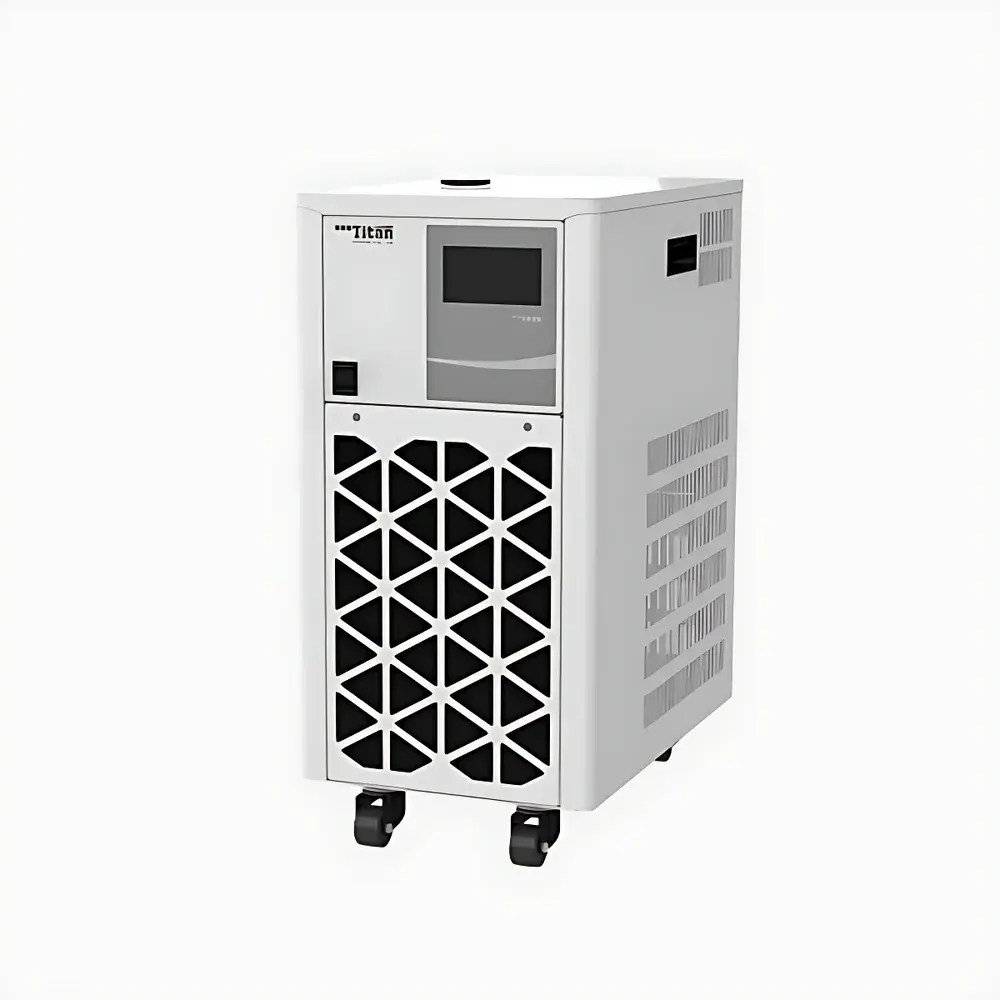
Titan HLT-0920 Integrated High-Low Temperature Circulating Chiller
| Brand | Titan |
|---|---|
| Origin | Shanghai, China |
| Manufacturer Type | Direct Manufacturer |
| Instrument Type | Integrated Circulating Chiller |
| Cooling Method | Water-Cooled |
| Temperature Range | −20 °C to +100 °C |
| Cooling Capacity | 1200 W (Heating Capacity: 1500 W) |
| Temperature Stability | ±0.05 °C |
| Circulation Pump Pressure | 1.0 bar |
| Circulation Flow Rate | 22 L/min |
| Reservoir Volume | 9 L |
| Operation Mode | Continuous Duty |
Overview
The Titan HLT-0920 is an integrated high-low temperature circulating chiller engineered for precision thermal control in demanding laboratory and industrial applications. Utilizing a dual-mode refrigeration-heating system based on vapor-compression thermodynamics, it delivers stable, programmable temperature regulation across a wide operational span—from cryogenic cooling at −20 °C to precise heating up to +100 °C. Its water-cooled condenser design enhances thermal efficiency and reduces ambient heat load compared to air-cooled alternatives, making it suitable for installation in temperature-sensitive or space-constrained environments such as analytical labs, material testing rooms, and pilot-scale reaction setups. The unit operates continuously under full load, supporting long-duration experiments requiring unbroken thermal stability—critical for applications including viscometry, spectroscopy cell temperature control, and calibration of temperature-sensitive sensors.
Key Features
- Integrated architecture with built-in reservoir (9 L), circulation pump, refrigeration/heating system, and PID-controlled digital thermostat—no external components required.
- High-precision temperature regulation with stability of ±0.05 °C, achieved via dual-sensor feedback loop and adaptive PID algorithm optimized for dynamic thermal loads.
- Robust water-cooled condensation system enables consistent performance even in ambient temperatures up to 35 °C; eliminates reliance on variable airflow and minimizes noise emission.
- High-flow circulation capability: 22 L/min at 1.0 bar pressure, compatible with extended tubing runs and multi-point distribution manifolds (e.g., for simultaneous jacketed reactor and spectrometer cooling).
- Simultaneous heating and cooling capacity (1500 W heating / 1200 W cooling) allows rapid thermal ramping and tight setpoint tracking during exothermic/endothermic processes.
- Stainless steel reservoir and corrosion-resistant fluid path materials ensure compatibility with water, water-glycol mixtures, and other common heat transfer fluids per ASTM D1384 and ISO 8504-2 guidelines.
Sample Compatibility & Compliance
The HLT-0920 is designed to interface with a broad range of external equipment—including rotary evaporators, calorimeters, laser sources, and environmental chambers—via standardized 1/2″ NPT or G1/2″ threaded ports. Its closed-loop circulation system maintains fluid integrity and prevents contamination during extended operation. The unit complies with IEC 61010-1:2010 for electrical safety in laboratory equipment and meets CE marking requirements for electromagnetic compatibility (EMC Directive 2014/30/EU). While not certified for use in classified hazardous locations, its construction adheres to GLP-aligned engineering practices, including traceable component sourcing and factory calibration documentation available upon request.
Software & Data Management
The onboard controller features a 4.3″ color TFT display with intuitive menu navigation, real-time trend graphing, and password-protected parameter locking—supporting audit-ready operation in regulated environments. Optional RS485 Modbus RTU or Ethernet (TCP/IP) interfaces enable integration into centralized lab management systems (LIMS) or SCADA platforms. When connected to Titan’s optional LabLink™ software (v3.2+), users gain access to time-stamped logging (with UTC synchronization), remote setpoint adjustment, alarm history export (CSV), and configurable event triggers—fully compliant with FDA 21 CFR Part 11 requirements for electronic records and signatures when deployed with appropriate validation protocols.
Applications
- Temperature stabilization of UV-Vis, FTIR, and Raman spectrometers during spectral acquisition.
- Cooling of high-power LED arrays and laser diodes in optical metrology systems.
- Thermal conditioning of samples in rheometers, differential scanning calorimeters (DSC), and thermogravimetric analyzers (TGA).
- Process temperature control in small-scale chemical synthesis reactors and crystallization studies.
- Calibration of platinum resistance thermometers (PRTs), thermocouples, and infrared pyrometers across defined temperature plateaus.
- Support of accelerated stability testing per ICH Q1A(R2) guidelines in pharmaceutical development labs.
FAQ
What heat transfer fluids are compatible with the HLT-0920?
Deionized water, 30–50% aqueous ethylene or propylene glycol solutions, and low-viscosity silicone oils (up to 50 cSt at 25 °C) are approved. Fluid selection must consider freeze protection, thermal conductivity, and chemical compatibility with stainless steel and EPDM seals.
Can the unit operate without a connected external load?
Yes—the internal bypass loop ensures stable circulation and temperature control during idle periods or system commissioning, preventing thermal shock or dry-run conditions.
Is external water supply required for the water-cooled condenser?
Yes—a continuous source of clean, low-conductivity cooling water (typically 15–25 °C, 2–4 bar supply pressure) is mandatory for condenser operation. A recirculating water tower or facility chilled water loop may be used.
Does the HLT-0920 support external temperature feedback control?
Yes—via optional PT100 input (0–10 V or 4–20 mA analog signal), enabling cascade control where the chiller modulates output based on actual process temperature rather than bath temperature alone.
What maintenance intervals are recommended?
Condenser water filter inspection every 3 months; annual glycol concentration and pH verification; biannual verification of refrigerant charge and pressure switch calibration per ISO 5149-2 maintenance protocols.



