
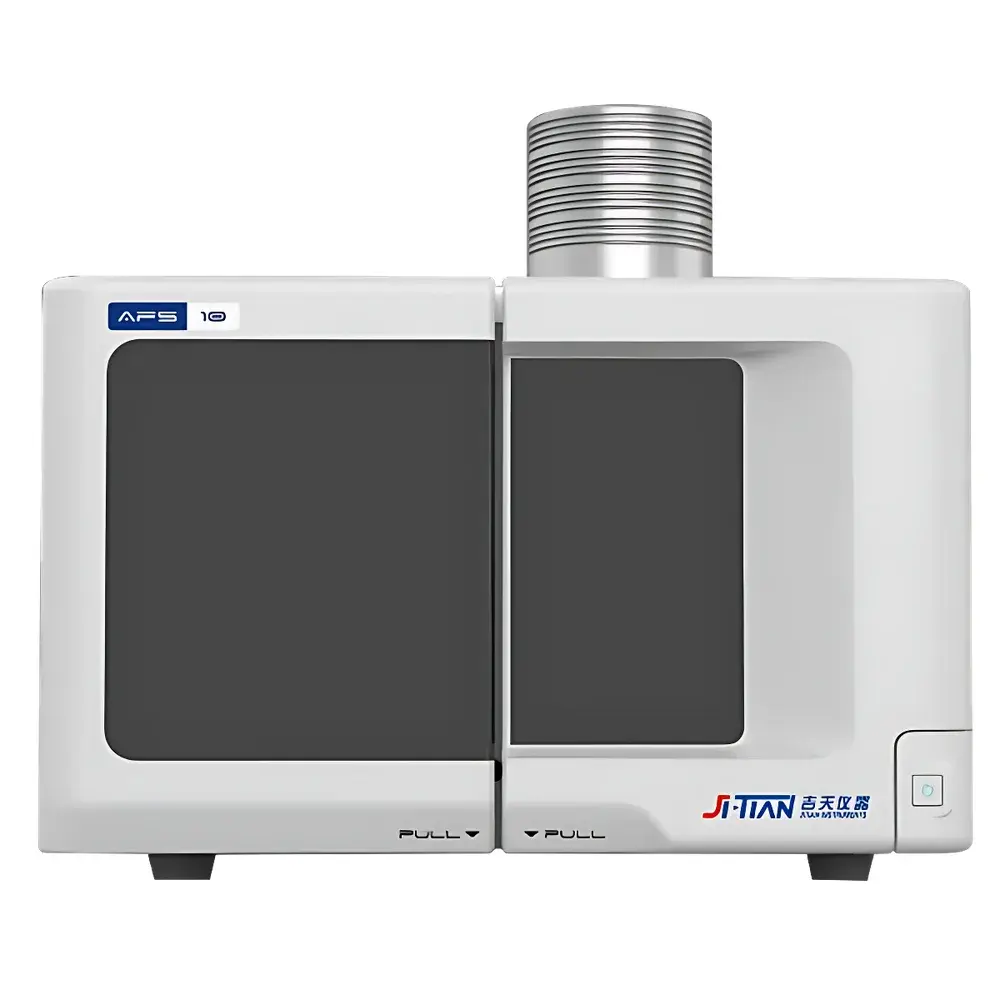
Titan Instruments AFS-10B Intermittent-Pump Fast-Sampling Atomic Fluorescence Spectrometer
| Brand | Titan Instruments |
|---|---|
| Origin | Beijing, China |
| Manufacturer Type | Direct Manufacturer |
| Product Category | Domestic |
| Model | AFS-10B |
| Instrument Type | Multi-channel Atomic Fluorescence Spectrometer |
| Sample Introduction Mode | Peristaltic Pump |
| Waste Disposal | Rear Exhaust Configuration |
| Hydride Generation Mode | Vapor Generation / Hydride Generation |
| Pneumatic Control System | Valve Island |
| Detectable Elements | As, Sb, Bi, Sn, Se, Te, Pb, Ge, Hg, Cd, Zn |
| Relative Standard Deviation (RSD) | < 0.6% |
| Linear Dynamic Range | > 3 orders of magnitude |
| Detection Limits | As, Sb, Se, Bi, Te, Hg, Sn, Pb < 0.01 µg/L |
| Photomultiplier Tube Wavelength Range | 160–320 nm |
| Atomizer Temperature Control Range | Adjustable (Precise Thermal Stabilization) |
Overview
The Titan Instruments AFS-10B is a multi-channel atomic fluorescence spectrometer engineered for high-sensitivity, trace-level quantification of hydride-forming and cold-vapor elements in liquid matrices. It operates on the principle of atomic fluorescence spectroscopy (AFS), where analyte species—pre-reduced to volatile hydrides (e.g., AsH₃, SbH₃, SeH₂) or elemental vapor (e.g., Hg⁰)—are atomized in a quartz cell under argon-hydrogen flame or quartz furnace conditions. Subsequent excitation by a high-intensity, element-specific hollow cathode lamp (HCL) induces fluorescence emission at characteristic wavelengths, which is detected with high quantum efficiency by a low-noise photomultiplier tube (PMT) operating within the 160–320 nm spectral window. The AFS-10B implements intermittent-pump sampling—a precise, pulse-driven peristaltic delivery system—enabling rapid, reproducible reagent and sample introduction while minimizing cross-contamination and memory effects. Its architecture is optimized for compliance with international regulatory frameworks governing trace metal analysis, including food safety (e.g., ISO 20645, AOAC 2019.03), environmental monitoring (EPA Method 1631E, ISO 17294-2), and clinical toxicology workflows.
Key Features
- Intermittent six-roller peristaltic pump with integrated pressure block design—ensures consistent flow pulsation, enhanced hydride generation efficiency, and reduced carryover between samples.
- High-speed acquisition circuitry with 500 Hz sampling frequency—minimizes inter-channel crosstalk and improves peak resolution in dual- or multi-channel simultaneous detection.
- Drift-compensated soft calibration algorithm—continuously monitors baseline stability and adjusts signal normalization in real time, improving long-term measurement repeatability.
- Dual-core control architecture combining ARM microprocessor and FPGA logic—enables parallel execution of instrument control, data acquisition, and thermal regulation tasks with deterministic timing.
- Independent MCU management for critical subsystems—including lamp power supply, pneumatic valve island, atomizer temperature controller, and PMT high-voltage module—enhancing fault isolation and system robustness.
- Intelligent preheating protocol with adaptive ramping—reduces instrument warm-up time without compromising lamp stability or atomizer thermal equilibrium.
- Auto-ignition for dual-channel HCLs with cumulative lamp usage logging—supports scheduled maintenance planning and facilitates GLP-compliant audit trails.
Sample Compatibility & Compliance
The AFS-10B accepts aqueous samples following standardized acid digestion (e.g., HNO₃/HCl/HF microwave-assisted) or direct dilution for low-matrix applications. It is validated for use with complex matrices including food homogenates, soil extracts, wastewater filtrates, biological tissues (after protease digestion), and pharmaceutical excipients. Regulatory alignment includes full method support for GB 5009.11–2014 (total and inorganic arsenic in food), GB 5009.17–2021 (total and organic mercury), HJ 694–2014 (water), HJ 702–2014 (solid waste), and HJ 1133–2020 (ambient particulate matter). All firmware and software modules adhere to data integrity requirements per FDA 21 CFR Part 11 (electronic records/signatures), supporting role-based user authentication, immutable audit logs, and electronic signature capture for QC release.
Software & Data Management
Titan’s AFS Control Suite provides a modular, Windows-based interface compliant with ICH GCP and ISO/IEC 17025 documentation standards. Key capabilities include: customizable UI themes and workflow templates; wizard-guided method development with parameter validation checks; sequence scheduling with auto-recovery from power interruption; real-time signal visualization with overlay comparison; batch report generation in PDF/XLS formats with embedded metadata (instrument ID, analyst, calibration history); and optional LIMS integration via ASTM E1384-compliant HL7 messaging. Audit trail records capture all user actions—including method edits, result overrides, and calibration events—with timestamps, operator IDs, and pre-/post-change values.
Applications
The AFS-10B delivers routine and research-grade performance across regulated and academic laboratories. Primary application domains include: quantitative determination of As, Hg, Se, and Sb in infant formula and rice-based products per EU Commission Regulation (EU) No 2023/915; speciation-ready analysis of arsenic species (As(III), As(V), MMA, DMA) when upgraded with HPLC-AFS coupling; environmental screening of mine-impacted soils and groundwater per US EPA Region 10 protocols; quality control of catalyst-grade bismuth oxide and antimony trioxide in metallurgical supply chains; and clinical assessment of urinary mercury biomonitoring in occupational health programs. Its compact footprint and low argon consumption (< 15 mL/min during atomization) make it suitable for mobile labs and resource-constrained facilities.
FAQ
What hydride-forming elements can the AFS-10B quantify at sub-part-per-trillion levels?
The instrument achieves certified detection limits ≤ 0.01 µg/L for As, Sb, Se, Bi, Te, Hg, Sn, and Pb in 2% HCl matrix, verified per ISO 11929:2019 uncertainty evaluation guidelines.
Is the AFS-10B compatible with third-party autosamplers?
Yes—it supports RS-232 and TTL-level trigger interfaces for seamless integration with 160-position or 212-position XYZ autosamplers, including models from CETAC and SCP Science.
Can the system be upgraded for elemental speciation analysis?
Yes—the rear panel includes a dedicated serial port and synchronized TTL output for coupling with HPLC systems; optional firmware enables time-resolved peak deconvolution and valence-state quantification for As, Hg, and Se.
How does the valve island pneumatic system improve analytical precision?
It eliminates analog pressure regulators and solenoid timing drift by using digitally addressed proportional valves with closed-loop feedback, ensuring ±0.5% flow accuracy across 0.1–5.0 mL/min carrier gas range.
Does the software support 21 CFR Part 11 compliance out-of-the-box?
Yes—user roles, electronic signatures, and tamper-evident audit logs are enabled by default; configuration files are digitally signed and stored in encrypted SQLite databases with SHA-256 hashing.




