
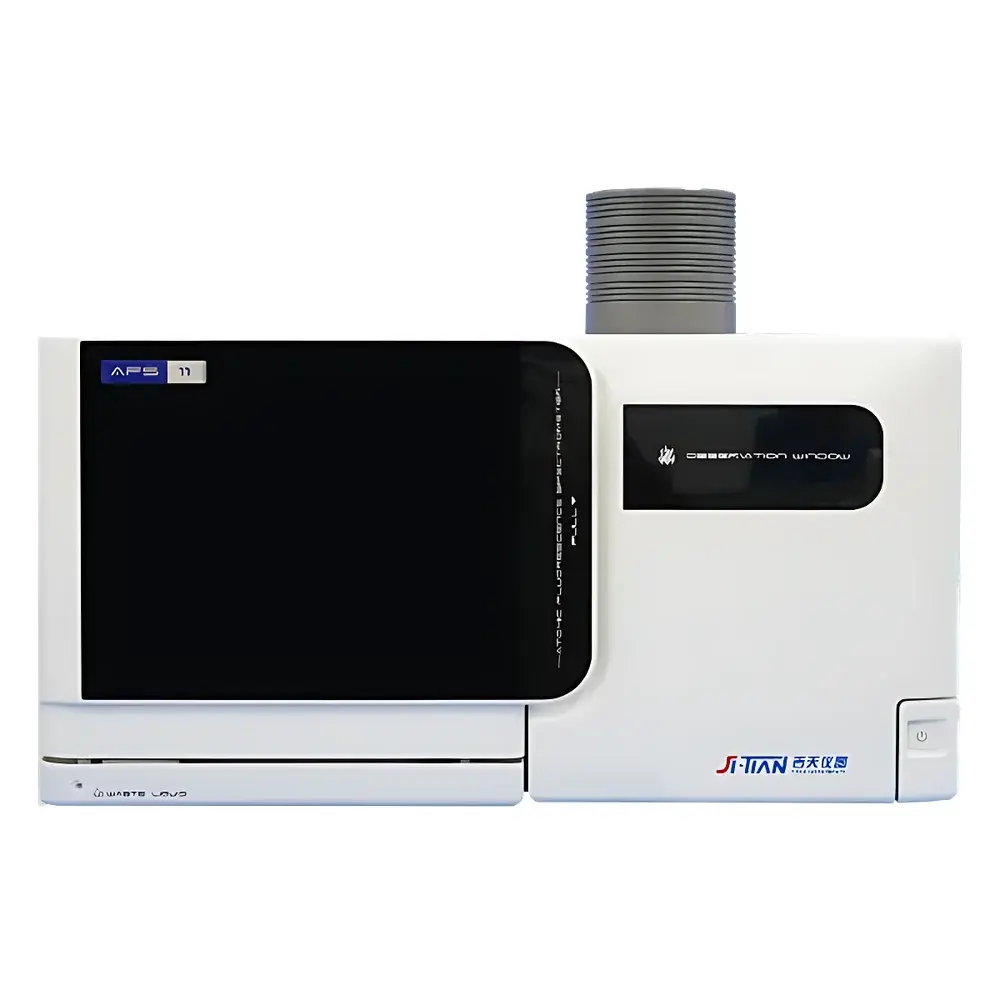
Titan Instruments AFS-11B Sequential Injection High-Precision Atomic Fluorescence Spectrometer
| Brand | Titan Instruments |
|---|---|
| Origin | Beijing, China |
| Manufacturer Type | Manufacturer |
| Instrument Type | Multi-channel Atomic Fluorescence Spectrometer |
| Sample Introduction | Dual Sequential Injection Pumps |
| Waste Disposal | Rear Exhaust Design |
| Sample Introduction Mode | Vapor Generation / Hydride Generation |
| Gas Flow Control | Valve Island System |
| Detectable Elements | As, Sb, Bi, Sn, Se, Te, Pb, Ge, Hg, Cd, Zn |
| Relative Standard Deviation (RSD) | <0.6% |
| Linear Dynamic Range | >3 orders of magnitude |
| Detection Limits | As, Sb, Se, Bi, Te, Hg, Sn, Pb < 0.01 µg/L |
| Photomultiplier Tube Wavelength Range | 160–320 nm |
| Atomizer Temperature Control Range | Programmable |
Overview
The Titan Instruments AFS-11B Sequential Injection High-Precision Atomic Fluorescence Spectrometer is a dedicated analytical platform engineered for trace-level quantification of hydride-forming and cold-vapor elements in complex environmental, food, clinical, and industrial matrices. It operates on the principle of atomic fluorescence spectroscopy (AFS), where analyte species—generated as volatile hydrides (e.g., AsH₃, SbH₃, SeH₂) or elemental vapor (e.g., Hg⁰)—are atomized in a quartz cell under controlled thermal conditions and excited by a high-intensity, element-specific hollow cathode lamp (HCL). The resulting fluorescence emission at characteristic wavelengths is collected orthogonally to minimize background scatter and measured with a low-noise photomultiplier tube (PMT) operating across 160–320 nm. The instrument’s sequential injection architecture enables precise metering of microliter-scale sample, carrier, and reductant volumes—eliminating pulsation, minimizing cross-contamination, and ensuring stoichiometric consistency in on-line chemical vapor generation. This design directly supports regulatory compliance with ISO/IEC 17025 method validation requirements and delivers the reproducibility and robustness demanded in accredited laboratories.
Key Features
- Dual sequential injection pump system with micro-liter precision and real-time flow compensation, achieving instrumental repeatability better than 0.05% RSD.
- Integrated valve island gas control architecture for stable, pulse-free carrier gas delivery and precise timing of hydride generation reactions.
- Programmable atomizer temperature control with closed-loop feedback, enabling optimization of atomization efficiency across multi-element analyses.
- ARM + FPGA dual-core main controller with distributed MCU modules for lamp power, pump actuation, PMT gain, and temperature regulation—ensuring deterministic timing and electromagnetic immunity.
- Automatic lamp ignition and identification logic supporting dual-channel simultaneous excitation; intelligent lamp alignment via optional eccentricity-compensating lamp holder.
- On-board drift correction algorithm (soft calibration) and Quality Control Protocol (QCP) module for real-time signal stabilization and automatic recalibration during extended runs.
- Night-mode scheduling with auto-wake preheat, furnace current monitoring for filament health diagnostics, and overflow-sensing waste reservoir (optional upgrade).
Sample Compatibility & Compliance
The AFS-11B is validated for use with acid-digested, microwave-assisted, or leached samples prepared according to standardized protocols including EPA Method 200.9, ISO 17294-2:2016, and GB/T 22105–2008. Its hydride generation interface accommodates aqueous extracts from soils, sediments, biological tissues, food composites, and wastewater matrices. The system meets functional requirements for routine analysis under GB 5009.11–2014 (total and inorganic arsenic in food), GB 5009.17–2021 (mercury speciation readiness), HJ 694–2014 (water), HJ 1133–2020 (ambient particulate matter), and HJ 702–2014 (solid waste). All hardware and firmware components are designed to support GLP/GMP-aligned workflows, including full audit trail logging, role-based user access control, electronic signature capability, and 21 CFR Part 11–compliant data integrity features when paired with the optional certified software package.
Software & Data Management
The Titan AFS Control Suite provides a modular, dockable GUI built on Qt framework, enabling real-time multi-channel spectral visualization, step-by-step method wizard guidance, and fully customizable reporting templates. Every analytical sequence—including standard curve generation, auto-dilution logic for over-range samples, QCP-triggered re-calibration, and spectral baseline correction—is logged with timestamped metadata and operator ID. Raw signal traces, integration parameters, lamp status logs, and pump pressure diagnostics are stored in HDF5 format for long-term archival and third-party statistical review. The software supports direct import of LIMS sample lists (CSV/XML), batch-wise result export (PDF, Excel, XML), and configurable pass/fail criteria per analyte based on regulatory thresholds. Optional add-ons include automated report watermarking, digital certificate signing, and secure cloud backup integration.
Applications
The AFS-11B serves as a primary quantification tool in national reference laboratories, municipal water quality centers, food safety testing facilities, and academic research groups focused on trace metal biogeochemistry. Routine applications include total arsenic and mercury screening in rice and seafood; selenium speciation readiness in dietary supplements; antimony and bismuth monitoring in PET plastic recycling streams; lead and cadmium verification in children’s toys and cosmetics; and mercury vapor assessment in clinical urine specimens. Its compatibility with microwave digestion systems (e.g., Milestone ETHOS UP, CEM MARS 6) and optional 160-/212-position autosamplers enables unattended overnight operation for high-throughput environmental monitoring programs. The instrument’s expandable architecture also supports future integration with HPLC separation modules for As(III)/As(V), MeHg/EtHg, and SeMet/SeCys analysis under ISO 17294-3 or USP /.
FAQ
What hydride-forming elements can the AFS-11B quantify with sub-part-per-trillion sensitivity?
The system achieves detection limits below 0.01 µg/L for As, Sb, Se, Bi, Te, Hg, Sn, and Pb when operated with optimized KBH₄ concentration, argon carrier flow, and quartz tube temperature settings.
Does the instrument support compliance with FDA 21 CFR Part 11 for electronic records?
Yes—when deployed with the Titan Certified Software Package (v4.2+), it provides full audit trail, electronic signatures, role-based permissions, and immutable raw data storage meeting Part 11 Annex 11 requirements.
Can the AFS-11B be upgraded for elemental speciation analysis?
Yes—the rear panel includes a dedicated RS-485 port and TTL trigger interface for seamless coupling with HPLC systems, enabling future deployment of As, Hg, and Se species separation protocols.
Is remote monitoring and diagnostic support available?
The embedded Ethernet interface supports SNMP-based network health polling, VNC-assisted technician remote access (with user consent), and automated firmware update notifications via secure TLS channel.
What maintenance intervals are recommended for the quartz atomizer and PMT detector?
Quartz tubes should be inspected after every 200–300 analyses and replaced if discoloration or cracking is observed; PMT gain calibration is advised quarterly or following lamp replacement, using NIST-traceable As standard solutions.




