
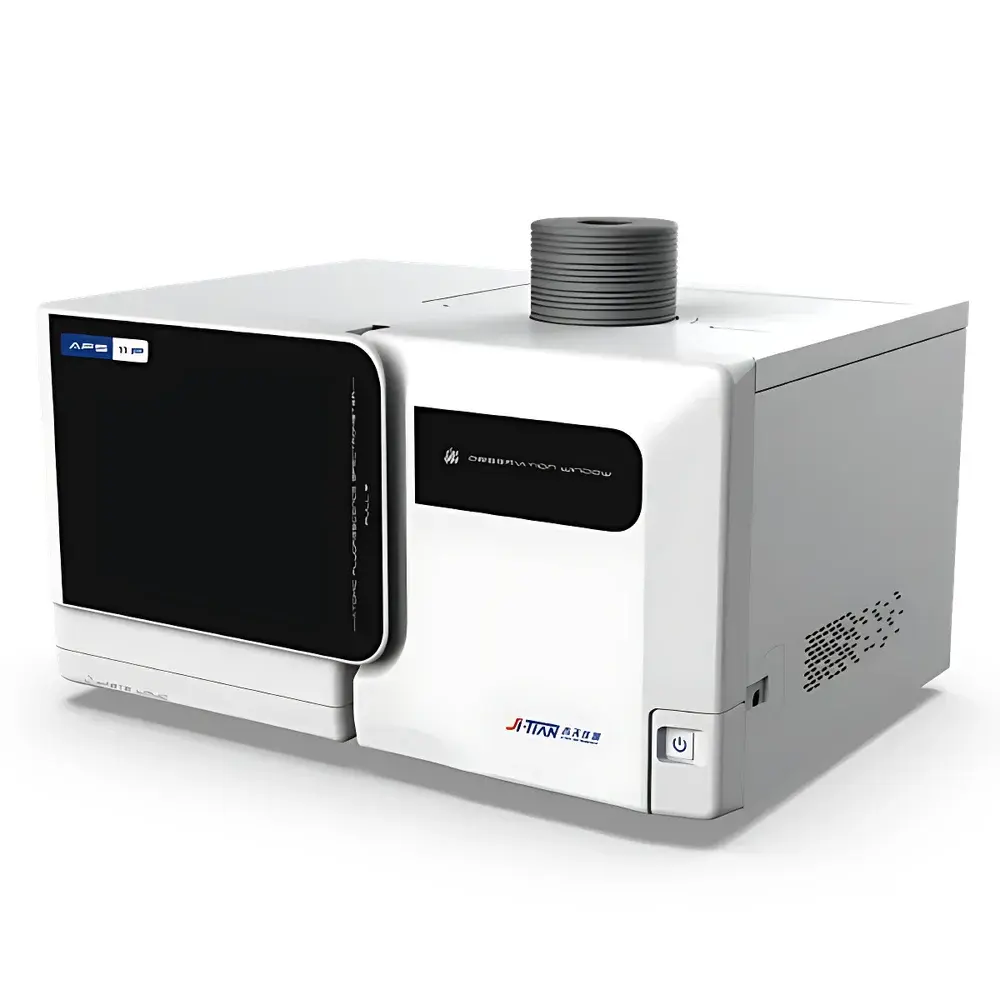
Titan Instruments AFS-11P Atomic Fluorescence Spectrometer
| Brand | Titan Instruments |
|---|---|
| Origin | Beijing, China |
| Manufacturer Type | Authorized Distributor |
| Country of Origin | China |
| Model | AFS-11P |
| Pricing | Available Upon Request |
Overview
The Titan Instruments AFS-11P Atomic Fluorescence Spectrometer is a high-performance, multi-channel hydride-generation atomic fluorescence instrument engineered for trace-level quantification of hydride-forming elements—including arsenic (As), mercury (Hg), selenium (Se), antimony (Sb), bismuth (Bi), tellurium (Te), lead (Pb), tin (Sn), and cadmium (Cd)—in complex aqueous matrices. Based on the principle of atomic fluorescence spectroscopy (AFS), the system atomizes analyte species via quartz-trap electrothermal or flame-assisted hydride generation, followed by excitation using element-specific hollow cathode lamps (HCLs) and highly sensitive detection of characteristic fluorescent emission at defined wavelengths. The AFS-11P implements dual-channel simultaneous measurement architecture with independent optical paths, enabling true concurrent analysis of two elements—such as As and Hg—without spectral interference or time multiplexing delay. Its design prioritizes long-term signal stability, low baseline drift, and robust reproducibility under routine laboratory conditions typical of environmental monitoring labs, food safety QA/QC facilities, and regulatory testing centers.
Key Features
- Dual sequential injection system with synchronized delivery of sample, carrier solution, and reducing agent (e.g., NaBH₄), ensuring precise stoichiometric control and minimizing reagent consumption and bubble formation.
- Integrated pneumatic manifold with pressure-regulated gas flow control, optimized for consistent hydride generation efficiency and reduced memory effect across repeated injections.
- Dedicated mercury drift compensation module: real-time background correction algorithm coupled with periodic internal standardization to maintain <±1.5% RSD for Hg over 8-hour continuous operation.
- Modular six-roller peristaltic pump with compact pump head and uniform compression block design—enables simultaneous replenishment of carrier stream during aspiration, eliminating flow interruption and enhancing baseline stability.
- Auto-ignition HCL power supply with intelligent lamp recognition and dual-lamp preheating; supports rapid warm-up (<90 s) and automatic alignment verification via eccentricity-compensating lamp holder with infinite rotational adjustment.
- Night-mode operation protocol: scheduled shutdown with thermal stabilization hold, followed by timed wake-up and automated pre-heating sequence prior to next analytical run—reducing operator dependency and improving inter-day repeatability.
- Real-time tungsten coil current monitoring to assess quartz furnace integrity and trigger predictive maintenance alerts before performance degradation occurs.
Sample Compatibility & Compliance
The AFS-11P accepts liquid samples prepared according to standard EPA Method 7062, ISO 17892-11, and GB/T 22105.2–2008 protocols, including acid-digested environmental solids (soils, sediments), filtered aqueous extracts (wastewater, drinking water), biological digests (tissues, blood), and food homogenates. It complies with GLP requirements through built-in audit trail functionality, electronic signature support, and role-based user access control (administrator, analyst, reviewer). Data integrity adheres to FDA 21 CFR Part 11 principles where enabled via optional software configuration—supporting secure electronic records, immutable timestamps, and change history logging for all method parameters and raw signal files.
Software & Data Management
Titan’s proprietary AFS Control Suite v4.2 provides a fully customizable workflow interface with drag-and-drop method builder, real-time dual-channel fluorescence intensity plotting, and overlayable calibration curve visualization. It includes guided setup wizards for method development, QC checkpoint enforcement (e.g., QCP pass/fail thresholds), and automated report generation compliant with ISO/IEC 17025 documentation standards. All raw data are stored in vendor-neutral .csv and .afsd binary formats, supporting third-party statistical analysis tools. Audit trails record every user action—including parameter edits, calibration updates, and result approvals—with tamper-evident hashing. Sample metadata import/export supports LIMS integration via ODBC and HL7-compatible batch upload.
Applications
The AFS-11P delivers validated performance across regulated and research-driven applications: monitoring total and inorganic As in rice and infant cereals per EU Commission Regulation (EU) No 2023/915; quantifying ultra-trace Hg in fish tissue and seawater per EPA 1631E; speciation-ready analysis of Se(IV)/Se(VI) in dietary supplements following ICH Q5C guidelines; routine screening of Pb and Cd in cosmetics per ASEAN Cosmetic Directive Annex II; and academic studies involving bioaccumulation kinetics in plant-soil systems. Its modular architecture allows seamless integration into centralized QA laboratories performing multi-element compliance testing for ISO 22000, HACCP, and USP / heavy metal limits.
FAQ
Does the AFS-11P support hyphenated speciation analysis?
Yes—the instrument features a dedicated RS-232 port and timing synchronization interface compatible with HPLC systems for As/Hg/Se species separation; optional firmware upgrade enables peak integration and valence-specific quantification.
What is the typical detection limit for mercury in ultrapure water?
Under optimized hydride generation and quartz-trap atomization conditions, the 3σ blank-based LOD is ≤0.003 µg/L (3 ng/L) for Hg, verified per ISO 11929 uncertainty framework.
Can the system be operated remotely via network connection?
Yes—Ethernet-enabled remote monitoring and method execution are supported through secure TLS-encrypted web interface; full control requires local administrator credentials.
Is the software compliant with 21 CFR Part 11 out-of-the-box?
Basic electronic signature and audit trail functions are embedded; full Part 11 compliance requires configuration validation and organizational SOP alignment, which Titan supports via IQ/OQ documentation packages.
What maintenance intervals are recommended for the quartz trap and gas–liquid separator?
Quartz traps should be inspected after every 200 injections and cleaned ultrasonically in 10% HNO₃; gas–liquid separators require weekly rinsing with deionized water and quarterly replacement of PTFE membranes.
Related Products






