
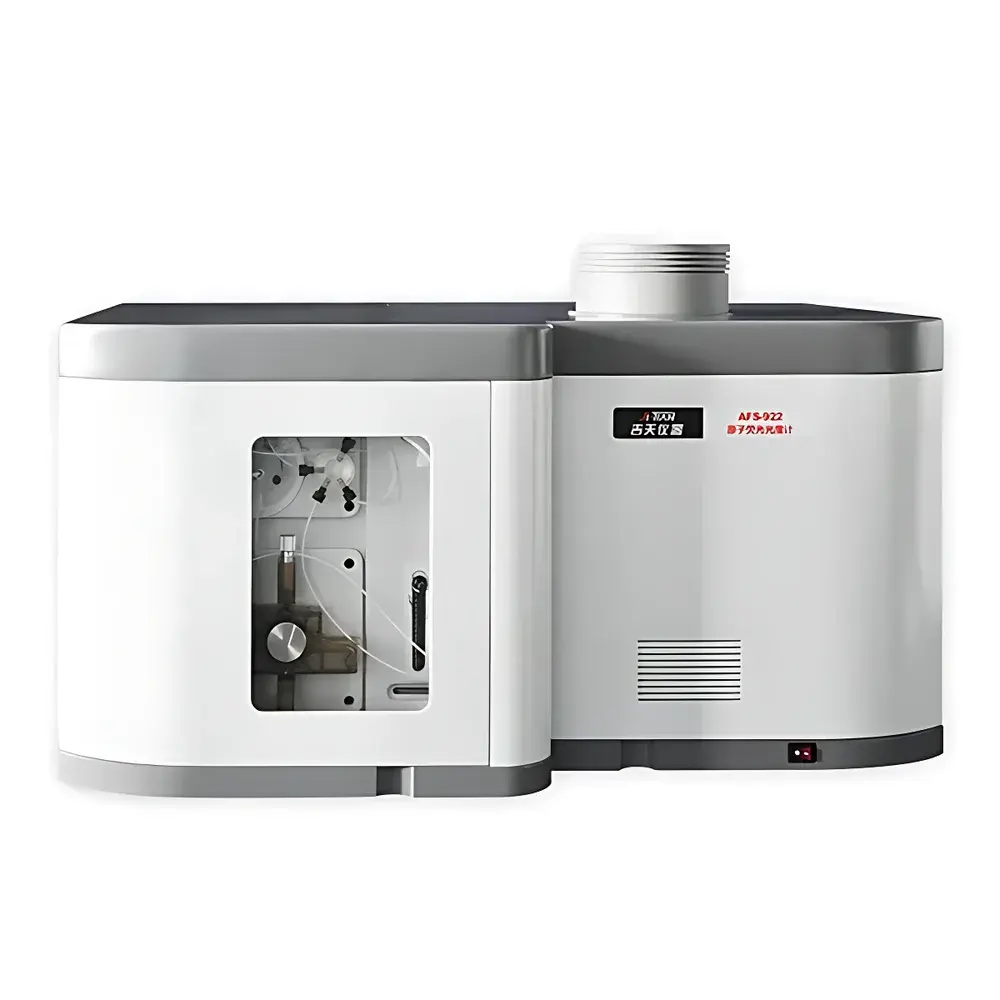
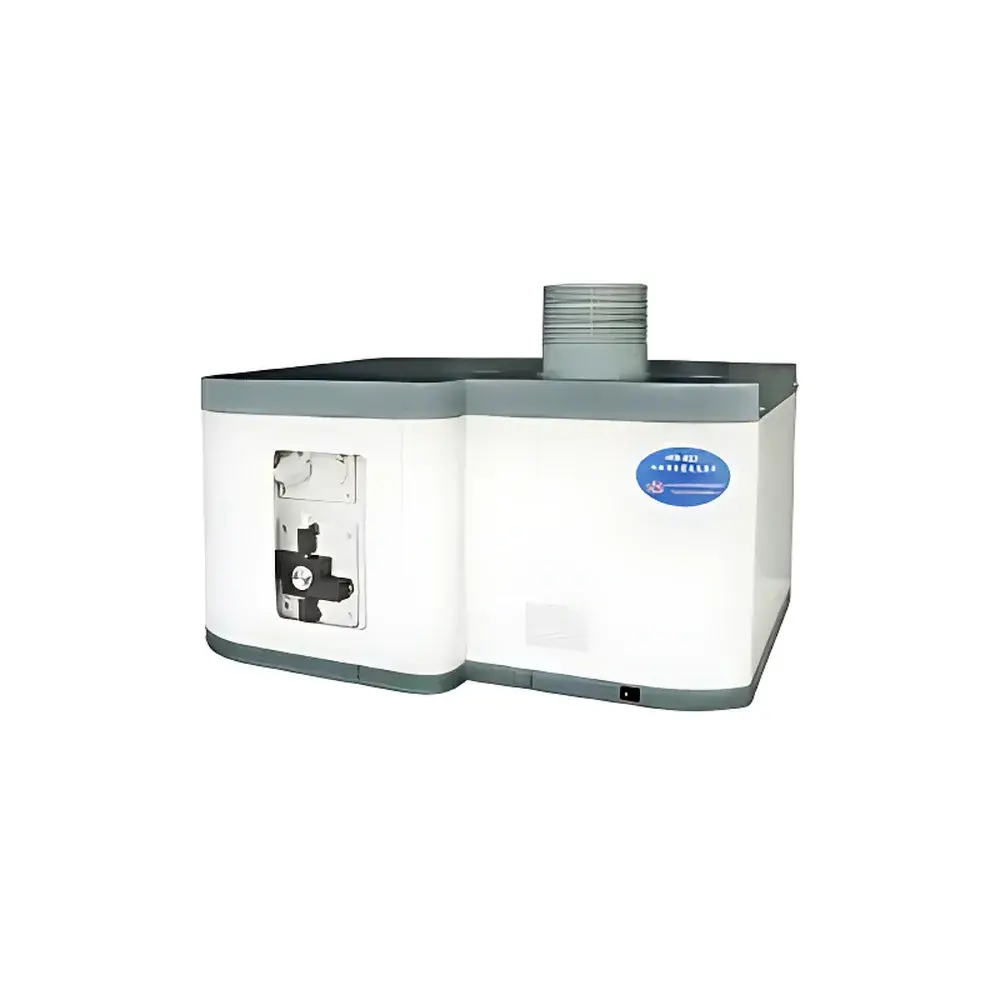
Titan Instruments AFS-922 Dual-Sequential-Injection Atomic Fluorescence Spectrometer
| Brand | Titan Instruments |
|---|---|
| Origin | Beijing, China |
| Manufacturer Type | Original Equipment Manufacturer (OEM) |
| Instrument Type | Multi-channel Atomic Fluorescence Spectrometer |
| Sample Introduction | Dual Sequential Injection Pump |
| Waste Liquid Disposal | Peristaltic Pump Extraction |
| Sample Introduction Mode | Vapor Generation / Hydride Generation |
| Gas Flow Control | Valve Island System |
| Detectable Elements | As, Se, Bi, Hg, Te, Sn, Ge, Pb, Zn, Cd, Au |
| Relative Standard Deviation (RSD) | <1% |
| Linear Dynamic Range | >3 orders of magnitude |
| Detection Limits | As, Se, Pb, Bi, Sb, Te, Sn: <0.01 µg/L |
| Hg, Cd | <0.001 µg/L |
| Ge | <0.05 µg/L |
| Zn | <1.0 µg/L |
| Au | <3.0 µg/L |
| Photomultiplier Tube Wavelength Range | 160–320 nm |
| Atomizer Temperature Control Range | Ambient to 1,000 °C (programmable) |
Overview
The Titan Instruments AFS-922 Dual-Sequential-Injection Atomic Fluorescence Spectrometer is an engineered solution for ultra-trace elemental analysis based on hydride generation–atomic fluorescence spectroscopy (HG-AFS). It operates on the principle of vapor-phase atomization followed by selective excitation of ground-state atoms using element-specific hollow cathode lamps, with subsequent measurement of isotropic atomic fluorescence emission at characteristic wavelengths. Designed for regulatory-compliant quantification in demanding analytical environments, the AFS-922 delivers high sensitivity, low background noise, and exceptional reproducibility—particularly for Group V and VI elements that form volatile hydrides (e.g., As, Se, Sb, Bi, Te, Sn, Pb) and cold-vapor elements (Hg, Cd, Au). Its dual-channel architecture enables simultaneous, independent quantification of two analytes within a single run, significantly improving throughput without cross-channel interference.
Key Features
- Dual sequential injection pump system ensures precise, pulse-free liquid delivery with sub-microliter volumetric accuracy—eliminating carryover and drift associated with conventional peristaltic pumping.
- Integrated valve island gas control module provides stable, programmable Ar–H₂ flame ignition and maintenance at optimized stoichiometric ratios, enabling reliable low-temperature flame initiation and sustained atomization.
- Shielded quartz tube atomizer with active temperature regulation (ambient to 1,000 °C) ensures consistent atom cloud geometry and minimizes diffusion losses for improved signal stability.
- Concentric beam path design with fused-silica optical windows supports both real-time flame observation and fully sealed operation—meeting laboratory safety requirements while preserving detection integrity.
- Multi-pulse lamp power supply extends hollow cathode lamp lifetime by >40% and enhances signal-to-noise ratio through synchronized excitation timing and reduced thermal broadening.
- On-line gas–liquid separator with integrated KBH₄ bubble removal technology prevents aerosol instability and flow interruption during hydride generation.
- Exhaust scrubbing module with activated carbon–impregnated capture trap removes residual As, Hg, and Se vapors from exhaust streams, ensuring compliance with occupational health and environmental ventilation standards.
Sample Compatibility & Compliance
The AFS-922 accommodates aqueous digests (microwave- or hot-block–assisted), filtered environmental waters, acid-extracted soils/sediments, and diluted biological matrices (urine, serum, tissue homogenates). It supports direct solid/liquid mercury and cadmium analysis via optional cold-vapor direct-injection module—bypassing digestion where appropriate. The instrument meets method validation criteria outlined in ISO/IEC 17025:2017 for testing laboratories and aligns with performance specifications in key regulatory methods including GB 5009.11–2014, GB 5009.17–2014, HJ 694–2014, HJ 702–2014, and EPA Method 7060A (As) and 7061A (Hg). Its hardware architecture and software audit trail functionality support GLP and GMP environments requiring 21 CFR Part 11–compliant data handling.
Software & Data Management
Titan AFS Control Suite v4.x is a bilingual (English/Chinese), Windows-based platform offering full instrument control, method development, and quantitative reporting. It features automated system diagnostics—including lamp energy monitoring, gas pressure verification, and pump stroke calibration—and supports multi-point calibration with up to 10 blank and 10 standard reference material (SRM) corrections per sequence. The software implements weighted linear regression, standard addition, and internal standard correction algorithms. All raw spectra, peak integration parameters, and user actions are timestamped and logged with immutable audit trails. Export formats include CSV, PDF, and XML; graphical overlays and report templates comply with ISO/IEC 17025 documentation requirements. Optional LIMS integration is supported via RS-232/485 serial protocols.
Applications
The AFS-922 serves routine and research applications across food safety (inorganic As in rice, Hg in fish), environmental monitoring (Hg in air particulates per HJ 542–2010; As/Se in groundwater), clinical toxicology (Urinary Cd, blood Hg), geochemical surveying (total As/Pb in soils per GB/T 22105–2008), pharmaceutical quality control (catalyst residue screening), and agricultural testing (heavy metals in fertilizers and feed). Its trace-level sensitivity and robust hydride generation make it especially suitable for compliance testing against WHO, EU Commission Regulation (EC) No. 1881/2006, and China’s GB 2762–2022 limits.
FAQ
What sample preparation methods are recommended prior to AFS-922 analysis?
Acid digestion (HNO₃–HCl or microwave-assisted HNO₃–H₂O₂) is required for solid matrices; aqueous samples may be filtered (0.45 µm) and preserved with HNO₃ to pH <2.
Can the AFS-922 quantify selenium and arsenic simultaneously?
Yes—using dual-channel mode with independent lamp excitation and wavelength selection, provided their hydride generation conditions (acid concentration, reductant flow) are compatible within a single protocol.
Is method validation support included with the instrument?
Yes—the software includes built-in tools for limit of detection (LOD), limit of quantification (LOQ), recovery assessment, and intermediate precision evaluation per ICH Q2(R2) guidelines.
How does the dual sequential injection system improve long-term stability?
By eliminating mechanical wear from rollers and tubing compression, it reduces flow variability and maintains volumetric accuracy over >10,000 injections without recalibration.
What safety certifications apply to the AFS-922 exhaust management system?
The integrated capture trap complies with OSHA 29 CFR 1910.1200 (Hazard Communication) and local institutional biosafety office requirements for mercury vapor containment.






