
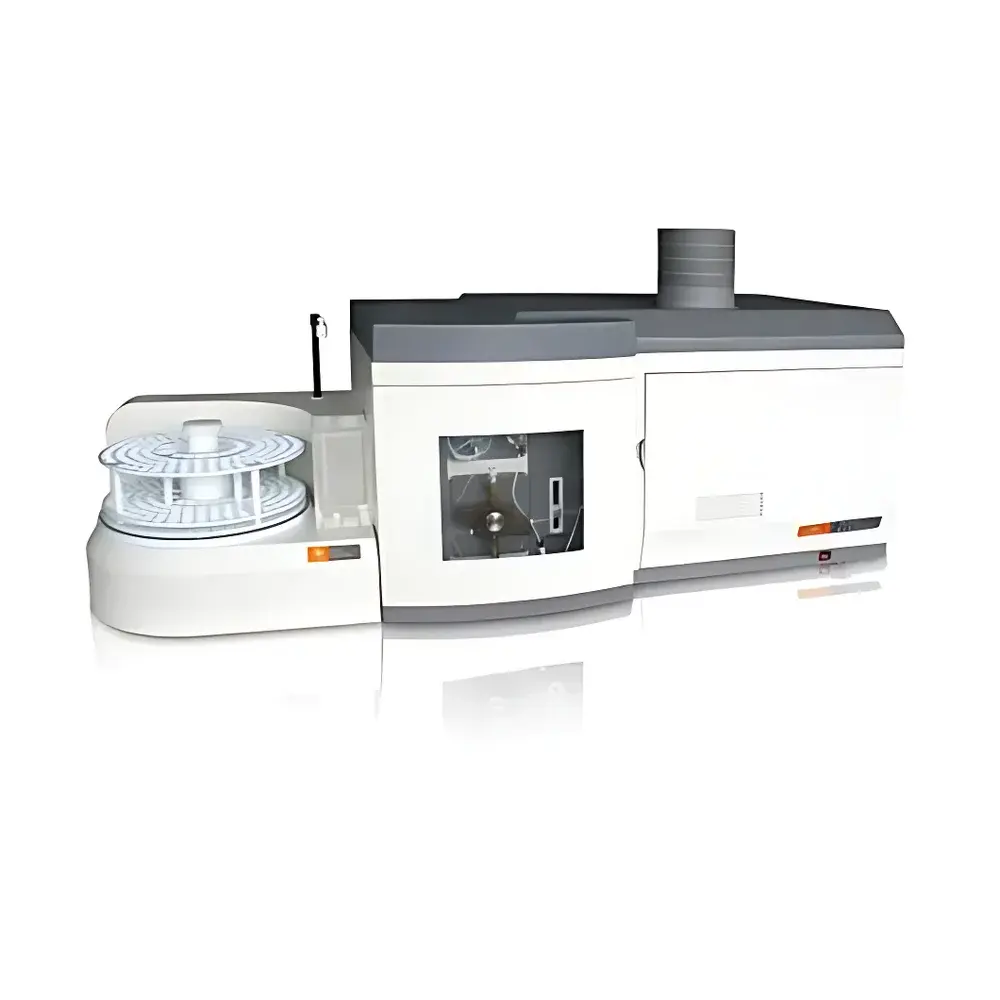
Titan Instruments AFS-9320/AFS-9330 Fully Automated Six-Lamp-Position Dual Sequential Injection Atomic Fluorescence Spectrometer
| Brand | Titan Instruments |
|---|---|
| Origin | Beijing, China |
| Model | AFS-9320 |
| Instrument Type | Multi-channel Atomic Fluorescence Spectrometer |
| Sample Introduction | Dual sequential injection pump |
| Waste Liquid Disposal | Peristaltic pump aspiration |
| Hydride Generation Mode | Vapor generation / hydride generation |
| Gas Flow Control | Mass flow controller |
| Detectable Elements | As, Se, Bi, Hg, Te, Sn, Ge, Pb, Zn, Cd, Au |
| RSD | < 0.8% |
| Linear Dynamic Range | > 3 orders of magnitude |
| Detection Limits | As, Bi, Sb < 0.01 µg/L |
Overview
The Titan Instruments AFS-9320 and AFS-9330 are fully automated, six-lamp-position atomic fluorescence spectrometers engineered for high-sensitivity, multi-element trace metal analysis in environmental, food safety, clinical, pharmaceutical, and geological laboratories. These instruments operate on the principle of atomic fluorescence spectroscopy (AFS), where analyte elements—converted to volatile hydride species or cold vapor—are atomized in an argon-hydrogen flame and excited by a high-intensity, element-specific hollow cathode lamp. The resulting fluorescence emission is detected by a solar-blind photomultiplier tube (PMT), optimized for UV spectral response (160–320 nm), minimizing interference from ambient visible light. Designed for compliance with international regulatory frameworks—including ISO/IEC 17025, USP /, and EPA Method 7063—the AFS-9320/9330 delivers robust performance across routine QC/QA workflows and method validation studies requiring sub-part-per-trillion detection capability.
Key Features
- Fully automated dual sequential injection system with precise volumetric control, ensuring reproducible sample/reagent delivery and long-term stability of injection volume over extended operation cycles.
- Six-position lamp turret with computer-controlled lamp selection, enabling rapid switching between As, Sb, Bi, Hg, Se, Te, Sn, Ge, Pb, Zn, Cd, and Au lamps without manual intervention.
- Mass flow controller-based gas regulation system providing continuous, programmable, and highly stable carrier gas (Ar) and shielding gas (Ar/H₂) flow—critical for flame stability and signal reproducibility.
- Dual-channel optical design (AFS-9330 only): simultaneous dual-element measurement using independent excitation paths and dual PMT detectors, with real-time source drift compensation to enhance baseline stability and measurement accuracy.
- Low-temperature, shielded quartz atomizer with double-layer furnace core, optimized for efficient atomization and reduced interferences from matrix volatilization.
- High-output, pulse-powered hollow cathode lamps employing short-pulse, high-current excitation—extending lamp lifetime while improving signal-to-noise ratio and peak intensity.
- Integrated chemical vapor generation (CVG) system with online bubble removal, automatic reagent addition (e.g., KBH₄, masking agents), and intelligent gas–liquid separation to minimize memory effects and carryover.
- Onboard hazardous vapor trapping module for post-measurement capture of residual As, Hg, and other toxic hydride vapors—supporting laboratory safety and OSHA-compliant exhaust handling.
Sample Compatibility & Compliance
The AFS-9320/9330 supports liquid samples following standard acid digestion (e.g., HNO₃/HCl microwave-assisted digestion per EPA 3052 or GB/T 22105-2008) and direct analysis of aqueous extracts, leachates, and digests. With optional direct mercury/cadmium analysis modules, solid and liquid matrices—including soils, tissues, and pharmaceuticals—can be measured without derivatization or pre-reduction. The system complies with multiple national and international standards, including GB 5009.11–2014 and GB 5009.17–2014 (China Food Safety Standards), HJ 694–2014 (water), HJ 542–2010 (ambient air), and HJ 702–2014 (solid waste). Its architecture supports GLP/GMP audit readiness through full electronic record retention, instrument state logging, and user-accessible audit trails—fully aligned with FDA 21 CFR Part 11 requirements when paired with compliant software configuration.
Software & Data Management
Equipped with Titan’s proprietary bilingual (English/Chinese) AFS Control Suite, the instrument provides comprehensive method development, calibration management, and report generation tools. Key capabilities include automatic system diagnostics, multi-point standard curve generation with single-standard dilution series, online sample dilution, dynamic background correction, and customizable reporting templates compliant with ISO 17025 Annex A5. The software supports up to 16 calibration curves simultaneously, enables data export in CSV, PDF, and XML formats, and includes embedded expert guidance—covering optimal lamp current settings, reagent concentrations, reaction delay times, and sample pretreatment protocols. All analytical sequences, parameter changes, and operator actions are time-stamped and logged, facilitating full traceability and regulatory review.
Applications
The AFS-9320/9330 is routinely deployed in accredited testing laboratories for quantification of regulated toxic elements at ultra-trace levels. Primary application domains include: (1) Environmental monitoring—As, Hg, and Sb in drinking water (EPA 1631), wastewater, sediments, and airborne particulates; (2) Food and agricultural testing—total inorganic arsenic in rice, methylmercury in seafood, and Cd in cereals per EU Commission Regulation (EU) No 488/2014; (3) Clinical and forensic toxicology—Hg and Se in whole blood or urine; (4) Pharmaceutical quality control—elemental impurities screening per ICH Q3D; (5) Geological and metallurgical research—trace Bi, Te, and Ge in ore concentrates and refinery streams. Optional hyphenated modules enable speciation analysis (e.g., As(III)/As(V), MMA/DMA, Se(IV)/Se(VI)) via coupling with HPLC or CE separation systems.
FAQ
What is the difference between the AFS-9320 and AFS-9330 models?
The AFS-9330 features dual-channel detection optics, enabling true simultaneous two-element analysis and integrated dual-PMT signal monitoring for enhanced stability. The AFS-9320 operates in sequential single-channel mode but shares identical automation, hydride generation, and atomization hardware.
Can the instrument measure mercury without cold vapor generation?
Yes—the AFS-9330 supports cold vapor atomic fluorescence (CV-AFS) for Hg using dedicated low-temperature vaporization, achieving sub-pg/mL detection limits without hydride chemistry.
Is method validation support included in the software?
Yes—the AFS Control Suite includes built-in tools for linearity assessment (r² ≥ 0.999), LOD/LOQ calculation per ICH Q2(R2), precision evaluation (RSD ≤ 0.8%), and recovery spike analysis with auto-generated validation reports.
Does the system comply with FDA 21 CFR Part 11 requirements?
When configured with password-protected user roles, electronic signatures, and immutable audit logs enabled, the software meets technical criteria for Part 11 compliance; full validation requires site-specific IQ/OQ/PQ documentation.
What maintenance is required for long-term operational reliability?
Routine maintenance includes quarterly quartz atomizer cleaning, biannual PMT voltage calibration, annual mass flow controller verification, and regular replacement of peristaltic pump tubing and hydride generation reagents—documented in the included Maintenance Scheduler module.
Related Products





