
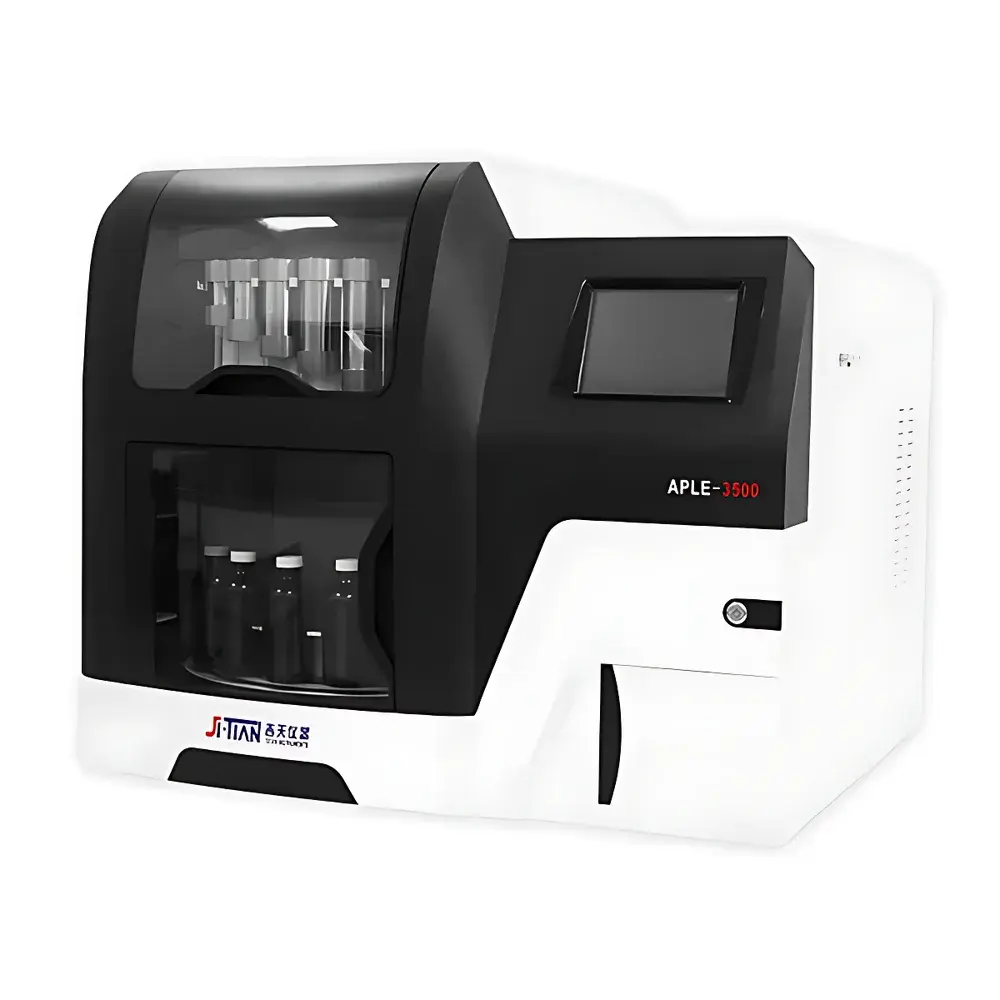
Titan Instruments APLE-3500 Accelerated Solvent Extractor
| Brand | Titan Instruments |
|---|---|
| Origin | Beijing, China |
| Manufacturer Type | Original Equipment Manufacturer (OEM) |
| Product Category | Domestic |
| Model | APLE-3500 |
| Instrument Type | Solid-Liquid Extraction System |
| Temperature Range | Ambient to 200 °C |
| Pressure Range | Atmospheric to 20 MPa |
| Extraction Cell Volumes | 1 mL, 5 mL, 11 mL, 22 mL, 34 mL, 66 mL, 100 mL |
| Extraction Cycle Time | 15–20 min per sample |
| Dimensions (W×D×H) | 86 cm × 76 cm × 73 cm |
| Sample Capacity | 26 positions (24 sample + 2 rinse positions) |
Overview
The Titan Instruments APLE-3500 Accelerated Solvent Extractor is a fully automated, high-pressure, high-temperature solid-liquid extraction system engineered for precision and reproducibility in environmental, food safety, and regulatory laboratories. It implements pressurized fluid extraction (PFE), also known as accelerated solvent extraction (ASE®-compatible methodology), wherein analytes are extracted from solid or semi-solid matrices using organic solvents at elevated temperatures (up to 200 °C) and pressures (up to 20 MPa). This thermodynamic environment enhances solubility, reduces surface tension, and accelerates mass transfer—enabling rapid, quantitative recovery of target analytes while minimizing thermal degradation. Unlike conventional Soxhlet extraction—which requires hours and large solvent volumes—the APLE-3500 achieves complete extractions in 15–20 minutes per sample with up to 90% less solvent consumption. Its design complies with the fundamental operational principles defined in U.S. EPA Method 3545A and aligns with multiple Chinese national standards (HJ and GB series) for multiresidue analysis of persistent organic pollutants.
Key Features
- Fully automated sequential processing of up to 24 samples unattended—ideal for overnight operation and high-throughput workflows.
- Modular, leak-resistant extraction cell architecture with seven standardized volumes (1–100 mL), facilitating method scalability from trace-level environmental monitoring to bulk food matrix analysis.
- High-integrity dual-piston solvent delivery pump with pulse-dampening technology ensures consistent flow rates, precise solvent metering, and extended component lifetime under sustained high-pressure conditions.
- 360° circumferential heating mantle provides uniform thermal distribution across the extraction cell, minimizing temperature gradients and ensuring accurate method transfer between instruments.
- Patented needle-guided cell insertion mechanism ensures repeatable alignment, eliminates solvent spray during cell pressurization, and reduces seal wear—lowering consumables cost and improving operational safety.
- Intuitive touchscreen interface with embedded control software supporting >100 pre-validated methods; real-time monitoring of pressure, temperature, solvent delivery volume, and cycle status with timestamped event logging.
Sample Compatibility & Compliance
The APLE-3500 is validated for heterogeneous solid and semi-solid matrices including soils, sediments, sludge, plant tissues, animal feed, cereals, dairy powders, and polymer composites. Its operational envelope meets the physical and chemical requirements specified in U.S. EPA Method 3545A for pressurized fluid extraction and is routinely deployed in laboratories performing analyses per HJ 805-2016 (PAHs), HJ 782/783-2016 (organic pollutants in solid waste and soil), HJ 834/835-2017 (SVOCs and organochlorine pesticides), and key GB standards including GB 23200.9-2016 (pesticide residues in grains), GB 5009.205-2013 (dioxins), GB 5009.6-2016 (fat determination), and GB/T 14553-2003 (organophosphorus pesticides). All hardware and firmware components support GLP-compliant data integrity protocols, including audit-trail-enabled user authentication, method version control, and electronic signature-ready reporting.
Software & Data Management
The APLE-3500 runs on Titan’s proprietary Extraction Control Suite (ECS v3.2), a Windows-based application compliant with FDA 21 CFR Part 11 requirements for electronic records and signatures. ECS supports method creation via guided wizards, batch scheduling with priority queuing, automatic calibration verification prompts, and export of structured CSV/Excel reports containing full metadata (operator ID, timestamp, cell ID, solvent lot, pressure/temperature profiles). Raw instrument logs are stored locally with optional network backup to secure NAS or LIMS-integrated servers. Audit trails record all user actions—including method edits, parameter overrides, and maintenance events—with immutable timestamps and operator attribution. Software updates are delivered via encrypted firmware packages with SHA-256 checksum validation.
Applications
- Environmental testing: extraction of PAHs, PCBs, dioxins/furans, organochlorine pesticides, and petroleum hydrocarbons from soil, sediment, and biota samples.
- Food safety compliance: multi-residue pesticide screening in grains, fruits, vegetables, and processed foods per GB and EU MRL regulations.
- Pharmaceutical and nutraceutical QC: lipid profiling, active ingredient isolation from botanical matrices, and residual solvent removal from excipients.
- Materials science: leaching studies of plasticizers, flame retardants, and additives from polymers and packaging materials.
- Forensic toxicology: recovery of drugs of abuse and metabolites from hair, tissue, and filter media prior to LC-MS/MS quantification.
FAQ
What solvents are compatible with the APLE-3500?
The system supports common organic solvents including hexane, acetone, dichloromethane, ethyl acetate, methanol, and mixtures thereof—provided they are chemically compatible with stainless steel (316 SS) and fluoropolymer (FFKM) wetted components and remain stable below 200 °C.
Does the APLE-3500 support method validation documentation?
Yes—Titan Instruments provides a comprehensive IQ/OQ documentation package, including installation checklists, operational qualification protocols, and performance verification test reports aligned with ISO/IEC 17025 and ASTM D7272-17 guidelines.
Can the APLE-3500 integrate with laboratory information management systems (LIMS)?
It supports standard ASCII-based data export (CSV, TXT) and optional OPC UA connectivity for bidirectional integration with major LIMS platforms, enabling automated sample ID ingestion and result auto-population.
Is preventive maintenance required, and how often?
Scheduled maintenance includes quarterly inspection of cell seals, annual calibration of pressure and temperature sensors, and biannual replacement of solvent inlet filters—documented in the included Maintenance Logbook and tracked via ECS service alerts.
What safety certifications does the APLE-3500 hold?
The instrument complies with IEC 61010-1:2010 for electrical safety, carries CE marking for EMC and Low Voltage Directive conformity, and meets UL 61010-1 requirements for North American deployment.



