
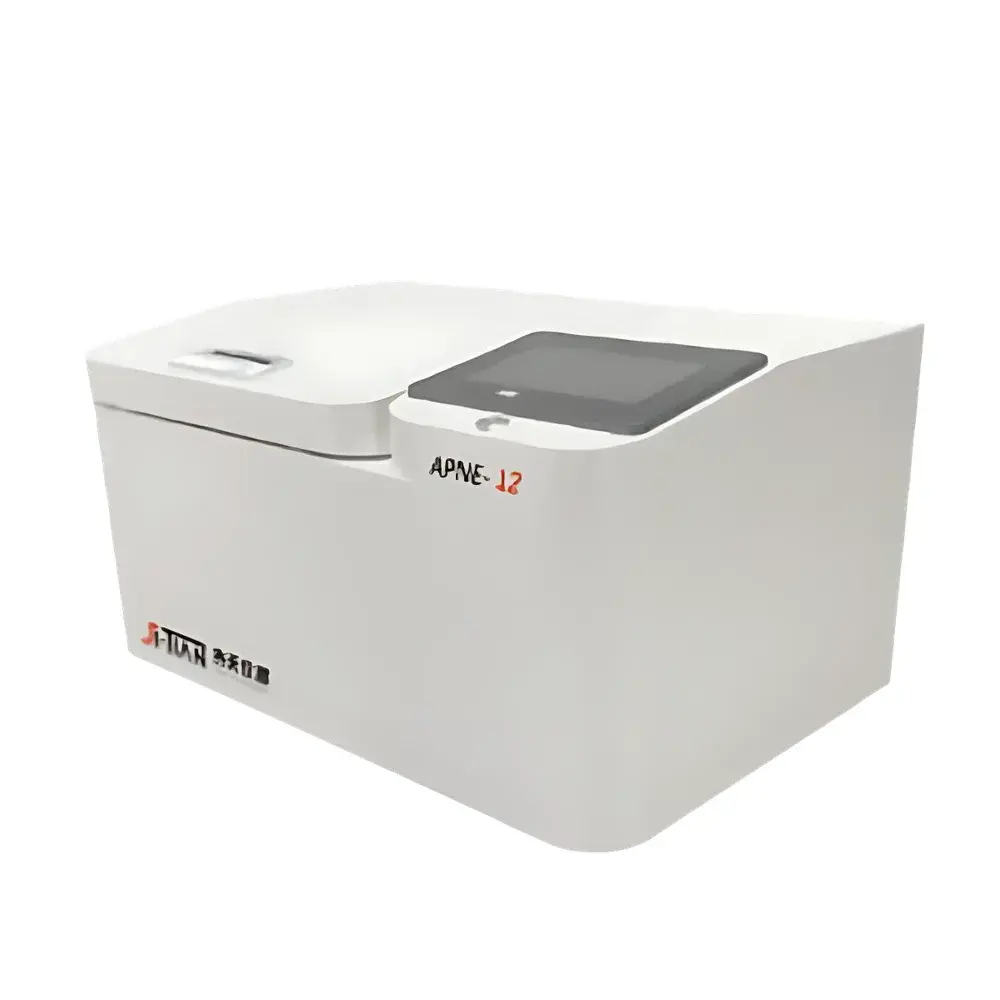
Titan Instruments APNE-12 Automated Parallel Nitrogen Evaporator
| Brand | Titan Instruments |
|---|---|
| Origin | Beijing, China |
| Manufacturer Type | Authorized Distributor |
| Country of Origin | China |
| Model | APNE-12 |
| Pricing | Available Upon Request |
Overview
The Titan Instruments APNE-12 Automated Parallel Nitrogen Evaporator is an engineered solution for high-throughput, reproducible sample concentration in analytical laboratories. Designed around the principle of controlled inert-gas (nitrogen) displacement under gentle thermal assistance, the system enables simultaneous evaporation of up to 12 samples without manual intervention. Unlike traditional open-bath or water-jacketed concentrators, the APNE-12 employs a dry-heating architecture with precisely regulated gas flow dynamics and optical endpoint detection—minimizing analyte degradation, oxidation risk, and solvent cross-contamination. It integrates seamlessly into standardized sample preparation workflows following liquid–liquid extraction (LLE), solid-phase extraction (SPE), or QuEChERS protocols, serving as a critical bridge between extraction and instrumental analysis (e.g., GC-MS, LC-MS/MS). Its operational philosophy aligns with Good Laboratory Practice (GLP) requirements by eliminating operator-dependent variables such as inconsistent needle positioning, variable gas pressure, or subjective endpoint judgment.
Key Features
- 12-channel parallel operation with independent pneumatic control per channel—enabling selective activation, staggered run initiation, and real-time pressure balancing across all gas lines.
- Dry-heating module constructed from aerospace-grade aluminum alloy—providing rapid thermal response, uniform heat distribution, and corrosion resistance; modular design supports interchangeable heating blocks for varying vial geometries (e.g., 10–15 mL conical, 4–6 mL round-bottom).
- Non-contact optical liquid-level sensing technology—each channel equipped with calibrated infrared sensors to detect meniscus position at pre-set endpoints (e.g., 0.5 mL, 1.0 mL, or dry-down), ensuring consistent final volume across replicates.
- Adjustable nitrogen needle orientation and laminar-flow nozzle design—optimized to direct gas tangentially across the solvent surface, accelerating evaporation while suppressing aerosol formation and splashing.
- Triple-mode operation: volume-based termination (auto-stop at target residual volume), time-based termination (programmable duration per channel), or hybrid mode combining both criteria for method flexibility.
- Sealed evaporator chamber with integrated active exhaust and internal hot-air recirculation—maintaining stable thermal environment, preventing ambient humidity ingress, and minimizing external lab nitrogen consumption.
- User-configurable endpoint detection height—allowing method-specific adaptation for volatile vs. semi-volatile analytes, viscous matrices (e.g., lipid-rich extracts), or low-surface-tension solvents (e.g., hexane, ethyl acetate).
Sample Compatibility & Compliance
The APNE-12 accommodates standard 10–15 mL glass test tubes, SPE collection tubes, and conical-bottom vials commonly used in environmental, food, pharmaceutical, and petrochemical laboratories. It is validated for use with common organic solvents including acetonitrile, methanol, dichloromethane, ethyl acetate, and hexane—compatible with ASTM D7067 (PAHs in soil), EPA Method 8270 (semivolatile organics), and ISO 17025-accredited workflows. While not intrinsically certified for GMP or FDA 21 CFR Part 11 compliance, its programmable method storage, audit-trail-capable event logging (via optional software integration), and deterministic endpoint logic support traceability requirements in regulated environments when deployed within documented SOPs.
Software & Data Management
The device operates via an embedded touchscreen interface supporting method creation, parameter saving (gas flow rate, temperature setpoint, endpoint volume, dwell time), and real-time status monitoring. Optional Ethernet or USB connectivity enables remote configuration and data export (CSV) of run logs—including start/stop timestamps, detected endpoint volumes per channel, and thermal profile summaries. When integrated with LIMS or ELN platforms, the APNE-12’s event-driven output facilitates automated workflow triggering (e.g., initiating GC injection upon completion signal). All settings are password-protected and version-controlled to meet basic data integrity expectations aligned with ALCOA+ principles.
Applications
- Environmental Analysis: Concentration of pesticide residues, PCBs, PAHs, and phthalates from soil, sediment, sludge, and wastewater extracts prior to GC or LC analysis.
- Food Safety Testing: Final volume adjustment of QuEChERS extracts from cereals, tea, meat, seafood, and dairy products—ensuring optimal sensitivity for multi-residue screening.
- Pharmaceutical & Nutraceutical QC: Sample cleanup and concentration steps in stability-indicating assays for vitamins, mycotoxins, and adulterants in dietary supplements and herbal preparations.
- Petrochemical & Polymer Analysis: Solvent removal from polymer dissolution samples or hydrocarbon fractionation eluates prior to FTIR or GPC characterization.
FAQ
What types of sample vessels are compatible with the APNE-12?
Standard 10–15 mL borosilicate glass test tubes and 4–6 mL conical vials with O-ring-sealed caps are supported; custom adapter plates can be ordered for alternative formats.
Does the system require external nitrogen supply regulation?
Yes—a clean, oil-free nitrogen source delivering 0.1–0.5 MPa is required; the instrument includes built-in pressure regulators and digital flow control per channel.
Can the APNE-12 be validated for ISO 17025 or GLP compliance?
While the hardware itself does not carry formal certification, its repeatable endpoint detection, method recall capability, and event logging support validation protocols when implemented with documented IQ/OQ/PQ procedures.
Is maintenance of the optical sensors required?
No routine calibration is needed; however, periodic inspection and cleaning of sensor windows with lint-free ethanol swabs are recommended to maintain detection accuracy.
How does the system prevent bumping or foaming during concentration?
Through precise control of gas velocity, optimized needle angle, and gradual temperature ramping—combined with endpoint-triggered shutdown before complete dryness.



