
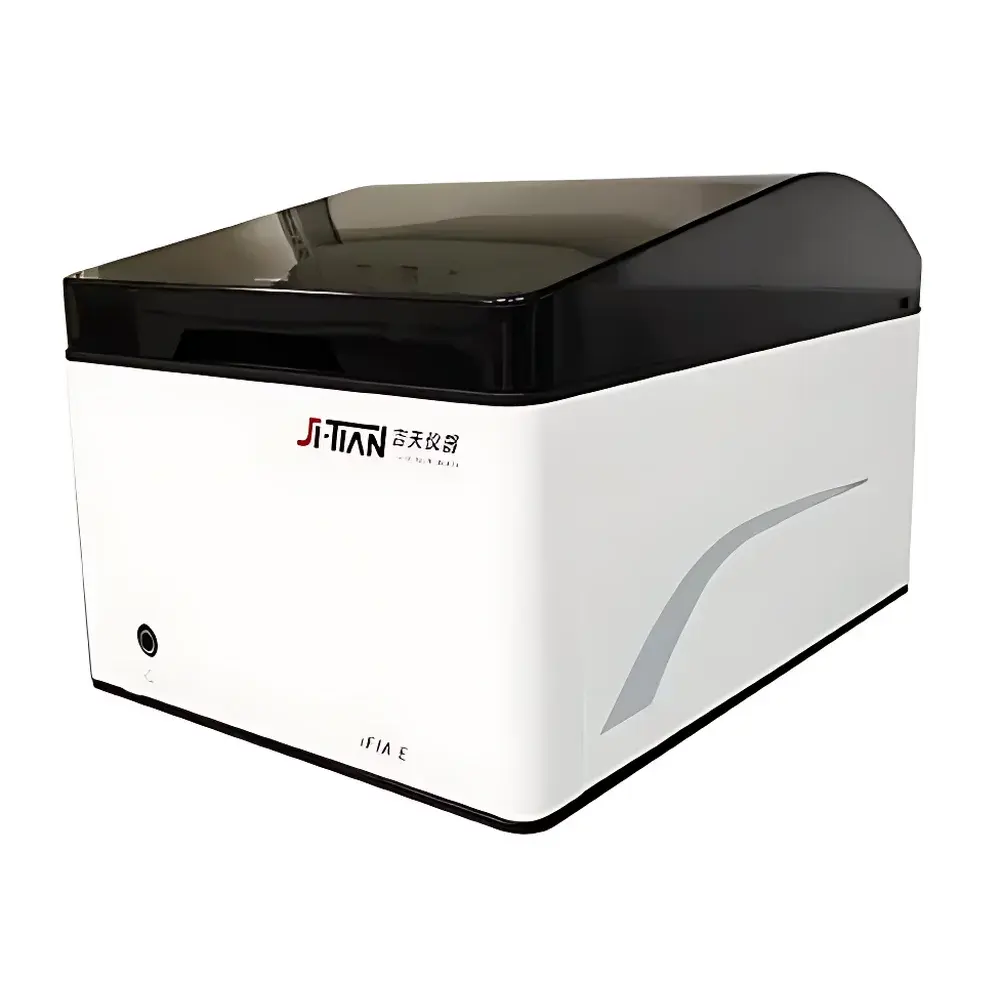
Titan Instruments iFIAE Fully Automated Multi-Parameter Flow Injection Analyzer
| Brand | Titan Instruments |
|---|---|
| Origin | Beijing, China |
| Manufacturer Type | Manufacturer |
| Product Category | Domestic |
| Model | iFIAE |
| Product Type | Flow Injection Analyzer |
| Wavelength Range | 340–1100 nm |
| Sample Volume Capacity | 10–50 mL per vial |
| Sample Tray Capacity | 50–300 positions |
| Reagent Positions | 12 |
| Flow Cell Path Length | 10 mm |
| Light Source | Tungsten Halogen Lamp |
Overview
The Titan Instruments iFIAE Fully Automated Multi-Parameter Flow Injection Analyzer is an integrated analytical platform engineered for high-throughput, trace-level quantification of inorganic and organic analytes in liquid matrices using standardized flow injection analysis (FIA) methodology. Based on the principles of controlled dispersion, reproducible zone formation, and precise timing of reagent mixing within microbore PTFE tubing networks, the iFIAE system enables robust, low-carrier-consumption determinations without manual sample pretreatment or offline derivatization. Its architecture adheres to core FIA design tenets—including segmented flow, programmable injection timing, and kinetic-based detection—making it suitable for routine compliance monitoring in regulated environmental and public health laboratories. The system operates under ISO/IEC 17025-aligned workflows and supports method validation per EPA Methods 353.2, 354.1, and ASTM D6508 for nutrient and contaminant speciation in water.
Key Features
- Pressure-tunable peristaltic pump with integrated compression block: delivers stable, pulse-free fluid propulsion across extended run times (≥24 h), minimizing baseline drift and improving inter-run reproducibility (RSD < 1.5% for repeated NH₄⁺ injections).
- Onboard temperature-controlled reaction modules: digital PID-controlled heating, distillation, UV photolysis, and cooling units are fully embedded within the instrument chassis—eliminating external thermal interference and ensuring consistent reaction kinetics across ambient fluctuations.
- PTFE membrane-based phase separation module: enables efficient in-line liquid–liquid extraction and steam distillation without carryover or memory effects; validated for cyanide and phenol recovery >98.2% at sub-µg/L levels.
- High-precision thermoelectric condenser: compact semiconductor-based cooling unit maintains condensate temperature stability within ±0.3 °C, critical for volatile analyte retention during distillation steps.
- Dual-beam spectrophotometric detector: equipped with a tungsten-halogen broadband source and optimized optics covering 340–1100 nm, supporting multi-wavelength absorbance measurements (e.g., 500 nm for phenol, 630 nm for phosphate, 420 nm for nitrite) with 10-mm fixed-pathlength flow cell.
Sample Compatibility & Compliance
The iFIAE accommodates aqueous samples from diverse sources including drinking water, wastewater, surface water, seawater, soil leachates, and plant digests—with minimal matrix interference due to built-in filtration, dilution, and matrix-matching protocols. It complies with international regulatory frameworks including EPA SW-846 Method 9056A (cyanide), ISO 6776 (ammonia), ISO 6878 (phosphate), and ISO 11905-1 (total nitrogen). All analytical sequences support full audit trail generation, electronic signature capability, and data integrity controls aligned with FDA 21 CFR Part 11 requirements when operated with compliant LIMS integration.
Software & Data Management
Controlled via TitanFlow™ v4.x software, the iFIAE provides intuitive method development tools, real-time chromatogram visualization, automated calibration curve fitting (linear, quadratic, or weighted regression), and batch processing with QC flagging (e.g., bracketing standards, duplicate spikes, blank thresholds). Raw spectral and temporal data are stored in vendor-neutral .csv and .xml formats. Software supports GLP/GMP-compliant reporting with configurable templates meeting ISO/IEC 17025 clause 7.8 documentation requirements, including analyst ID, instrument ID, environmental conditions, and reagent lot traceability.
Applications
- Water quality monitoring: simultaneous determination of NH₄⁺, NO₂⁻, NO₃⁻, PO₄³⁻, total phosphorus, total nitrogen, COD (via permanganate index), sulfide, phenol, total cyanide, anionic surfactants (MBAS), Cr(VI), boron, formaldehyde, and urea.
- Environmental solid-phase analysis: extract-based quantification of ammonium-N, nitrate-N, Kjeldahl-N, available phosphorus, Al³⁺, and boron in soils and plant tissues following EPA 3050B or ISO 11466 digestion protocols.
- Food and agricultural testing: screening of nitrate in vegetables, phosphate in dairy effluents, and sulfite residues in beverages using validated FIA adaptations.
FAQ
What regulatory methods are pre-validated on the iFIAE platform?
The system includes factory-loaded method templates aligned with EPA 353.2 (nitrate/nitrite), EPA 354.1 (phosphate), ISO 6776 (ammonia), and ISO 11905-1 (total nitrogen), all verified through third-party interlaboratory studies.
Can the iFIAE be integrated into an existing LIMS environment?
Yes—via ASTM E1467-compliant ODBC drivers and secure RESTful API endpoints supporting HL7 and ASTM E1384 message structures for bidirectional sample queue and result transfer.
Is UV digestion capability included as standard or optional?
UV photolysis module is fully integrated and standard across all iFIAE configurations, operating at 254 nm with adjustable exposure time (0–300 s) and quartz flow-through reactor geometry.
What maintenance intervals are recommended for the peristaltic pump tubing?
Titan recommends tubing replacement every 500 operational hours or after 10,000 injections—whichever occurs first—using certified PTFE-reinforced silicone tubing supplied under part number TUB-iFIAE-12.





