
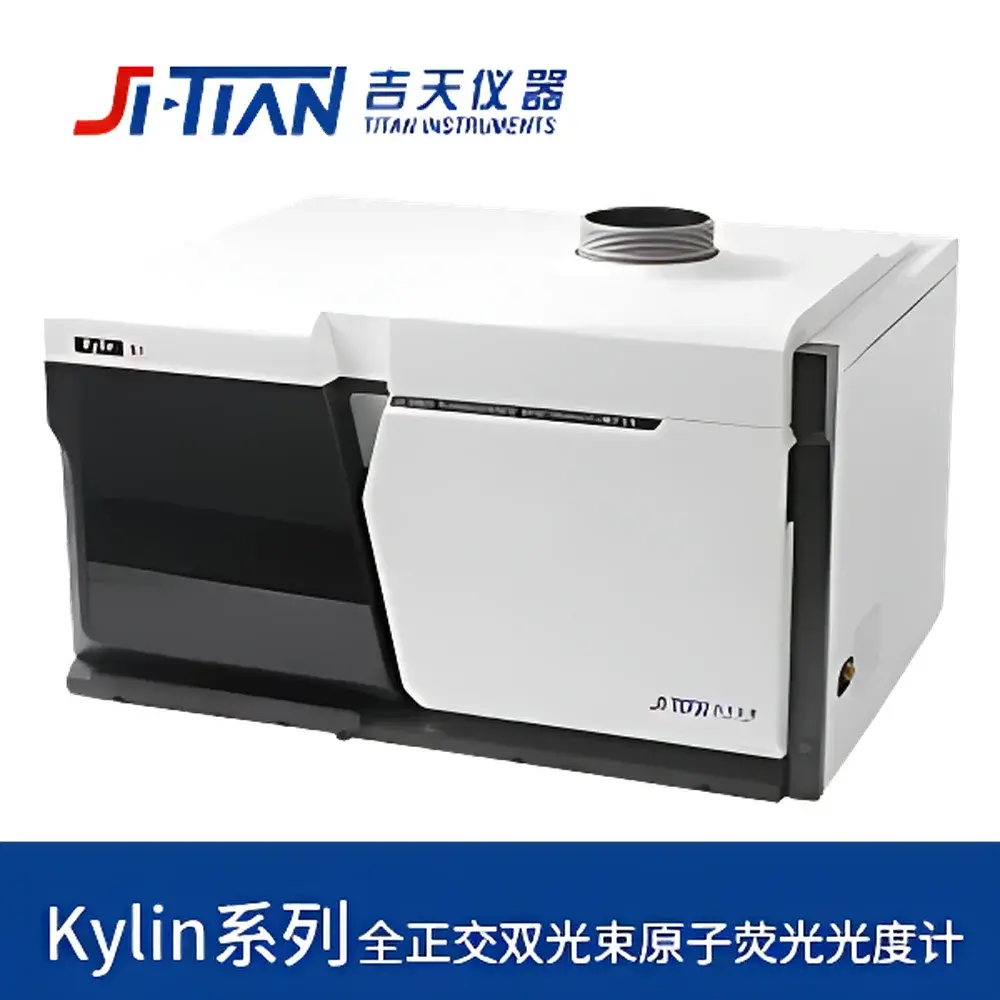
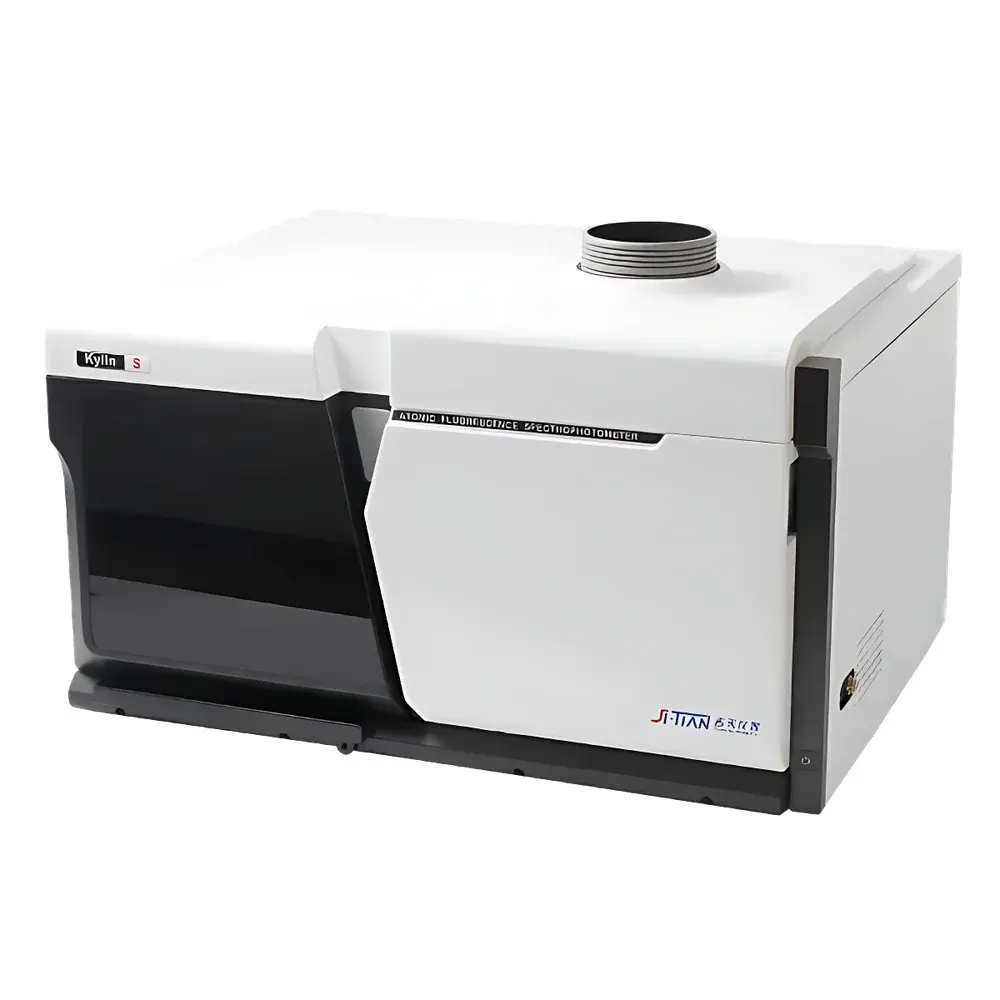
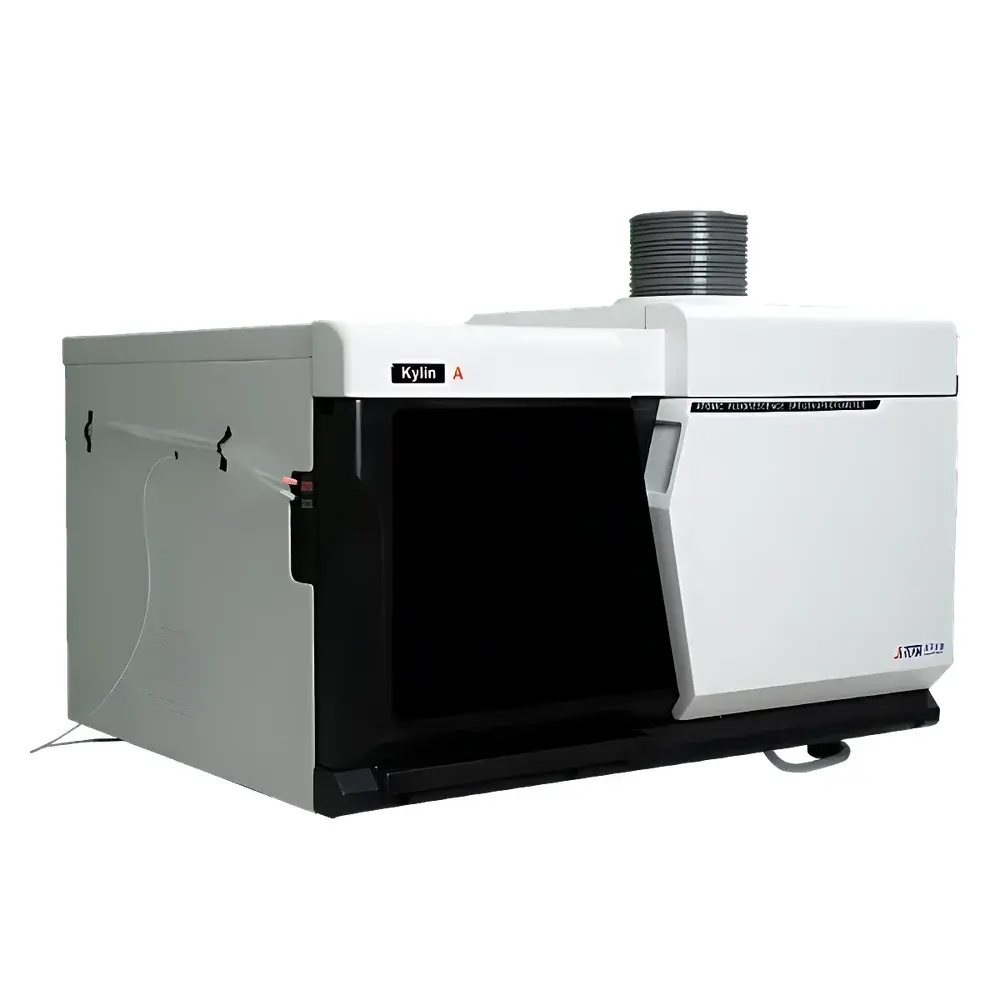
Titan Instruments Kylin Atomic Fluorescence Spectrometer
| Brand | Titan Instruments |
|---|---|
| Origin | Beijing, China |
| Manufacturer Type | Manufacturer |
| Product Category | Domestic |
| Model | Kylin |
| Instrument Type | Multi-channel Atomic Fluorescence Spectrometer |
| Sample Introduction Method | Dual Sequential Injection Pump |
| Waste Disposal | Rear Exhaust Design |
| Hydride Generation Mode | Vapor Generation / Hydride Generation |
| Gas Flow Control | Mass Flow Controller (MFC) |
| Detectable Elements | As, Hg, Se, Sn, Bi, Sb, Pb, Ge, Cd, Te, Zn, Au |
| Relative Standard Deviation (RSD) | < 0.6% |
| Linear Dynamic Range | > 3 orders of magnitude |
| Detection Limits | As, Sb, Se, Bi, Te, Hg, Sn, Pb < 0.01 µg/L |
| Photomultiplier Tube Wavelength Range | 160–320 nm |
| Atomizer Temperature Control Range | Programmable and Element-Optimized |
Overview
The Titan Instruments Kylin Atomic Fluorescence Spectrometer is a high-performance, multi-channel analytical instrument engineered for ultra-trace determination of hydride-forming and cold-vapor elements in environmental, food, clinical, geological, pharmaceutical, and industrial matrices. Based on the principle of atomic fluorescence spectroscopy (AFS), the Kylin system excites ground-state atoms—generated via hydride vapor generation (HVG) or cold vapor atomic fluorescence (CV-AFS)—with a high-intensity, element-specific hollow cathode lamp (HCL). The resulting fluorescence emission at characteristic wavelengths is collected orthogonally to minimize stray light interference and maximize signal-to-noise ratio. Its fully orthogonal dual-beam 3D optical architecture ensures exceptional channel-to-channel consistency and long-term photometric stability—critical for regulatory compliance and multi-element routine analysis.
Key Features
- Four-channel simultaneous detection capability for As, Se, Pb, Bi, Sb, Te, Sn, Hg, Cd, Ge, Zn, and Au—enabling true parallel quantification without sequential dwell-time compromises.
- Integrated dual sequential injection pump system with sub-microliter precision, delivering superior reproducibility in reagent and sample delivery for hydride generation chemistry.
- Orthogonal dual-beam optical path design with matched photomultiplier tubes (160–320 nm spectral response), minimizing background scatter and enabling robust baseline correction across all channels.
- Smart plug-and-play hollow cathode lamps with embedded memory chips—automatically recognized upon insertion, eliminating manual alignment and lamp positioning calibration.
- Intelligent temperature-controlled quartz-trap atomizer with dynamic, element-specific thermal optimization—ensuring optimal atomization efficiency and signal stability for each analyte.
- Electronic flow control (EFC) gas management system with real-time pressure and mass flow monitoring, integrated alarm diagnostics, and automatic shut-off for safety-critical applications.
- Carbon-fiber-reinforced PTFE sampling probes—replacing fragile quartz needles—to enhance mechanical durability and reduce maintenance downtime.
- Comprehensive self-diagnostic suite covering optical unit integrity, vapor generation performance, atomizer status, gas flow validation, liquid level sensing, and lamp health monitoring.
- Graphical user interface with real-time visualization of instrument status, parameter trends, and hardware diagnostics—designed for rapid operational assessment and troubleshooting.
Sample Compatibility & Compliance
The Kylin AFS supports direct aqueous analysis following standardized acid digestion or microwave-assisted digestion protocols. It is validated for use with solid, liquid, and semi-solid samples—including soils, sediments, biological tissues (blood, urine, hair), foodstuffs (dairy, meat, cereals), fuels, pharmaceutical excipients, and metallurgical slags—after appropriate sample preparation per ISO 17294-2, ASTM D5673, USP , and EPA Method 1631E. The system meets essential requirements for GLP/GMP-compliant laboratories, including full audit trail logging, role-based user permissions, electronic signature support, and method version control—all aligned with FDA 21 CFR Part 11 data integrity expectations.
Software & Data Management
The Kylin operates under a dual-language (English/Chinese), Windows-based software platform featuring method development wizards, automated calibration curve generation, QC check integration (blanks, spikes, duplicates), and customizable reporting templates compliant with ISO/IEC 17025 documentation standards. All raw spectra, peak integration parameters, instrument settings, and operator actions are time-stamped and cryptographically logged. Data export supports CSV, PDF, and XML formats for LIMS integration. Software updates are delivered via secure firmware signing and rollback-capable installation packages.
Applications
- Environmental Monitoring: Quantification of As, Hg, Pb, and Cd in drinking water (per WHO guidelines), wastewater, soil (GB/T 22105-2008), air particulates (HJ 1133-2020), and solid waste (HJ 702-2014).
- Food Safety: Routine screening for inorganic arsenic in rice (GB 5009.11-2014), total mercury in seafood (GB 5009.17-2014), and selenium in infant formula.
- Clinical & Toxicology: Trace metal profiling in human biofluids and tissues for nutritional assessment (Se, Zn) and heavy metal exposure monitoring (Pb, Hg, As).
- Geological & Metallurgical Analysis: Determination of Au in ore leachates, Ge in semiconductor-grade silicon, and Te/Sb in alloy scrap using micro-volume hydride generation.
- Pharmaceutical Quality Control: Residual catalyst metal testing (e.g., Pd, Pt) and elemental impurity screening per ICH Q3D guidelines—particularly for Hg, As, Cd, and Pb in APIs and excipients.
FAQ
What hydride-forming elements can the Kylin AFS detect with certified detection limits?
The Kylin achieves sub-ppt detection limits for As, Sb, Se, Bi, Te, Hg, Sn, and Pb (< 0.01 µg/L); cold-vapor Hg and Cd at < 0.001 µg/L; Ge at < 0.05 µg/L; Zn at < 1.0 µg/L; and Au at < 3.0 µg/L—verified per ISO 11929 uncertainty estimation principles.
Does the system support regulatory-compliant data handling for pharmaceutical labs?
Yes—the software includes 21 CFR Part 11–compliant audit trails, electronic signatures, user access tiers, and immutable method storage—validated for GxP environments.
How does the dual sequential injection pump improve measurement precision?
By decoupling reagent and sample metering with independent syringe actuators and pressure-compensated fluid paths, it eliminates cross-contamination and volumetric drift—delivering RSD < 0.6% across 10 replicate injections.
Is the atomizer temperature actively controlled during analysis?
Yes—temperature is dynamically adjusted in real time based on the selected element, ensuring optimal atom cloud density and fluorescence yield while minimizing memory effects.
Can the Kylin integrate with existing laboratory information management systems (LIMS)?
Yes—via standardized ODBC and HL7-compatible data export modules, supporting automated result transfer and batch-level metadata synchronization.




