
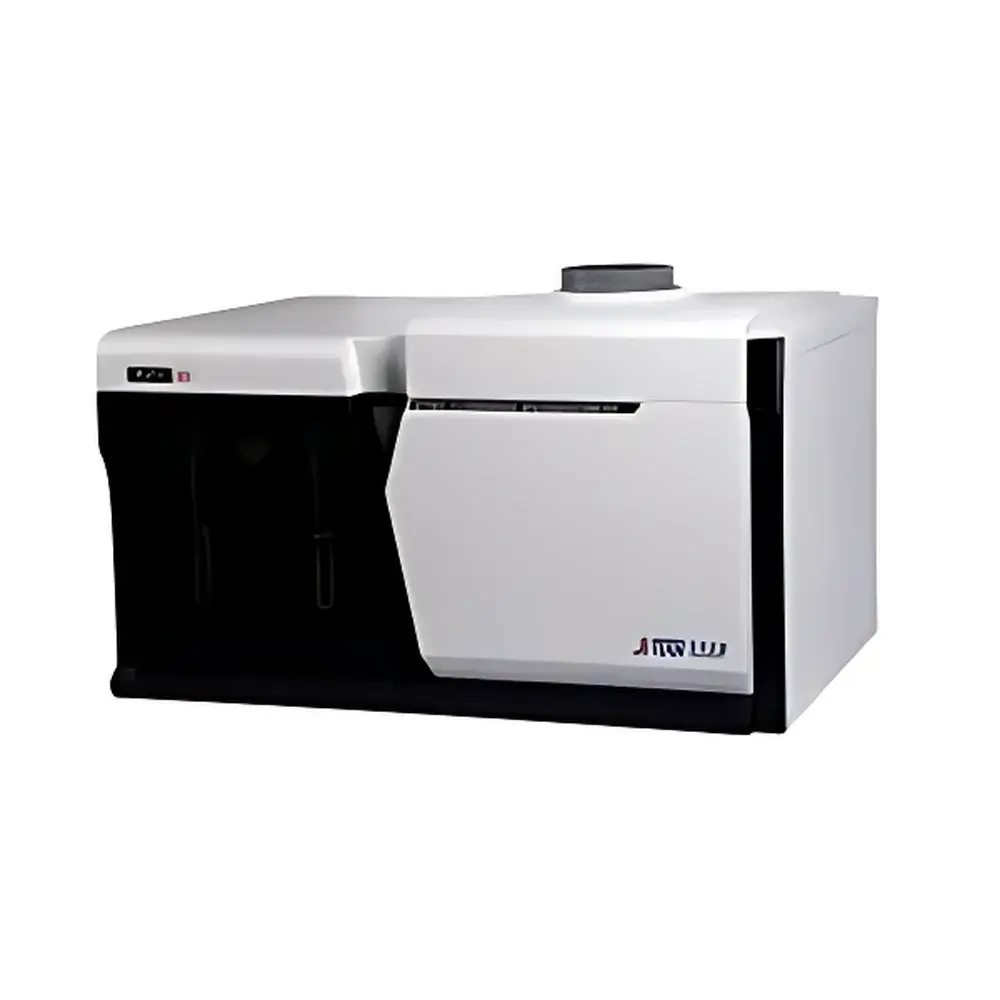
Titan Instruments Kylin S18 Multi-Channel Atomic Fluorescence Spectrometer
| Brand | Titan Instruments |
|---|---|
| Origin | Beijing, China |
| Model | Kylin S18 |
| Instrument Type | Multi-channel Atomic Fluorescence Spectrometer |
| Sample Introduction | Dual Sequential Injection Pump |
| Waste Disposal | Rear Exhaust Design |
| Hydride Generation Mode | Vapor Generation / Hydride Generation |
| Gas Flow Control | Mass Flow Controller (MFC) |
| Detectable Elements | As, Hg, Se, Sn, Bi, Sb, Pb, Ge, Cd, Te, Zn, Au |
| RSD | < 0.6% |
| Linear Dynamic Range | > 3 orders of magnitude |
| Detection Limits | As, Bi, Sb < 0.01 µg/L |
| PMT Wavelength Range | 160–320 nm |
| Atomizer Temperature Control Range | 100–350 °C |
Overview
The Titan Instruments Kylin S18 is a high-performance, multi-channel atomic fluorescence spectrometer (AFS) engineered for trace-level quantification of hydride-forming and cold-vapor elements in complex environmental, food, clinical, pharmaceutical, geological, and industrial matrices. Based on the principle of atomic fluorescence spectroscopy—where analyte atoms, generated in situ via hydride or cold-vapor atomization, are excited by a sharp-line hollow cathode lamp (HCL) source and emit characteristic fluorescence photons at specific wavelengths—the Kylin S18 delivers exceptional sensitivity, precision, and operational robustness. Its design adheres to fundamental requirements of modern elemental analysis workflows: low detection limits, high channel-to-channel consistency, automated calibration, and compliance-ready data integrity. Unlike single-channel AFS systems, the Kylin S18 supports simultaneous measurement across up to four independent optical channels, enabling true multi-element analysis without sequential lamp switching delays—critical for high-throughput laboratories performing routine regulatory testing.
Key Features
- Four-channel parallel detection architecture with full optical symmetry: all channels employ identical optical path lengths, detector gain settings, and signal processing algorithms to ensure inter-channel reproducibility and eliminate systematic bias.
- Integrated dual sequential injection pump system: delivers precise, pulse-free reagent and sample metering with sub-microliter accuracy; eliminates carryover and improves long-term stability of hydride generation efficiency.
- Orthogonal dual-beam optical geometry: excitation and fluorescence collection axes are spatially separated by 90°, minimizing stray light interference and enhancing signal-to-noise ratio—particularly critical for ultra-trace mercury and arsenic determination.
- Intelligent plug-and-play hollow cathode lamps: direct-insertion design with auto-identification and real-time lamp current monitoring; includes built-in lamp usage timer and automatic mercury lamp pre-ignition sequence.
- Temperature-controlled quartz-trap atomizer with programmable 100–350 °C range: enables element-specific optimization of atomization efficiency and matrix interference suppression (e.g., higher temperatures for refractory elements like antimony and bismuth).
- EFC-based gas flow regulation: electronic mass flow controllers provide continuous pressure and flow rate monitoring, dynamic compensation for line fluctuations, and audible/visual alarms upon deviation beyond user-defined thresholds.
- Carbon-fiber-reinforced PTFE sampling probes: replace brittle quartz capillaries, significantly improving mechanical durability and reducing maintenance frequency in high-volume labs.
- Comprehensive self-diagnostic suite: automatically verifies operational status of optical module alignment, vapor generation unit integrity, atomizer thermal profile, gas supply pressure, liquid level sensors, and lamp functionality—logging fault codes with contextual diagnostics.
Sample Compatibility & Compliance
The Kylin S18 is validated for use with aqueous extracts, acid digests (HNO₃/HCl/HF), microwave-assisted digestates, and alkaline leachates derived from diverse sample types including drinking water, wastewater, soil, sediment, biological tissues (blood, urine, hair, nails), foodstuffs (milk, meat, wine, feed), pharmaceutical excipients, metallurgical slags, crude oil, and lubricants. It conforms to multiple internationally recognized analytical standards, including but not limited to: US EPA Method 200.9 (trace metals in water), ISO 17294-2:2016 (water quality—elemental analysis by ICP-MS/AFS), ASTM D5762–21 (trace mercury in petroleum products), and Chinese national standards GB 5009.11–2014, GB 5009.17–2014, HJ 694–2014, and HJ 702–2014. The instrument’s hardware and software architecture support GLP/GMP-aligned operation, with audit trail logging, role-based access control, electronic signature capability, and data immutability features compliant with FDA 21 CFR Part 11 requirements.
Software & Data Management
The Kylin S18 operates under Titan’s proprietary AFS Control Suite—a dual-language (English/Chinese), Windows-based platform designed for analytical traceability and method lifecycle management. Key capabilities include: fully customizable method templates with parameter locking and version control; real-time graphical monitoring of instrument status (lamp intensity, atomizer temperature, gas flow, pump position); automated calibration curve generation with forced zero-point validation and outlier rejection; integrated QC flagging (spike recovery, duplicate precision, blank drift); and export-ready reporting with embedded metadata (operator ID, timestamp, instrument serial number, method revision). All raw spectral data, processed results, and system logs are stored in encrypted SQLite databases with configurable backup intervals and retention policies. Audit trails record every user action—including method edits, result overrides, and calibration events—with immutable timestamps and operator credentials.
Applications
The Kylin S18 serves as a primary analytical tool in accredited environmental testing laboratories for monitoring regulated contaminants in water (As, Hg, Sb per WHO/EPA guidelines), soils (total As, Hg, Pb per ISO 17294), and solid waste (HJ 702–2014). In food safety labs, it supports compliance with EU Commission Regulation (EC) No 1881/2006 and China’s GB 2762–2022 for inorganic arsenic in rice and mercury in fish. Clinical toxicology units utilize its low ng/L detection capability for biomonitoring selenium deficiency or chronic heavy metal exposure in whole blood and urine. Pharmaceutical QA/QC departments deploy it for elemental impurity screening (ICH Q3D Category 1 & 2 elements) in active pharmaceutical ingredients (APIs) and excipients. Metallurgical R&D facilities rely on its ability to quantify trace gold and germanium in ore concentrates and alloy scrap—enabling accurate grade assessment and process optimization.
FAQ
What elements can the Kylin S18 quantify with certified detection limits?
The instrument achieves sub-0.01 µg/L detection limits for arsenic, antimony, and bismuth using standard hydride generation protocols. Mercury detection limits are typically ≤ 0.001 µg/L under cold-vapor mode. Selenium, lead, tin, cadmium, and tellurium are also routinely measured at low-ppt levels.
Is the Kylin S18 compatible with third-party LIMS integration?
Yes—the AFS Control Suite supports ODBC-compliant database export and provides structured CSV/Excel output with standardized field headers, enabling seamless ingestion into major laboratory information management systems (LIMS) such as LabWare, STARLIMS, and Thermo Fisher SampleManager.
Does the system support automated method development for new sample matrices?
While fully automated method development is not implemented, the software includes a guided optimization wizard that assists users in selecting optimal carrier gas flow, reaction coil temperature, photo-multiplier voltage, and delay times based on empirical signal response curves.
How does the dual sequential injection pump improve analytical precision compared to conventional peristaltic systems?
By eliminating pulsatile flow and tubing compression variability, the piston-driven dual pump ensures constant reagent/sample mixing ratios and reproducible reaction kinetics—directly contributing to the instrument’s < 0.6% RSD performance across extended run sequences.
Can the Kylin S18 be operated in single-channel mode for dedicated high-sensitivity applications?
Yes—channel activation is software-configurable. Users may deactivate unused optical paths to maximize photon collection time per element, thereby improving signal integration and lowering effective detection limits for priority analytes.





