
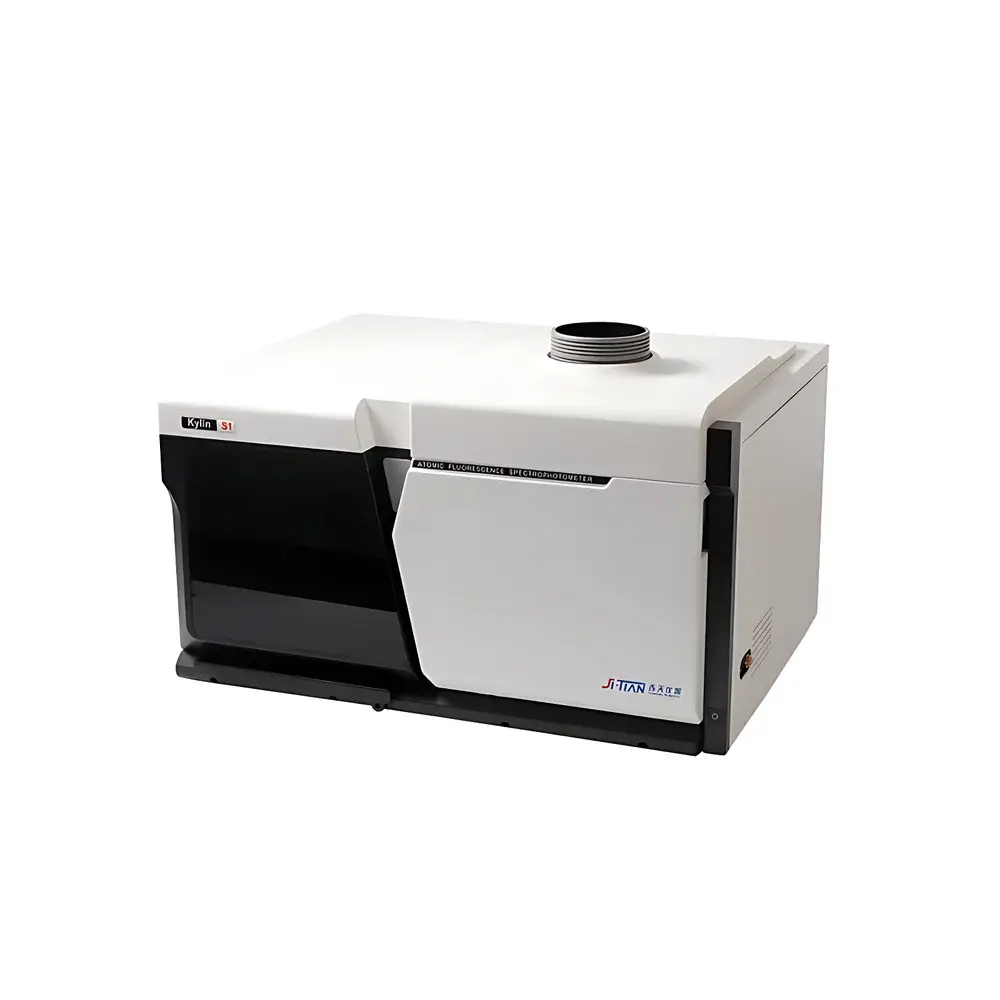
Titan Instruments Kylin Series Atomic Fluorescence Spectrometer
| Brand | Titan Instruments |
|---|---|
| Origin | Beijing, China |
| Model | Kylin |
| Instrument Type | Multi-channel Atomic Fluorescence Spectrometer |
| Sample Introduction | Dual Sequential Injection Pump |
| Optical System | Fully Orthogonal Dual-beam 3D Optical Path |
| Number of Channels | 2–4 Configurable |
| Reference Drift Correction | Enabled on All Channels |
| Hollow Cathode Lamps | Plug-and-Play Smart Lamps with Embedded Memory Chip |
| Lamp Current Monitoring & Usage Timer | Supported |
| Atomizer | Shielded Quartz Tube with Auto-height Adjustment & Temperature Control (100–400 °C) |
| Gas Flow Control | EFC (Electronic Flow Control) with PID Regulation, Real-time Pressure/Flow Monitoring & Safety Interlock |
| Vapor Generation | Chemical Vapor Generation with Multi-stage Gas-Liquid Separation |
| Detection Limits | As, Se, Pb, Bi, Sb, Te, Sn: < 0.01 µg/L |
| Hg, Cd | < 0.001 µg/L |
| Ge | < 0.05 µg/L |
| Zn | < 1.0 µg/L |
| Stability (Drift) | ≤1.5% |
| Noise | ≤1.5% |
| Inter-channel Interference | ≤±1.0% |
| Repeatability | ≤0.6% RSD |
| Linearity | >3 Orders of Magnitude |
| Power Supply | 220 V, 50 Hz, Max 400 W |
| Dimensions (H×W×D) | 52 cm × 76 cm × 68 cm |
| Net Weight | 40 kg |
| Communication Interfaces | LAN, USB, RS-232 |
Overview
The Titan Instruments Kylin Series Atomic Fluorescence Spectrometer (AFS) is a high-performance, multi-channel analytical instrument engineered for trace and ultra-trace elemental analysis of hydride-forming and cold-vapor elements. Based on the principle of atomic fluorescence spectroscopy—where ground-state atoms in a quartz atomizer are excited by a sharp-line radiation source (hollow cathode lamp), emitting characteristic fluorescence proportional to analyte concentration—the Kylin platform delivers exceptional sensitivity, selectivity, and robustness for routine and regulatory-grade testing. Designed and manufactured in Beijing, it represents a mature implementation of China-developed AFS technology, widely adopted in national standard methods (GB, HJ, NY series) and aligned with international measurement principles referenced in ISO 11929, ASTM D5673, and EPA Method 1631E for mercury speciation support. Its fully orthogonal dual-beam 3D optical architecture minimizes stray light and enhances signal-to-noise ratio, while integrated thermal stabilization and automated alignment eliminate operator dependency—making it suitable for GLP-compliant laboratories requiring long-term reproducibility across environmental, food safety, clinical, and geological applications.
Key Features
- Fully orthogonal dual-beam 3D optical path with real-time reference drift correction applied across all channels—ensuring inter-channel consistency and minimizing baseline drift during extended sequences.
- Plug-and-play smart hollow cathode lamps featuring embedded memory chips for automatic lamp identification, current optimization, and usage time logging—eliminating manual alignment and reducing warm-up variability.
- Dual sequential injection pump system for precise, pulse-free sample and reagent delivery—enabling accurate stoichiometric control in hydride generation and minimizing carryover.
- Temperature-controlled shielded quartz atomizer (100–400 °C range) with motorized height adjustment—optimizing atomization efficiency per element and decoupling performance from ambient temperature fluctuations.
- EFC (Electronic Flow Control) gas management system with PID-regulated Ar/H₂ flow, integrated pressure/flow sensors, and fail-safe shut-off logic—including no-gas ignition prevention and auto-shutdown at power loss.
- Carbon-fiber-reinforced PTFE sampling probe—resistant to breakage, reduced droplet adhesion, and equipped with internal/external wash cycles to suppress cross-contamination between samples.
- Patented stabilized lamp power supply with auto-ignition, real-time current monitoring, and programmable current ramping—extending lamp lifetime and ensuring stable excitation output.
Sample Compatibility & Compliance
The Kylin AFS supports direct analysis of aqueous digests, leachates, and filtered extracts without derivatization for 12 key elements: As, Se, Sb, Bi, Te, Sn, Pb, Hg, Cd, Ge, Zn, and Au. It complies with over 200 published Chinese national, industry, and local standards—including GB 5749–2022 (drinking water), HJ 694–2014 (water quality), NY/T 761–2008 (vegetable residues), and GB/T 22105.2–2008 (soil). While not certified to FDA 21 CFR Part 11 out-of-the-box, its software architecture supports audit trail export, user role-based access control, and method file integrity—facilitating validation under GMP/GLP frameworks when deployed with documented SOPs and IQ/OQ protocols. Sample introduction is compatible with acid-digested soils, food homogenates, biological fluids (urine, blood), petroleum distillates, and metallurgical slags following standardized preparation procedures (e.g., microwave-assisted HNO₃/HCl digestion per ISO 11466).
Software & Data Management
KylinControl™ software provides a unified interface for instrument control, method development, and data evaluation. Core capabilities include: comprehensive self-diagnostic routines covering optical alignment, vapor generation timing, atomizer status, gas flow integrity, and lamp health; graphical real-time monitoring of fluorescence intensity, carrier gas pressure, and reagent levels; modular method templates pre-configured for environmental, food, clinical, and geochemical workflows; spectral overlay tools for comparative peak verification; independent recalibration and curve-refitting without re-running samples; customizable report generation supporting PDF, CSV, and XML export with configurable metadata fields; and full audit trail functionality logging all user actions, parameter changes, and system events—with timestamped, non-erasable records exportable for regulatory review. All data files are stored in encrypted, version-controlled repositories with optional network backup integration.
Applications
The Kylin Series is routinely deployed in accredited laboratories for quantitative determination of regulated elements across diverse matrices. In environmental testing, it quantifies sub-ppt Hg in wastewater effluents (EPA-aligned), As and Sb in soil pore water, and Se in groundwater per WHO guidelines. For food safety, it validates compliance with EU Commission Regulation (EC) No 1881/2006 for inorganic arsenic in rice and infant formula. Clinical labs apply it to monitor Se status in serum and Hg exposure in hair or urine specimens—supporting occupational health surveillance. Geological surveys rely on its multi-element capability for rapid screening of As, Sb, and Hg in rock digests prior to ICP-MS confirmation. Additionally, it supports pharmaceutical excipient testing per USP /, petrochemical catalyst analysis, and metallurgical grade certification of zinc and lead alloys—where its low detection limits and high throughput deliver measurable ROI in high-volume QC environments.
FAQ
What elements can the Kylin AFS detect?
The instrument is optimized for hydride-generating elements (As, Se, Sb, Bi, Te, Sn, Pb) and cold-vapor metals (Hg, Cd), with validated performance also reported for Ge, Zn, and Au under specific chemical vapor generation conditions.
Is method validation support available?
Yes—Titan Instruments provides application notes, standard operating procedures, and calibration verification protocols aligned with ISO/IEC 17025 requirements. Full validation packages (including LOD/LOQ, linearity, precision, and recovery studies) can be developed in collaboration with qualified laboratory personnel.
Can the Kylin integrate with LIMS?
It supports bidirectional data exchange via ASTM E1384-compliant ASCII export and configurable ODBC drivers—enabling seamless ingestion into major LIMS platforms including Thermo Fisher SampleManager, LabVantage, and STARLIMS.
What maintenance intervals are recommended?
Daily: Probe cleaning and waste line inspection. Weekly: Gas filter replacement and lamp current verification. Quarterly: Atomizer quartz tube inspection and EFC sensor calibration check. Annual: Full optical alignment verification and pump tubing replacement—documented in the included maintenance logbook.
Does the system meet cybersecurity requirements for networked deployment?
The KylinControl™ software operates on Windows OS with configurable firewall rules, TLS 1.2+ encryption for remote diagnostics, and password-protected firmware updates—meeting baseline NIST SP 800-53 controls for laboratory IT infrastructure when deployed behind enterprise segmentation.




