
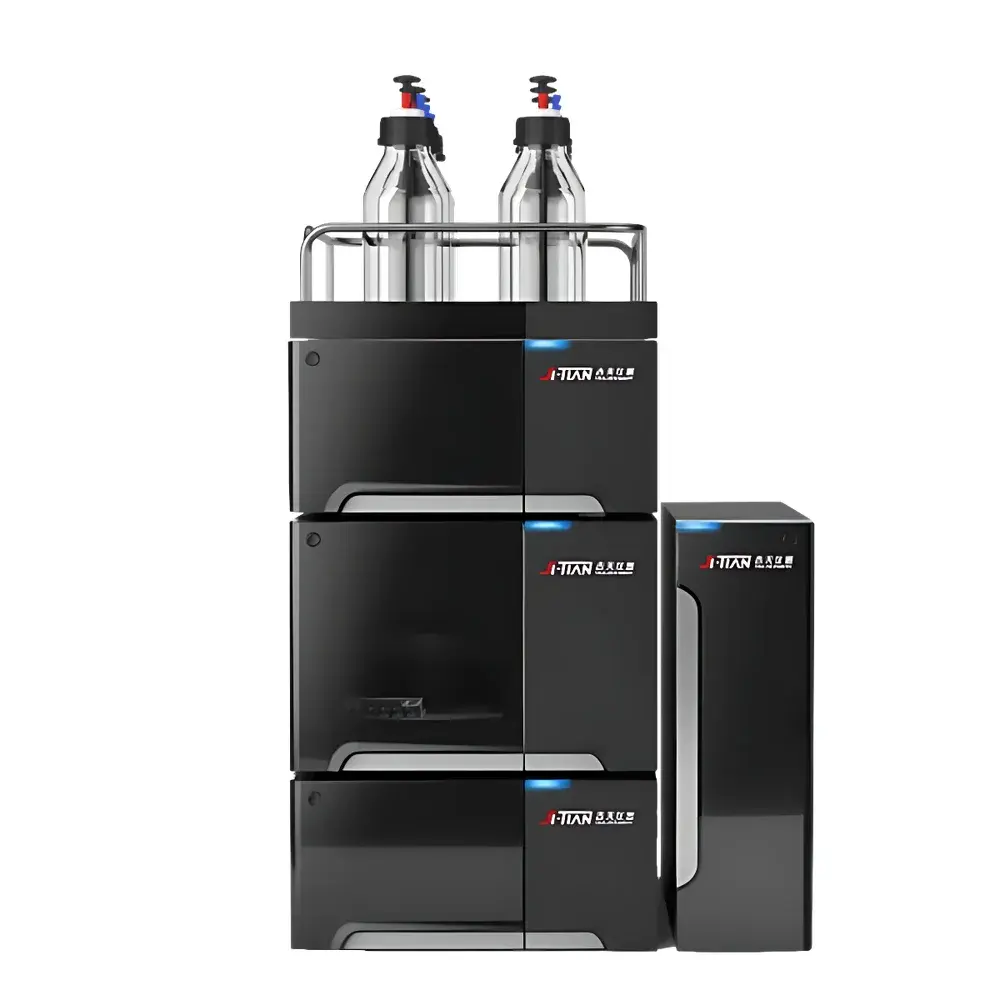
Titan Instruments LC-8000 Ultra-High Performance Liquid Chromatograph (UHPLC)
| Brand | Titan Instruments |
|---|---|
| Origin | Beijing, China |
| Manufacturer Type | Authorized Distributor |
| Instrument Type | Ultra-High Performance Liquid Chromatograph (UHPLC) |
| Model | LC-8000 |
| Pressure Range | Up to 70 MPa |
| Column Compatibility | Supports 2 µm particle-packed columns |
| Flow Pulsation | <10 psi (PPRC technology) |
| Column Oven Capacity | Accommodates up to six 250 mm columns simultaneously |
| Temperature Uniformity | ±0.1 °C (forced-air circulation + high-precision PID control) |
| Autosampler Wash | Dual-needle displacement cleaning mechanism |
| Data Acquisition Rate | Up to 100 Hz |
| Regulatory Compliance | FDA 21 CFR Part 11, GLP, GMP |
Overview
The Titan Instruments LC-8000 Ultra-High Performance Liquid Chromatograph (UHPLC) is an engineered analytical platform designed for high-resolution, high-throughput separation of complex organic molecules in regulated and research laboratory environments. Based on the fundamental principles of reversed-phase, normal-phase, and hydrophilic interaction liquid chromatography (HILIC), the LC-8000 leverages high-pressure gradient elution (up to 70 MPa) and sub-2-µm stationary phases to achieve superior peak capacity, reduced analysis time, and enhanced sensitivity compared to conventional HPLC systems. Its modular architecture supports both isocratic and multi-step gradient methods, with real-time pressure monitoring, active solvent compressibility compensation, and thermally stabilized fluidic pathways—ensuring retention time reproducibility ≤0.15% RSD across consecutive injections under routine operation.
Key Features
- High-pressure binary or quaternary gradient pumping system delivering stable flow rates from 0.001 to 5.0 mL/min at pressures up to 70 MPa—enabling optimal utilization of sub-2-µm core-shell and fully porous columns.
- Proprietary Pulseless Pressure Regulation Circuit (PPRC) technology maintains flow pulsation below 10 psi (<0.07 MPa), minimizing baseline noise and improving integration accuracy for trace-level quantitation.
- Large-capacity column oven with forced-air convection and dual-sensor PID control maintains temperature stability within ±0.1 °C across the full 5–85 °C operating range; accommodates up to six 250 mm × 4.6 mm columns with automatic valve-based column switching capability.
- Autosampler featuring dual-needle displacement wash design: inner needle aspirates sample while outer needle performs high-speed solvent rinse between injections—reducing carryover to <0.005% for challenging matrices such as plasma extracts or pesticide-spiked soil leachates.
- UV-Vis photodiode array detector (standard configuration) with 100 Hz data acquisition rate, 1 nm optical resolution, and spectral range of 190–800 nm—supporting peak purity assessment, library matching, and multi-wavelength quantitation without method re-injection.
- Fully integrated system control firmware compliant with FDA 21 CFR Part 11 requirements, including electronic signatures, audit trail logging, user role-based access control, and immutable record archiving—validated for use in GLP and GMP-regulated laboratories.
Sample Compatibility & Compliance
The LC-8000 is validated for direct injection of aqueous, organic, and mixed-solvent samples—including protein digests, environmental water extracts, pharmaceutical formulations, and food matrix supernatants—following appropriate filtration (0.22 µm) and dilution protocols. It meets essential performance criteria outlined in ISO 17025:2017 for chromatographic instrument qualification, and its software architecture supports IQ/OQ/PQ documentation templates aligned with USP , ASTM E2500, and ICH Q2(R2) guidelines. System suitability testing (SST) parameters—including tailing factor, theoretical plates, resolution, and %RSD of retention time and peak area—are automatically calculated and reportable per regulatory submission standards.
Software & Data Management
Titan ChromoLink™ 3.2 workstation software provides a unified interface for method development, sequence scheduling, real-time chromatogram visualization, and post-run processing. All raw data files are stored in vendor-neutral .CDF format (compatible with Open Chromatography Data Format specifications), ensuring long-term readability and third-party software interoperability. The system supports secure network deployment with centralized license management, automated backup to NAS or cloud storage (AES-256 encrypted), and configurable retention policies aligned with organizational data governance frameworks. Audit trails capture every user action—including method edits, integration parameter changes, and result approvals—with timestamps, operator IDs, and IP addresses—fully traceable for internal audits or regulatory inspections.
Applications
- Food Safety: Quantitative determination of artificial sweeteners (e.g., aspartame, sucralose), preservatives (sorbic acid, benzoic acid), mycotoxins (aflatoxin B1, ochratoxin A), and pesticide residues using QuEChERS-extracted samples.
- Environmental Analysis: Multi-residue screening of organophosphate insecticides, chlorinated herbicides, polycyclic aromatic hydrocarbons (PAHs), and per- and polyfluoroalkyl substances (PFAS) in wastewater, sediment, and air particulate matter.
- Pharmaceutical Quality Control: Assay of active pharmaceutical ingredients (APIs), related substances profiling per ICH Q5, dissolution testing, and stability-indicating methods for antibiotics and CNS-active compounds.
- Clinical & Biomedical Research: Separation and quantification of amino acids, bile acids, neurotransmitters, and phase II drug metabolites (e.g., glucuronides, sulfates) in serum, urine, and cerebrospinal fluid.
- Chemical & Materials Science: Characterization of synthetic dyes, polymer additives, fragrance components, and reaction intermediates in process development and impurity profiling studies.
FAQ
Is the LC-8000 compatible with mass spectrometry interfaces?
Yes—the system features standard ESI and APCI source coupling ports, low-dead-volume capillary connections (1/16″ OD × 0.005″ ID), and synchronized timing signals for seamless integration with single-quadrupole, triple-quadrupole, and high-resolution Q-TOF mass spectrometers.
Can the column oven accommodate longer or narrower-bore columns?
The oven supports columns ranging from 30 mm to 250 mm in length and 2.1 mm to 4.6 mm internal diameter; optional column racks are available for 1.0 mm ID microbore configurations.
What validation documentation is provided with the instrument?
Each shipment includes Factory Acceptance Test (FAT) reports, Installation Qualification (IQ) checklists, and Operational Qualification (OQ) protocols preloaded in the software—customizable to site-specific SOPs and regulatory jurisdiction requirements.
Does the system support method transfer from legacy HPLC platforms?
Yes—ChromoLink™ includes an automated HPLC-to-UHPLC method translation engine that adjusts flow rate, gradient slope, and injection volume based on column dimensions, particle size, and mobile phase viscosity—preserving selectivity and resolution during platform migration.





