
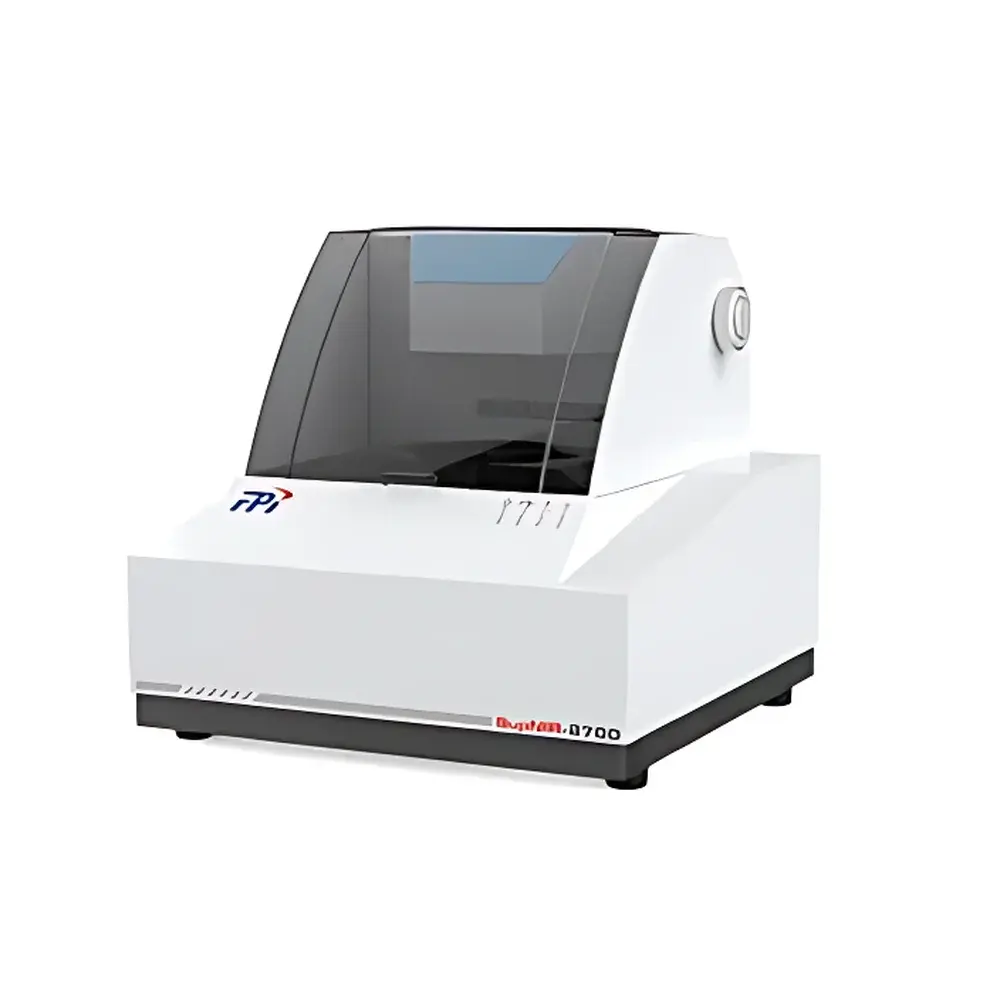
Titan Instruments SupNIR-2700 Series Near Infrared Spectrometer
| Brand | Titan Instruments |
|---|---|
| Origin | Zhejiang, China |
| Instrument Type | Laboratory NIR Spectrometer |
| Optical Design | Holographic Digital Grating + TEC-Cooled InGaAs Detector |
| Wavelength Range | 1000–1800 nm (SupNIR-2700), up to 2500 nm (SupNIR-2720/2750) |
| Scan Speed | 0.2 s per spectrum |
| Spectral Sampling Interval | 1 nm |
| Measurement Mode | Diffuse Reflectance |
| Spectral Resolution | 10 nm |
| Wavelength Accuracy | ±0.2 nm |
| Wavelength Repeatability | ±0.05 nm |
| Absorbance Noise | <50 µA |
| Stray Light | <0.1% |
| Analysis Time | <60 s |
| Max. Simultaneous Parameters | 30 |
| Sample Mass | <120 g |
| Light Source Lifetime | >5000 h |
| Communication Interface | USB 2.0 |
| Operating Temperature | 5–35 °C |
| Operating Humidity | 5–85 % RH |
| Power Supply | 198–242 V AC, 50 Hz, 0.5 A |
| Dimensions (L×W×H) | 400 × 420 × 360 mm |
| Weight | 18 kg |
| Chemometrics Software | RIMP (PLS, ANN, SIMCA, Hierarchical Clustering) |
| Model Transfer Capability | Cross-instrument compatible |
Overview
The Titan Instruments SupNIR-2700 Series Near Infrared Spectrometer is a laboratory-grade, grating-scanning dispersive spectrometer engineered for rapid, non-destructive quantitative and qualitative analysis of solid agricultural and industrial materials. Operating on the principle of diffuse reflectance near-infrared spectroscopy (NIRS), it measures absorption and scattering characteristics across the short-wave NIR region (1000–1800 nm standard; extendable to 2500 nm in higher-tier variants). The system integrates a holographic digital diffraction grating with a thermoelectrically cooled (TEC) indium gallium arsenide (InGaAs) photodetector array—ensuring thermal stability, high signal-to-noise ratio (>10,000:1 typical), and long-term spectral fidelity. Unlike Fourier-transform or diode-array instruments, the grating-scanning architecture provides inherently high wavelength accuracy (±0.2 nm) and repeatability (±0.05 nm), critical for calibration transfer and multi-site method harmonization in regulated environments.
Key Features
- Robust optical architecture featuring auto-aligned, maintenance-free light source module—eliminates manual collimation and reduces downtime during lamp replacement.
- Rotating sample tray design improves measurement reproducibility for heterogeneous particulates (e.g., ground grains, mixed feed pellets), mitigating sampling bias inherent in static diffuse reflectance setups.
- Built-in certified reference standards enable automated performance verification and real-time instrument health monitoring—including optical path diagnostics, detector saturation alerts, and wavelength drift compensation.
- High-speed spectral acquisition (0.2 s per full-spectrum scan) supports throughput-intensive workflows such as incoming raw material inspection or inline process screening when coupled with optional automation interfaces.
- Cross-platform model portability: PLS, ANN, and SIMCA models built on one SupNIR unit can be deployed without revalidation on other units within the same series—facilitating networked QA/QC across geographically dispersed facilities.
- Comprehensive hardware-level compliance: Meets IEC 61010-1 safety requirements for laboratory electrical equipment and conforms to electromagnetic compatibility (EMC) Class B limits per CISPR 11.
Sample Compatibility & Compliance
The SupNIR-2700 accepts unprocessed solid samples—including granular feeds, milled cereals, oilseeds, protein concentrates, and pharmaceutical excipients—in their native physical state. No grinding, drying, or solvent extraction is required. Sample presentation uses standardized 50-mm-diameter Petri-style cups or custom trays compatible with GLP-compliant labeling protocols. While not intrinsically designed for GMP-regulated final product release testing, the system supports audit-ready operation when configured with RIMP’s optional 21 CFR Part 11-compliant user access control, electronic signature, and immutable audit trail modules. It aligns with ASTM E1655 (standard practices for NIR quantitative analysis) and ISO 12099 (cereals and animal feeding stuffs—calibration and validation of NIR instruments).
Software & Data Management
RIMP software serves as the integrated analytical platform—delivering instrument control, spectral preprocessing (Savitzky-Golay smoothing, SNV, MSC, derivatives), chemometric modeling (PLS regression for moisture/fat/protein; ANN for non-linear property prediction; SIMCA for adulterant detection), and database-driven reporting. All operations occur within a validated Windows-native GUI supporting Unicode character sets and multilingual metadata tagging. Raw spectra and processed results are stored in HDF5 format, enabling interoperability with third-party tools (e.g., MATLAB, Python scikit-learn). Network connectivity allows remote firmware updates, centralized model library deployment via secure HTTPS, and diagnostic telemetry logging—essential for enterprise-scale instrument fleets operating under ISO/IEC 17025 quality management systems.
Applications
The SupNIR-2700 is extensively deployed in feed formulation labs for rapid assessment of crude protein, ether extract, neutral detergent fiber (NDF), acid detergent fiber (ADF), and amino acid profiles in soybean meal, corn distillers’ dried grains (DDGS), and fishmeal. In grain trading and storage facilities, it enables real-time moisture and dockage estimation during elevator intake—reducing reliance on time-consuming oven-drying methods (AOAC 950.46). Oilseed processors use it to monitor free fatty acid (FFA) and peroxide value trends during refining. Breeding programs leverage its speed to screen thousands of seed samples annually for heritable traits like oleic acid content or starch composition—accelerating selection cycles without destructive sampling. Its adaptability extends to food authenticity verification (e.g., detecting rice adulteration in basmati exports) and QC of botanical extracts in nutraceutical manufacturing.
FAQ
Does the SupNIR-2700 comply with FDA 21 CFR Part 11 for electronic records?
Yes—when equipped with RIMP’s optional Part 11 add-on package, which enforces role-based authentication, electronic signatures, and tamper-evident audit trails.
Can calibration models developed on SupNIR-2720 (1000–2500 nm) be used directly on SupNIR-2700 (1000–1800 nm)?
No—spectral range mismatch requires model truncation and re-validation using only the overlapping 1000–1800 nm region; full-range models must be rebuilt.
Is external environmental control required for stable operation?
Ambient temperature must remain within 5–35 °C and humidity below 85 % RH non-condensing; no dedicated HVAC is mandated, but vibration isolation is recommended for optimal signal stability.
What is the maximum sample particle size accommodated without grinding?
Particles ≤ 2 mm in diameter yield consistent results; larger fragments should be homogenized to ensure representative diffuse reflectance sampling.
How frequently must the internal reference standards be recertified?
Titan Instruments recommends annual traceable recalibration against NIST SRM 1920a (ceramic reflectance standard); onboard diagnostics flag deviations exceeding ±0.5 % reflectance drift.







