
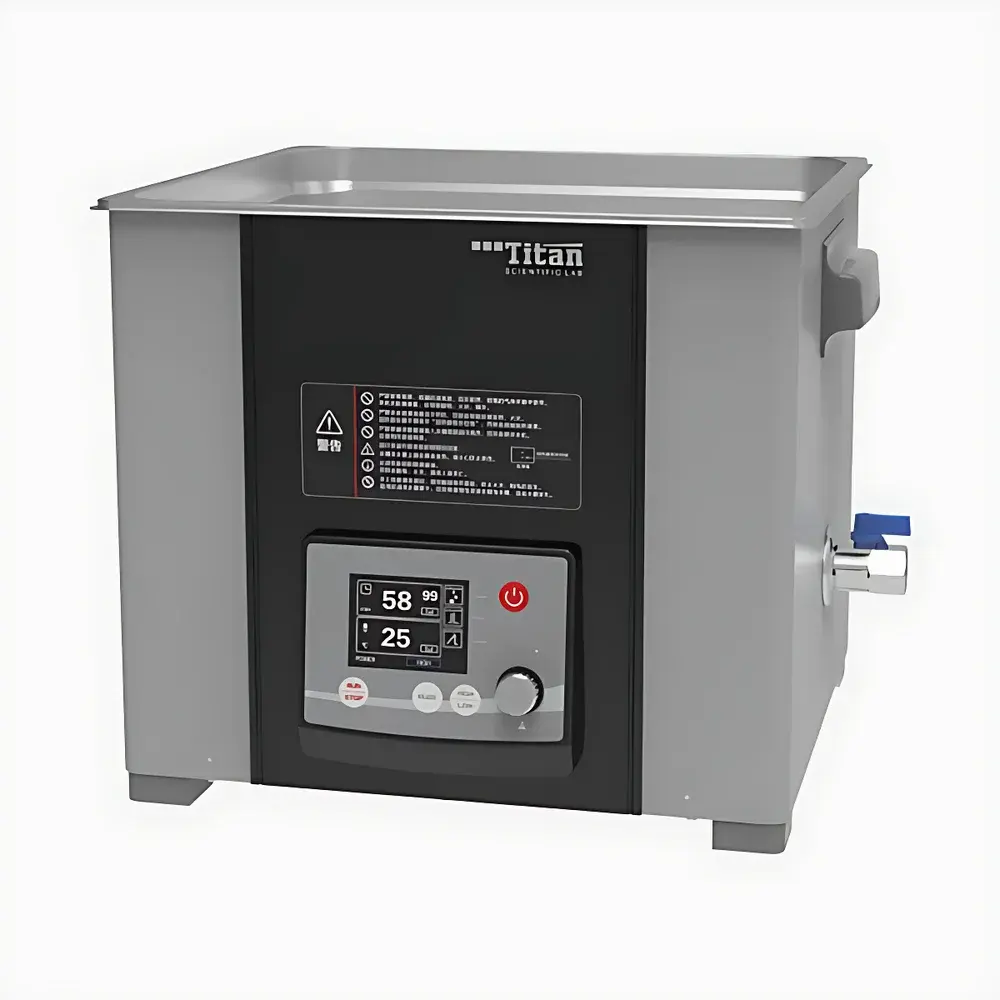
Titan SUC-15 Ultrasonic Cleaner
| Brand | Titan |
|---|---|
| Origin | Shanghai, China |
| Manufacturer Type | Direct Manufacturer |
| Product Category | Domestic |
| Model | SUC-15 |
| Instrument Type | General-Purpose |
| Capacity | 15 L |
| Ultrasonic Frequency | 37 kHz |
| Ultrasonic Power Output | 240 W |
| Adjustable Power | No |
| Adjustable Temperature | No |
| Timer Range | 1–99 min |
| Sound-Dampening Lid | Not Included |
| Drain & Fill Port | Yes |
Overview
The Titan SUC-15 Ultrasonic Cleaner is a robust, entry-level general-purpose ultrasonic cleaning system engineered for routine laboratory and light industrial applications. It operates on the principle of high-frequency cavitation—where 37 kHz acoustic energy induces controlled microbubble formation and collapse within a liquid medium—generating localized shear forces that effectively dislodge particulate contaminants, organic residues, and loosely adhered biofilms from submerged surfaces. Designed for reliability and ease of operation, the SUC-15 delivers consistent cleaning performance across standard glassware, metal tools, optical components, and small precision parts without requiring temperature or power modulation. Its fixed-frequency, fixed-power architecture ensures mechanical stability and long-term repeatability under continuous use in QC labs, university teaching facilities, and maintenance workshops where process standardization outweighs variable parameter control.
Key Features
- Stable 37 kHz transducer array: Optimized for broad-spectrum contaminant removal—particularly effective against dust, polishing compounds, flux residues, and dried aqueous solutions—while minimizing risk of surface pitting on delicate substrates such as aluminum alloys or thin-walled tubing.
- 240 W nominal ultrasonic output: Delivers sufficient energy density for thorough cleaning in 15 L stainless steel tank volume (300 × 240 × 210 mm internal dimensions), supporting batch processing of multiple items simultaneously without significant energy attenuation.
- Digital timer with 1–99 minute range: Enables precise exposure control to prevent over-cleaning or solvent degradation; timer automatically shuts off transducers upon completion, eliminating manual supervision requirements.
- Integrated drain and fill port: Facilitates rapid solution exchange between cycles—critical for multi-step cleaning protocols involving pre-rinse, detergent soak, and final deionized water rinse—reducing cross-contamination and improving throughput efficiency.
- Industrial-grade 304 stainless steel tank: Resistant to corrosion from common aqueous cleaning agents (e.g., alkaline detergents, ethanol/water mixtures) and compatible with mild acidic rinses; reinforced bottom plate ensures structural integrity during prolonged operation.
- No built-in heating or power regulation: Intentionally designed for ambient-temperature cleaning workflows where thermal stress must be avoided—ideal for heat-sensitive polymers, coated optics, or assembled electronic subassemblies.
Sample Compatibility & Compliance
The SUC-15 accommodates a wide range of sample geometries—including beakers, pipettes, crucibles, watch parts, dental instruments, and printed circuit board assemblies—provided they fit within the tank’s internal footprint and are fully submersible. It is not intended for sterilization or microbial inactivation; users requiring validated disinfection must integrate complementary methods (e.g., autoclaving, chemical immersion). While the unit itself carries no CE, UL, or FDA certification, its construction and operational parameters align with baseline safety expectations outlined in IEC 61000-6-3 (EMC emissions) and ISO 13850 (emergency stop provisions for lab equipment). For GLP/GMP environments, documentation of cleaning cycle parameters (time, solution type, lot number) is recommended for audit traceability.
Software & Data Management
The SUC-15 operates via standalone hardware controls only—no embedded firmware, USB interface, or software connectivity is provided. All operational parameters are set manually using front-panel push-button inputs and an LED display. This analog-digital hybrid design eliminates cybersecurity vulnerabilities, reduces calibration drift associated with microcontroller-based timing circuits, and ensures uninterrupted functionality in electromagnetically noisy environments (e.g., near centrifuges or RF generators). Users maintaining electronic lab notebooks (ELNs) or LIMS systems may log cleaning events manually using the model number, timer setting, solution composition, and batch identifier—supporting basic data integrity practices per ALCOA+ principles.
Applications
- Routine cleaning of volumetric glassware prior to titration or spectroscopic analysis
- Removal of machining oils and metal fines from precision tooling and gauges
- Preparation of SEM/TEM sample holders and stubs to eliminate electrostatic artifacts
- Cleaning of reusable filtration housings and membrane support discs
- Deposition residue removal from quartz crystal microbalance (QCM) sensors
- Supporting ASTM D2621 (standard practice for ultrasonic cleaning of automotive parts) and ISO 13485-aligned device reprocessing workflows
FAQ
Is the SUC-15 suitable for cleaning delicate optical lenses or coated mirrors?
Yes—when used with low-surface-tension solvents (e.g., isopropanol or specialized lens cleaners) and limited exposure times (≤5 min), it effectively removes fingerprint oils and dust without damaging anti-reflective coatings.
Can I use tap water as the cleaning medium?
Tap water may be used for preliminary rinsing, but deionized or distilled water is strongly recommended to prevent mineral spotting and transducer fouling over extended use.
Does the unit include a degassing function?
No—the SUC-15 lacks active degassing; users should allow 5–10 minutes of initial operation before loading samples to permit natural air bubble evacuation from the solution.
What maintenance is required for long-term reliability?
Monthly inspection of the tank seal integrity and periodic descaling (using 5% citric acid solution) if hard water is used; transducer performance remains stable for >5,000 operating hours under normal load conditions.



