
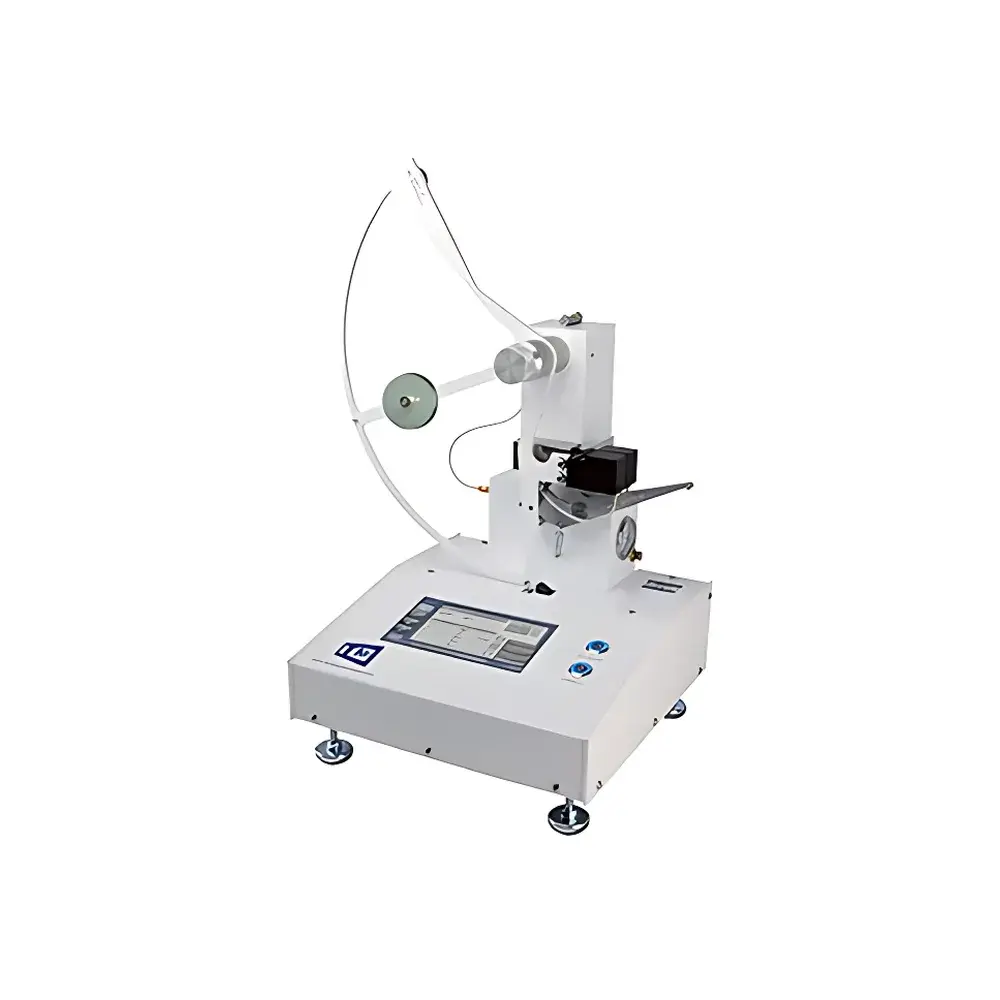
TMI Elmendorf Tear Tester Model 83-76
| Brand | TMI |
|---|---|
| Origin | USA |
| Manufacturer Type | Authorized Distributor |
| Import Status | Imported |
| Model | 83-76 |
| Price | Upon Request |
| Display | 7" Full-Color Digital Touchscreen |
| Data Storage | Up to 200 Test Results (Editable) |
| Pendulum Options | 3200 g (83-11-06), 6400 g (83-11-07), Universal 200/400/800/1600 g (83-11-08, incl. Calibration Weights) |
| Clamping | Pneumatic Fixture with Adjustable Pressure (psi & kg/cm²) |
| Release Mechanism | Pneumatic Pendulum Release |
| Auto-Calibration | Integrated Pendulum Self-Calibration |
| Units | gf, mN, lbf, % of Pendulum Capacity |
| Statistical Output | Mean, Min/Max, Standard Deviation |
| Multi-Layer Force Calculation | Supported |
| Data Export | USB Flash Drive, USB ESC/POS Printer, RS232 Serial Interface, GraphMaster™ Software |
| Compliance Standards | TAPPI T 414, ASTM D1922, ASTM D1424, ASTM D689, ISO 1974, CPPA D.9, AS/NZS 1301.400s, BS 4468, SCAN P-11 |
| Power Supply | 120/240 VAC, 50/60 Hz |
| Air Supply | 600 kPa (87 psi), ISO Class 1–4–1 Instrument Air, 1/4" OD Tubing |
| Dimensions | 12" × 12" × 12" (305 mm × 305 mm × 508 mm) |
| Weight | 23 lbs (10.4 kg) |
Overview
The TMI Elmendorf Tear Tester Model 83-76 is a precision-engineered instrument designed for the quantitative determination of tear resistance in flexible sheet materials—including paper, board, plastic films, nonwovens, textiles, and laminates—using the classical Elmendorf pendulum method. Based on the principle of energy conservation, the device measures the force required to propagate a pre-cut slit under controlled dynamic conditions: a weighted pendulum swings through a fixed arc, tearing the specimen clamped at both ends; the energy loss—calculated from the difference between initial and final swing amplitudes—is directly proportional to the average tear force. This gravimetric, mechanical measurement technique delivers high reproducibility across laboratories and conforms rigorously to internationally harmonized test protocols. The Model 83-76 is not a generic benchtop tester but a metrologically traceable system engineered for compliance-critical environments such as quality control labs in packaging, pulp & paper manufacturing, and medical device packaging validation.
Key Features
- 7-inch full-color digital touchscreen interface with intuitive icon-driven navigation and real-time graphical feedback during test execution.
- Pneumatically actuated clamping system with adjustable pressure (displayed in psi and kg/cm²), ensuring consistent specimen hold-down without slippage or localized deformation.
- Triple-pendulum configuration support: standardized 3200 g (83-11-06) and 6400 g (83-11-07) pendulums for high-range tear testing, plus a universal 200/400/800/1600 g modular pendulum set (83-11-08) with integrated calibration weights—enabling seamless range adaptation without recalibration downtime.
- Automated pendulum self-calibration routine, eliminating manual zero-point drift correction and supporting audit-ready traceability per ISO/IEC 17025 requirements.
- Pneumatic release mechanism synchronized with clamp activation ensures precise timing and eliminates operator-induced variability.
- Onboard statistical engine computes mean, minimum, maximum, and standard deviation across up to 200 stored results—with editable dataset labeling, date/time stamping, and user-defined test IDs.
- Multi-layer tear force calculation algorithm accommodates composite specimens (e.g., coated papers or laminated pouches), automatically normalizing force per layer when thickness and layer count are entered.
Sample Compatibility & Compliance
The Model 83-76 accepts specimens conforming to standard dimensions specified in governing methods: 63 mm × 75 mm (TAPPI/ASTM) or 75 mm × 88 mm (ISO/SCAN). Its pneumatic clamping geometry maintains uniform edge loading across substrates ranging from 20 g/m² tissue to 400 g/m² corrugated linerboard. All operational parameters—including pendulum mass, swing angle, and cut length—are programmatically locked to match the selected standard, preventing inadvertent protocol deviations. The instrument is fully compliant with TAPPI T 414 (for paper and board), ASTM D1922 (plastic films), ASTM D1424 (textiles), ASTM D689 (coated papers), ISO 1974 (international tear standard), CPPA D.9, AS/NZS 1301.400s, BS 4468, and SCAN P-11. Its design supports GLP/GMP-aligned workflows, including electronic signature readiness when paired with GraphMaster™ software configured for FDA 21 CFR Part 11 compliance (audit trail, role-based access, and data immutability).
Software & Data Management
Data integrity and reporting efficiency are ensured through multiple export pathways: direct USB flash drive logging (CSV/TXT), real-time printing via ESC/POS-compatible thermal printers, RS232 serial output for legacy LIMS integration, and native GraphMaster™ software connectivity. GraphMaster™ provides advanced visualization—including time-series tear profiles, comparative bar charts across material lots, and SPC trend analysis—and enables secure database archiving with configurable retention policies. All exported files include embedded metadata: instrument ID, operator login, environmental conditions (if externally logged), calibration status, and full test parameter history—meeting documentation requirements for ISO 9001 internal audits and regulatory submissions.
Applications
- Quality assurance of paperboard cartons and folding boxboard for e-commerce packaging durability.
- Validation of tear propagation resistance in sterile barrier packaging (ISO 11607-1) for medical devices.
- R&D screening of biodegradable film formulations under ASTM D1922.
- Supplier qualification testing of nonwoven wipes used in cleanroom applications (per ASTM D1424).
- Process monitoring of coating uniformity on release liners, where localized tear anomalies indicate caliper variation.
- Regulatory dossier preparation for FDA 510(k) submissions requiring mechanical integrity evidence of pouch seals and laminates.
FAQ
What standards does the Model 83-76 natively support?
The instrument firmware is pre-configured with parameter sets for TAPPI T 414, ASTM D1922, ASTM D1424, ASTM D689, ISO 1974, CPPA D.9, AS/NZS 1301.400s, BS 4468, and SCAN P-11—each validated against reference materials certified by NIST-traceable interlaboratory studies.
Is the pendulum calibration traceable to national standards?
Yes. The included calibration weights for the 83-11-08 universal pendulum set are supplied with individual NIST-traceable certificates of calibration. The onboard self-calibration routine verifies pendulum moment-of-inertia consistency against these certified masses.
Can the instrument be integrated into an automated QC line?
While the Model 83-76 is a standalone benchtop unit, its RS232 interface supports command-driven operation (e.g., trigger test, retrieve result) and can be embedded into PLC-controlled test cells using Modbus RTU gateways.
Does it support multi-language UI?
The touchscreen interface operates exclusively in English, consistent with ISO/IEC 17025 documentation language requirements for accredited testing laboratories.
What maintenance is required beyond scheduled calibration?
Annual verification of pneumatic pressure regulator accuracy and air filter integrity (per ISO 8573-1 Class 4–1 specifications) is recommended; no lubrication or mechanical adjustment is required due to solid-state sensor architecture and sealed bearing pendulum mounts.



