
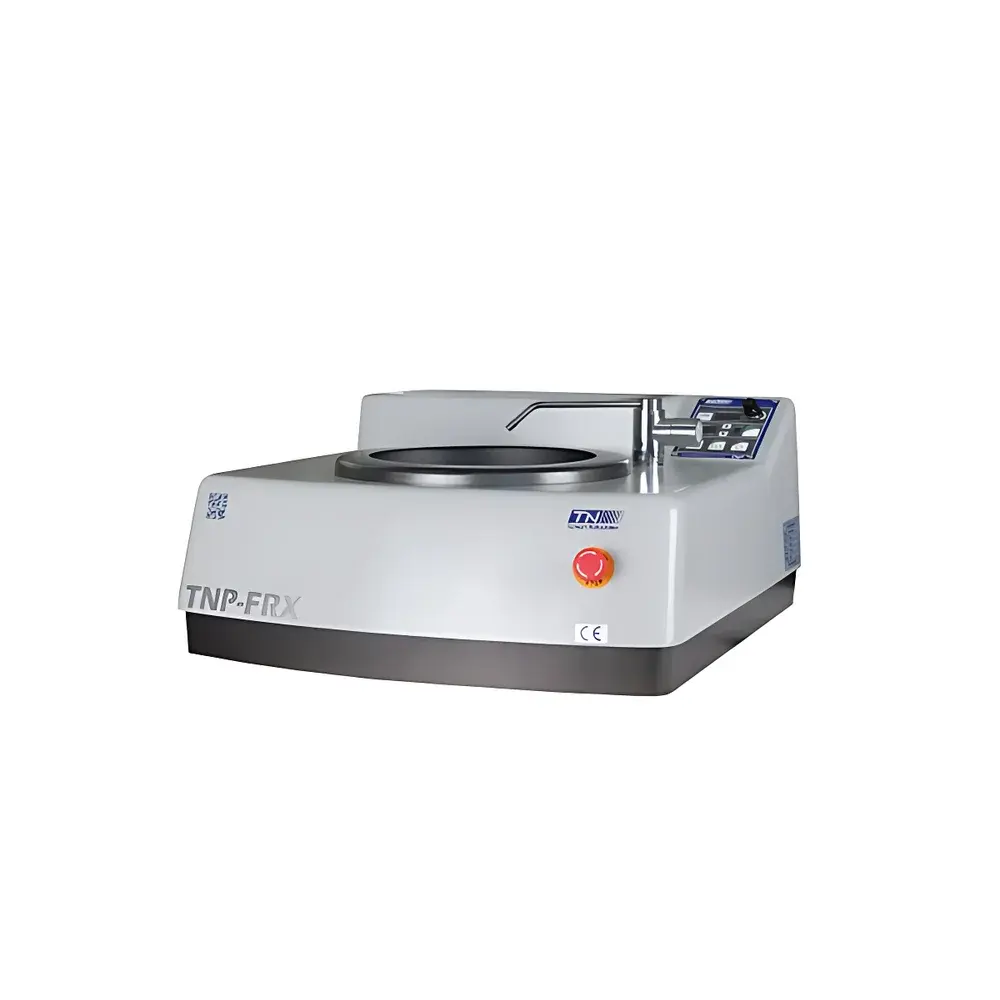
TN Testing TNP-1025FRX Manual Single-Plate Metallographic Grinder-Polisher
| Brand | TN Testing |
|---|---|
| Origin | Taiwan |
| Model | TNP-1025FRX |
| Dimensions (L×W×D) | 556 × 652 × 568 mm |
| Grinding Plate Count | 1 |
| Grinding Plate Diameter | 250 mm |
| Plate Speed | 800 rpm |
| Construction | Cast Aluminum Base with FRP Enclosure |
| Water Delivery System | Stainless Steel/Ceramic Nozzle with Triangular Anti-Clogging Water Path |
| Control Interface | Waterproof Membrane Keypad with 9-Step Program Memory |
| Optional | Removable Anti-Soil Liner |
Overview
The TN Testing TNP-1025FRX is a manually operated, single-plate metallographic grinder-polisher engineered for precision sample preparation in metallurgical, materials science, and failure analysis laboratories. It employs conventional abrasive grinding and cloth-based polishing mechanisms—relying on controlled mechanical shear, particle embedding, and hydrodynamic lubrication—to produce planar, scratch-free surfaces suitable for optical microscopy, SEM imaging, and microhardness testing. Designed for routine use in QC labs and academic research facilities, the TNP-1025FRX prioritizes operational stability, vibration damping, and long-term repeatability over automation—making it especially appropriate for labs where manual process control, material-specific protocol tuning, and operator-dependent endpoint judgment remain standard practice.
Key Features
- Robust cast aluminum base structure—optimized for mass inertia and resonance suppression—reduces operational vibration by up to 40% compared to conventional cast iron frames, improving surface flatness and minimizing edge rounding during coarse grinding.
- Integrated quick-change platen system compatible with magnetic adapters and industry-standard diamond-impregnated grinding discs (e.g., 250 mm diameter, ISO 8442-1 compliant), enabling rapid transition between grit stages without tools or alignment recalibration.
- Stainless steel/ceramic composite spray nozzle—co-engineered with industrial sanitaryware specialists—delivers consistent, adjustable water flow at optimized angles (15°–30° incidence) to ensure uniform coolant distribution across the full 250 mm grinding surface while minimizing splash and aerosol generation.
- Triangular-section water channel architecture—featuring shortened path length, smooth internal bore geometry, and chemically inert fluoropolymer-lined tubing—significantly reduces particulate retention and biofilm accumulation, extending maintenance intervals between descaling procedures.
- Waterproof membrane keypad with non-volatile memory storage for nine independent grinding-polishing protocols; each stores plate rotational speed (adjustable within 0–800 rpm), cycle duration (1–999 seconds), and multi-stage sequence logic for sequential disc changes.
- FRP (fiberglass-reinforced polymer) enclosure—resistant to acidic etchants, organic solvents, and abrasive slurry splatter—offers corrosion resilience and simplified wipe-down cleaning, reducing daily decontamination time by approximately 35% versus painted steel housings.
Sample Compatibility & Compliance
The TNP-1025FRX accommodates standard metallographic specimens up to 40 mm in diameter and 30 mm in height—including ferrous alloys, non-ferrous metals (Al, Cu, Ti), ceramics, composites, and sintered powders. Its open-access design supports both mounted and unmounted samples, and its manual feed mechanism allows real-time tactile feedback during final polishing stages—a critical requirement for brittle-phase preservation and interfacial defect assessment. The system complies with ISO 11270:2016 (metallographic specimen preparation), ASTM E3-22 (standard guide for preparation of metallographic specimens), and supports GLP documentation workflows when paired with external lab management software. While not inherently 21 CFR Part 11 compliant, audit-ready operation is achievable via timestamped protocol logs exported from connected PCs.
Software & Data Management
The TNP-1025FRX operates as a standalone instrument with embedded firmware controlling motor drive, timer sequencing, and parameter recall. No proprietary PC software is required for basic operation; however, optional RS-232 or USB-to-serial interfaces allow integration with LIMS or custom Python/Matlab scripts for automated logging of cycle timestamps, speed settings, and cumulative runtime. All nine stored protocols retain calibration-independent values and survive power cycling. Firmware updates are performed via microSD card (sold separately), supporting version-controlled traceability per ISO/IEC 17025 clause 5.9.2.
Applications
- Routine cross-sectional preparation of weld joints, heat-affected zones (HAZ), and coated substrates for ASTM E112 grain size analysis.
- Preparation of fracture surfaces prior to SEM-EDS elemental mapping—where minimized topographic distortion preserves cleavage facet integrity.
- Low-temperature polishing of soft alloys (e.g., Pb-Sn solders, Mg-based AM parts) using colloidal silica suspensions under controlled load and dwell time.
- Teaching laboratories requiring intuitive, low-maintenance platforms for undergraduate metallurgy courses aligned with ABET-accredited curricula.
- Field-deployable prep stations in mobile metallurgical labs—leveraging its compact footprint (0.36 m² floor space) and 230 V / 50 Hz input compatibility.
FAQ
Is the TNP-1025FRX compatible with automatic force-applying heads?
No—it is strictly a manual-feed system. Load application relies on operator-applied downward pressure; no motorized vertical actuation or load-sensing capability is integrated.
Can I retrofit third-party consumables such as Struers or Buehler grinding discs?
Yes—any 250 mm diameter disc with standard M12 threaded center mounting or magnetic backing is mechanically compatible.
What maintenance intervals are recommended for the water delivery system?
Visual inspection every 40 operating hours; full disassembly and ultrasonic cleaning of the nozzle assembly every 200 hours or after processing highly siliceous or oxide-rich samples.
Does the unit include a built-in sediment trap or filter?
No—but the triangular water path geometry and sloped internal channels function as passive particulate settlers; an inline 50 µm stainless mesh filter (part #TNP-FIL-50) is available as optional accessory.
Is the removable liner certified for chemical resistance to HF-based etchants?
The standard liner is rated for pH 2–12 exposure; HF compatibility requires the optional PTFE-coated liner (part #TNP-LIN-PTFE), which withstands ≤10% v/v hydrofluoric acid for ≤5 minute contact durations.



