
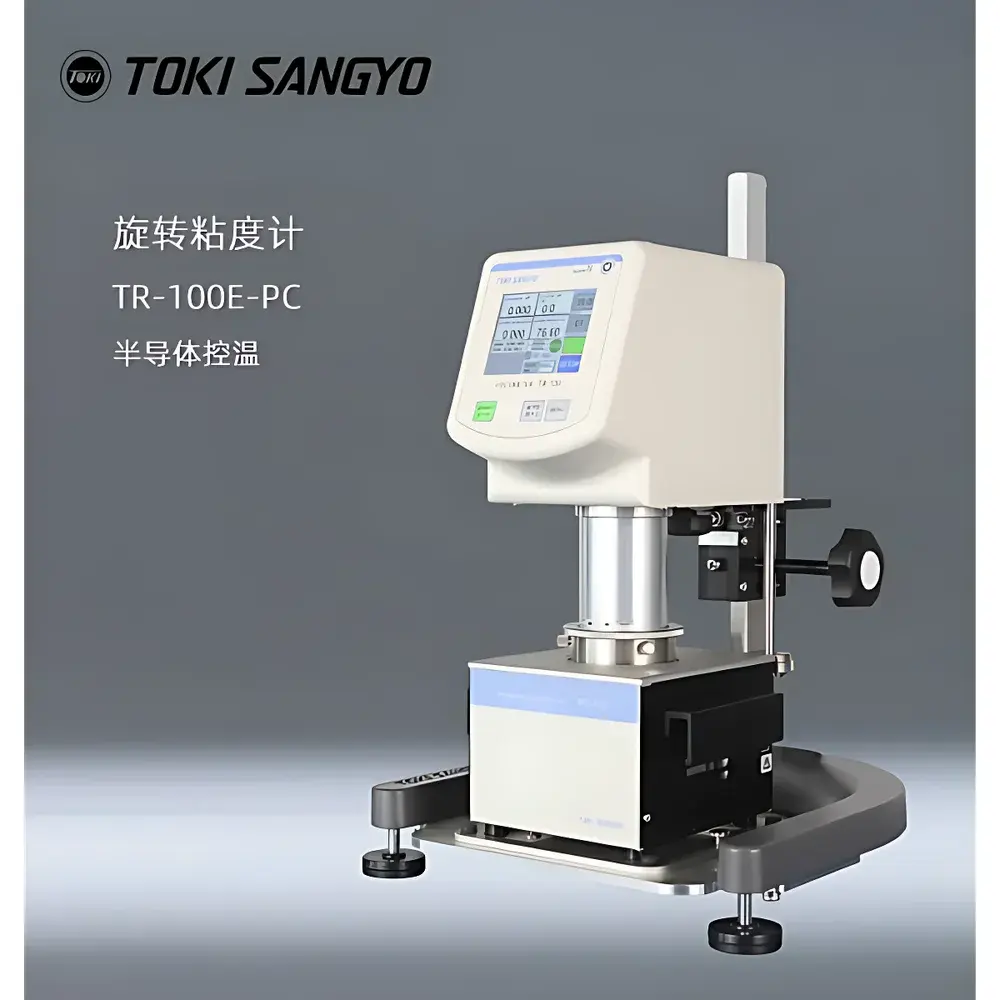
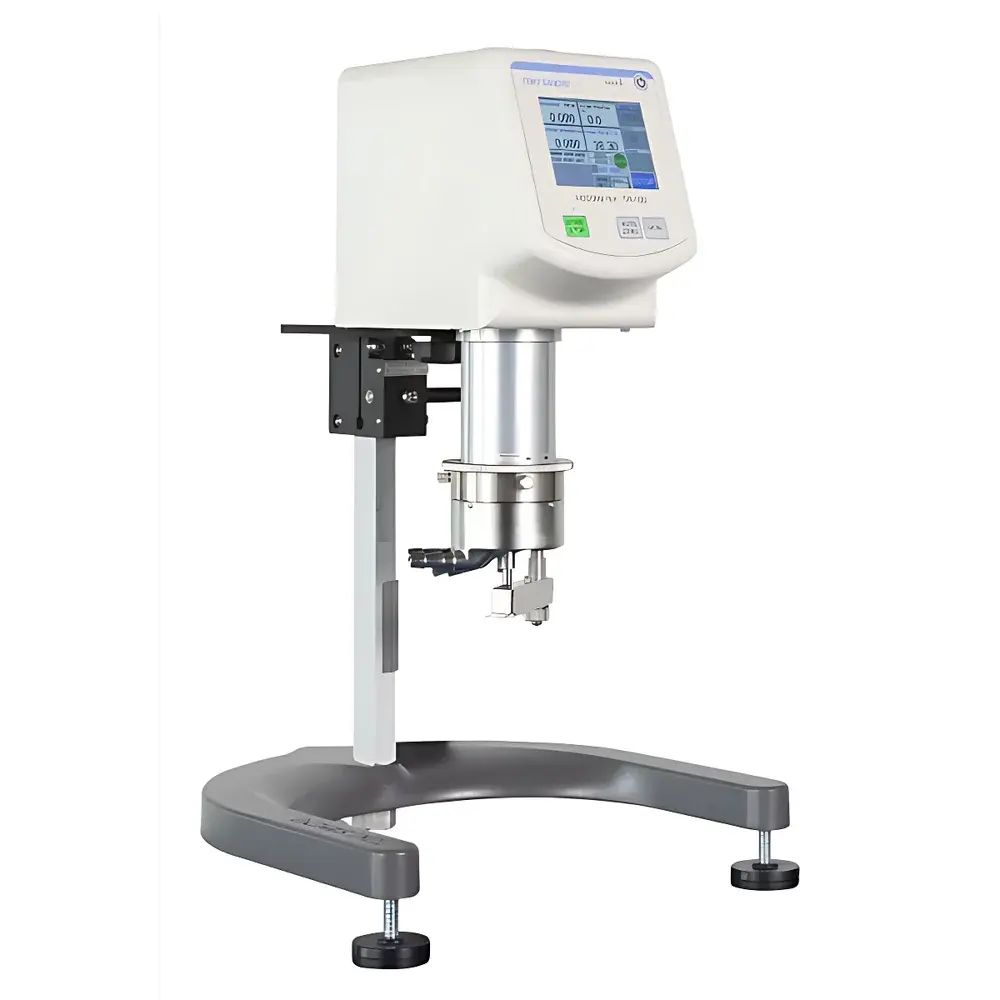
TOKI SANGYO TR-100E Series Cone-and-Plate Viscometer with Peltier Temperature Control
| Brand | TOKI SANGYO |
|---|---|
| Origin | Japan |
| Model Variants | TR-100EL(PC), TR-100EH(PC), TR-100ER(PC), TR-100EU(PC) |
| Viscometer Type | Rotational Viscometer (Cone-and-Plate Geometry) |
| Mounting | Benchtop Fixed Installation |
| Operating Environment | Ambient Temperature |
| Viscosity Range | 15 – 320,000,000 mPa·s |
| Temperature Control Range | 10–40 °C |
| Temperature Resolution | 0.1 °C |
| Temperature Accuracy | ±0.2 °C |
| Rotational Speed Range | 0.1–100.0 rpm (0.1 rpm increments) |
Overview
The TOKI SANGYO TR-100E Series is a precision-engineered cone-and-plate rotational viscometer designed for high-reproducibility viscosity measurements in quality control, R&D, and production environments—particularly where thermal stability and operator safety are critical. Unlike coaxial cylinder (cup-and-bob) or spindle-based systems, the cone-and-plate geometry establishes a well-defined, uniform shear gap (typically 1–2° cone angle) that enables accurate calculation of shear rate and shear stress under controlled laminar flow conditions. This configuration satisfies the fundamental rheological requirement of constant shear rate across the entire sample volume, making it ideal for Newtonian and moderately non-Newtonian fluid characterization. The TR-100E integrates Peltier-based temperature regulation directly into the plate assembly, delivering rapid thermal equilibration and stable isothermal measurement conditions within the 10–40 °C range—essential for evaluating temperature-dependent behavior of semiconductor slurries, photoresists, adhesives, and electronic encapsulants.
Key Features
- Cone-and-plate sensor architecture: Ensures precise, geometry-defined shear field with minimal sample volume (typically 0.5–1.0 mL), reducing material waste and enabling rapid thermal response.
- Peltier-controlled temperature plate: Integrated thermoelectric module provides active heating and cooling without external chillers or baths; maintains ±0.2 °C accuracy with 0.1 °C resolution.
- 3.5-inch color TFT touchscreen interface: Intuitive graphical UI displays real-time viscosity, torque, shear rate, temperature, and motor status; supports multi-language operation and on-screen parameter setup.
- Fine-resolution speed control: Adjustable rotational speed from 0.1 to 100.0 rpm in 0.1 rpm increments, enabling low-shear characterization of weak gels and high-shear evaluation of low-viscosity fluids.
- Auto-locking spindle mechanism: Engages automatically upon test completion to immobilize the cone shaft, preventing mechanical wear on the precision pivot bearing during rotor removal—critical for long-term calibration stability.
- Fail-safe power management: Power-off sequence delays shutdown until spindle locking is confirmed, eliminating risk of bearing damage from abrupt de-energization.
- Intelligent operational safeguards: Includes automatic preheat activation (configurable as auto-start trigger), programmable run/stop timing, and dual-range over/under-scale alerts (±10% and >100% torque limits).
Sample Compatibility & Compliance
The TR-100E accommodates a broad spectrum of industrial and technical fluids—including solvent-based photoresists, CMP slurries, dielectric pastes, solder mask inks, and UV-curable adhesives—without requiring custom fixtures. Its sealed, corrosion-resistant aluminum housing meets IP42 environmental protection standards for laboratory use. While the instrument itself does not carry CE or UL certification out-of-box (certification is responsibility of end-user’s local regulatory authority), its analog/digital signal architecture and firmware design support integration into GLP/GMP workflows. Data output formats (CSV, ASCII) are compatible with LIMS and MES platforms. Optional temperature probe interfaces allow traceable calibration against NIST-traceable reference standards, supporting ISO/IEC 17025-compliant validation protocols.
Software & Data Management
The TR-100E(PC) variants feature RS-232 and USB-B connectivity for direct PC communication. TOKI SANGYO’s proprietary ViscoLink software (Windows-compatible) enables remote instrument control, real-time data streaming, multi-point time-sweep and temperature-ramp experiments, and automated report generation (PDF/Excel). All measurement sessions include embedded metadata: timestamp, operator ID, temperature setpoint, rotational speed, torque reading, and system diagnostic flags. Audit trail functionality records parameter changes and calibration events—aligning with FDA 21 CFR Part 11 requirements when deployed with appropriate user access controls and electronic signature modules.
Applications
- Viscosity profiling of semiconductor photolithography resists across process-relevant temperature windows (e.g., 23 °C ± 0.5 °C for coating uniformity assessment)
- Rheological screening of chemical-mechanical polishing (CMP) slurries to ensure consistent particle suspension and shear-thinning behavior
- QC testing of conductive pastes and underfill materials used in flip-chip packaging
- Batch-to-batch consistency verification of encapsulation resins and die-attach adhesives
- Temperature-dependent viscosity mapping for thermal interface materials (TIMs) in power electronics
- Stability monitoring of nano-dispersions and colloidal suspensions during shelf-life studies
FAQ
What sample volume is required for cone-and-plate measurement?
Typically 0.5–1.0 mL, depending on cone angle and plate diameter—significantly less than cup-and-bob configurations.
Is the TR-100E compliant with ASTM D445 or ISO 3219?
It adheres to the geometric and operational principles defined in ISO 3219 (rotational viscometers using defined geometries); full compliance requires user-performed validation per Section 6 of the standard.
Can the instrument perform yield stress estimation?
Not natively via built-in algorithms; however, ramped-speed or controlled-stress protocols can be executed manually or via ViscoLink scripting to derive approximate yield values using Casson or Bingham models.
What maintenance is required for long-term accuracy?
Annual recalibration of torque and temperature sensors using certified reference standards is recommended; routine cleaning of cone/plate surfaces with lint-free swabs and solvent is sufficient between runs.
Is the Peltier plate compatible with external temperature controllers?
No—the thermal control loop is fully integrated and closed-loop regulated by the internal PID controller; external interfacing is limited to setpoint override via serial command.



