
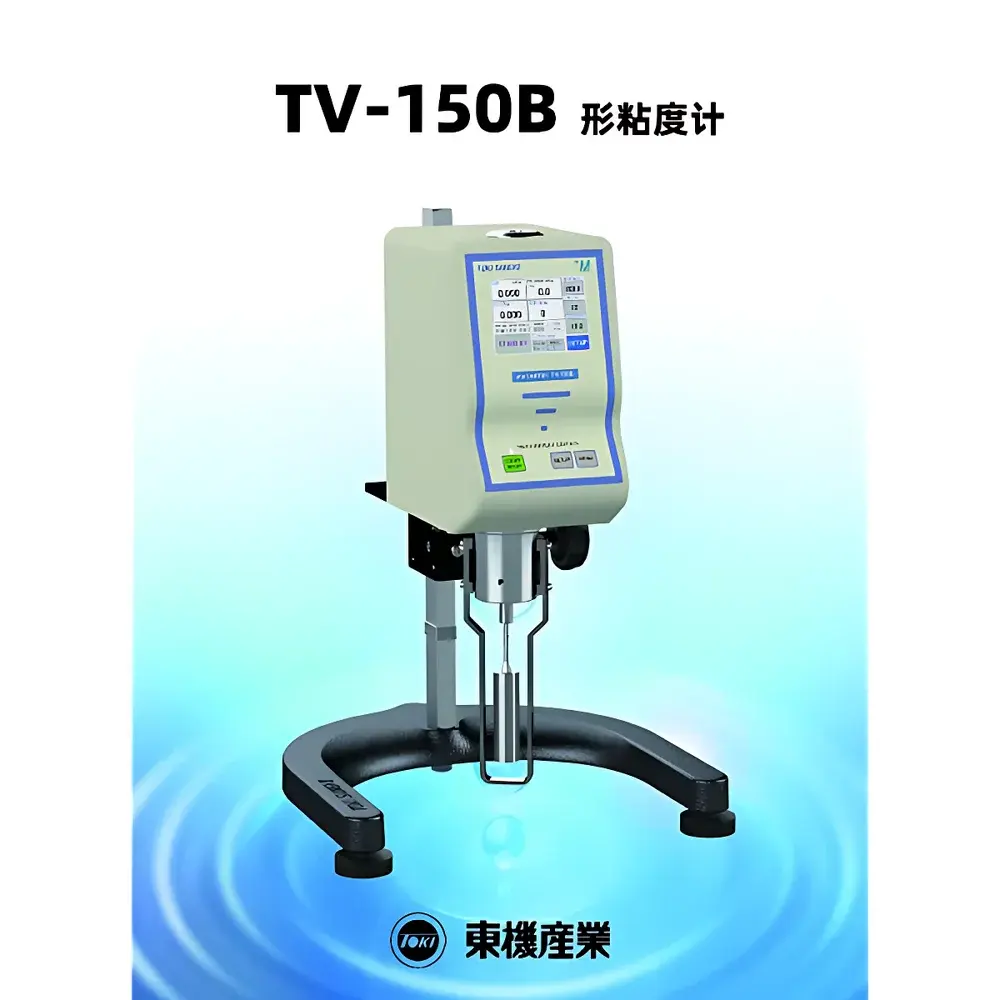
TOKI SANGYO TV-150BU Rotational Viscometer
| Brand | TOKI SANGYO |
|---|---|
| Origin | Japan |
| Model | TV-150BU |
| Instrument Type | Benchtop Rotational Viscometer |
| Viscosity Range | 400 – 320,000,000 mPa·s |
| Rotational Speed | 0.1–100.0 rpm (0.1 rpm increments) |
| Accuracy | ±1.0% of full scale |
| Repeatability | ±0.2% of full scale |
| Torque Range | 0–5749.6 µNm |
| Display | 3.5-inch color LCD touchscreen |
| Sample Temperature Environment | 0–40 °C, RH <90% non-condensing |
| Wetted Parts Material | Stainless steel |
| Power Supply | AC 100–230 V, 20 VA |
| Dimensions (main unit) | 120 × 182 × 199 mm (W×D×H) |
| Base Dimensions | 300 × 310 × 436 mm (W×D×H) |
| Weight | ~2.4 kg |
| Standard Spindles | 4 included |
Overview
The TOKI SANGYO TV-150BU is a high-precision benchtop rotational viscometer engineered for reliable, long-term viscosity measurement of Newtonian and non-Newtonian fluids across an exceptionally wide dynamic range—from 400 to 320 million mPa·s. Based on the coaxial cylinder (Couette flow) principle, it measures torque generated by fluid resistance during controlled rotation of a spindle immersed in the sample. Its core innovation lies in the torsion-wire and magnetic bearing system—eliminating mechanical contact between rotating and stationary components. This design ensures zero wear on critical motion elements, enabling stable calibration retention and metrological consistency over thousands of operational hours without recalibration drift. The instrument is optimized for routine QC/QA labs, R&D environments, and production floor applications where reproducibility, low maintenance, and traceable measurement integrity are mandatory.
Key Features
- Torsion-wire + magnetic bearing suspension system: Eliminates shaft friction and bearing degradation; delivers intrinsic mechanical stability and lifetime repeatability.
- 3.5-inch full-color LCD touchscreen interface: Provides real-time display of viscosity (mPa·s or cP), % torque, upper measurement limit, and rotational speed—enabling intuitive parameter setup and immediate visual feedback.
- Quick-swap spindle mounting: Tool-free, plug-in spindle installation ensures rapid interchange among four standard spindles—minimizing downtime between sample measurements.
- Benchtop fixed-frame architecture: Integrated base platform (300 × 310 × 436 mm) provides vibration-damping stability and alignment consistency for high-sensitivity torque detection.
- Wide-speed control: Precise motor-driven rotation from 0.1 to 100.0 rpm in 0.1-rpm increments supports both low-shear characterization (e.g., polymer melts, gels) and high-shear screening (e.g., coatings, inks).
- Full-scale torque capacity of 5749.6 µNm: Enables accurate quantification of ultra-high-viscosity materials—including bitumen, uncured elastomers, and ceramic slurries—without range switching or sensor saturation.
Sample Compatibility & Compliance
The TV-150BU accommodates a broad spectrum of industrial and research-grade samples—including paints, adhesives, pharmaceutical suspensions, food emulsions, lubricants, and battery slurries—within ambient temperature conditions (0–40 °C). All wetted parts are constructed from corrosion-resistant stainless steel, ensuring chemical compatibility with mildly aggressive solvents and aqueous systems. The instrument meets fundamental mechanical and electrical safety requirements per IEC 61010-1 and conforms to electromagnetic compatibility standards (IEC 61326-1). While not inherently 21 CFR Part 11 compliant, its deterministic analog torque sensing architecture and non-volatile parameter storage support audit-ready documentation when integrated into validated laboratory workflows aligned with ISO/IEC 17025, ASTM D2196, ISO 2555, and USP viscosity testing guidelines.
Software & Data Management
The TV-150BU operates as a standalone instrument with embedded firmware—no external PC required for basic operation. All measurement data (viscosity, torque, speed, timestamp) are stored internally and exportable via USB interface in CSV format for downstream analysis in Excel, MATLAB, or LIMS platforms. The touchscreen interface supports user-defined test protocols—including multi-speed ramp sequences and timed hold steps—for standardized method execution. Optional PC software (sold separately) enables remote control, real-time graphing, statistical batch reporting, and GLP-compliant electronic signature logging—facilitating integration into GMP-regulated quality systems requiring full traceability and change control.
Applications
- Quality control of high-viscosity industrial fluids: Bitumen grading, epoxy resin curing monitoring, silicone rubber compound consistency verification.
- Pharmaceutical formulation development: Viscosity profiling of sustained-release suspensions, ointment bases, and injectable hydrogels under low-shear conditions.
- Food science laboratories: Rheological assessment of starch-thickened sauces, chocolate mass, and dairy-based fillings across processing-relevant shear rates.
- Academic rheology education: Demonstrating shear-thinning behavior, yield stress estimation (via flow curve extrapolation), and temperature-viscosity relationships using optional Peltier accessories.
- Materials science research: Characterizing concentrated colloidal dispersions, nanocomposite pastes, and additive manufacturing feedstocks prior to extrusion or jetting.
FAQ
What spindle configurations are supported with the TV-150BU?
The instrument ships with four standard cylindrical spindles optimized for the specified viscosity range; additional geometry options (e.g., vane, T-bar, or ultra-low-volume spindles) are available through TOKI SANGYO’s accessory catalog.
Is temperature control integrated into the base unit?
No—temperature regulation requires external circulation baths or Peltier-stage accessories; the TV-150BU itself is rated for operation within 0–40 °C ambient conditions.
Can the TV-150BU be calibrated traceably to national standards?
Yes—certified reference oils (e.g., Cannon-Fenske or NIST-traceable silicone standards) are used for periodic verification; calibration certificates conforming to ISO/IEC 17025 may be issued by authorized service centers.
Does the instrument support automatic viscosity unit conversion?
Yes—the display and data output allow seamless toggling between SI (mPa·s) and CGS (cP) units, with automatic scaling to avoid scientific notation clutter.
What maintenance is required beyond routine cleaning?
None—due to the contactless torsion-wire/magnetic bearing system, no lubrication, alignment, or wear-part replacement is necessary throughout the instrument’s service life.



