
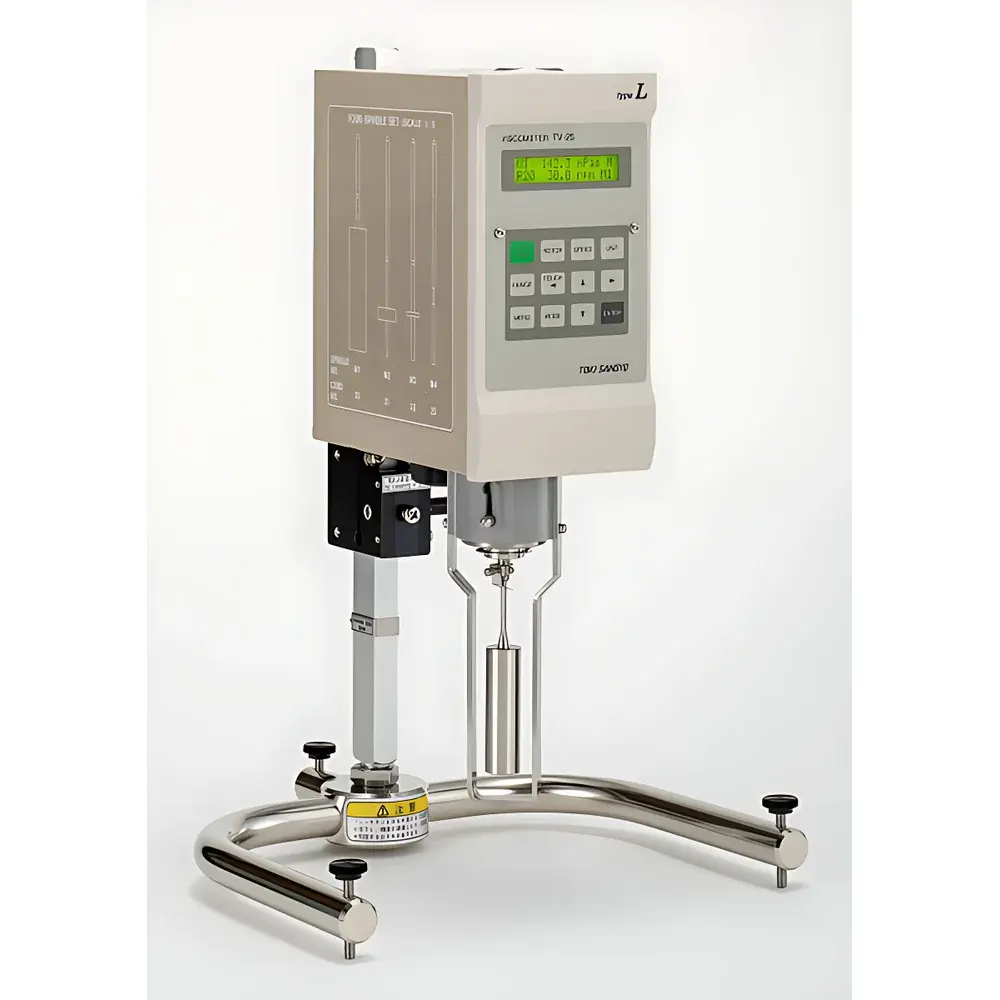
TOKI SANGYO TVB-25L/TVB-25H/TVB-35L/TVB-35H Advanced Portable Rotational Viscometer
| Brand | TOKI SANGYO |
|---|---|
| Origin | Japan |
| Model | TVB-25L, TVB-25H, TVB-35L, TVB-35H |
| Instrument Type | Portable Rotational Viscometer |
| Viscosity Range | 0.1–320,000,000 mPa·s |
| Speed Range | 0.01–100.0 rpm (adjustable in 0.1 rpm increments) |
| Torque Measurement Principle | Servo-controlled torque balance method |
| Bearing Architecture | Pivot-free hinge mechanism |
| Accuracy | ±1% of full scale |
| Repeatability | ±0.2% of full scale |
| Temperature Range | 10–60 °C |
| Compliance | JIS Z 8803, ISO 2555, ASTM D2196 |
| Data Interface | RS-232, USB |
| Power Supply | AC 100–230 V, 50/60 Hz |
| Dimensions (H×W×D) | 320 × 105 × 220 mm (main unit) |
| Weight | ~9 kg (including stand) |
Overview
The TOKI SANGYO TVB-25 and TVB-35 series are precision-engineered portable rotational viscometers designed for high-fidelity viscosity measurement across an exceptionally broad dynamic range—up to eightfold expansion without rotor replacement. These instruments operate on the servo-controlled torque balance principle, employing a zero-point null method that eliminates mechanical drift and ensures linear response across the entire measurement span. Unlike conventional viscometers relying on jewel pivot bearings—which introduce hysteresis and wear-related nonlinearity—the TVB series utilizes a patented pivot-free hinge mechanism. This architecture delivers consistent torsional compliance and eliminates bearing-induced torque artifacts, enabling reliable data acquisition from ultra-low-viscosity liquids (0.1 mPa·s) to highly structured polymer melts and pastes (up to 320 million mPa·s). The design conforms to internationally recognized standards including JIS Z 8803 (rotational viscometry), ISO 2555 (determination of apparent viscosity), and ASTM D2196 (non-Newtonian fluid behavior), making it suitable for QC laboratories operating under GLP or GMP frameworks.
Key Features
- Servo-driven torque balance system with real-time null-point detection ensures minimal mechanical inertia and high signal fidelity.
- Pivot-free hinge structure replaces traditional jewel bearings—eliminating stiction, wear, and calibration drift over extended operation.
- Dynamic range expansion up to 8× within a single rotor configuration (e.g., M-series or H-series), enabled by automatic torque-range switching and adaptive gain control.
- Ultra-fine speed resolution: programmable rotation from 0.01 to 100.0 rpm in 0.1 rpm increments—critical for characterizing shear-thinning/thickening behavior and yield stress estimation.
- Integrated auto-zero and offset correction routines reduce operator dependency and improve inter-laboratory reproducibility.
- Four preset measurement modes: Manual, Time-based Auto-Stop, Viscosity-threshold Auto-Stop, and fully programmable multi-step sequences (up to 40 segments on TVB-35 models).
- Remote control capability via dry-contact input signals; status outputs (measuring, alarm, completion) provided as open-collector TTL-compatible signals.
- Real-time upper/lower limit alarms with audible notification and visual flagging—essential for unattended batch monitoring.
Sample Compatibility & Compliance
The TVB-25/35 series supports both bulk-container testing (B-type configuration) and micro-volume cone-plate measurements (E-type, sold separately). In B-mode, samples are placed directly into standard beakers or cylindrical vessels (no specialized geometry required), accommodating volumes from 20 mL upward. The instrument’s torque-sensing architecture remains insensitive to container wall effects within typical lab-scale geometries. All wetted parts—including rotor shafts, spindles, and sample cups—are constructed from corrosion-resistant stainless steel (SUS316 equivalent), ensuring compatibility with aqueous, organic, and mildly aggressive media. Regulatory alignment includes traceability to JIS and ISO viscosity standards, with built-in support for cP, mPa·s, Pa·s, and kPa·s unit conversion. For audit-ready environments, raw torque and speed timestamps are logged at user-configurable intervals, satisfying basic FDA 21 CFR Part 11 data integrity prerequisites when paired with validated software.
Software & Data Management
While the TVB series operates as a standalone benchtop instrument, its RS-232 and USB interfaces enable seamless integration with third-party data acquisition platforms or custom LIMS workflows. Real-time streaming of viscosity, torque, speed, and temperature (when used with optional external probe) is supported at configurable sampling rates. Internal memory stores five independent parameter sets per mode—ideal for routine SOP execution across multiple product lines. Data export follows ASCII-delimited format for direct import into Excel, MATLAB, or statistical analysis packages. TI (Thixotropy Index) calculation is embedded: users define two shear rates (typically ratio 1:10), and the device computes η₁/η₂ automatically—valuable for quality control of paints, adhesives, and cosmetic emulsions. No proprietary drivers or closed ecosystems are required; communication protocols are documented in the technical manual for OEM integration.
Applications
These viscometers serve diverse sectors where wide-range rheological screening is critical but full rheometer investment is unjustified. In coatings and ink manufacturing, they quantify sag resistance and leveling behavior across shear rates mimicking application conditions (e.g., spray, roll, brush). Polymer processors use them to monitor melt viscosity shifts during extrusion trials or resin curing kinetics. Food R&D labs apply them to characterize texture modifiers, starch gels, and dairy suspensions under controlled thermal ramping (with external bath coupling). Pharmaceutical formulation teams employ them for suspension stability assessment and ointment spreadability profiling—particularly where USP or EP 2.9.36 compliance is targeted. The absence of mechanical pivots also makes them uniquely suited for abrasive or particulate-laden slurries common in ceramics, battery slurry, and mining process control.
FAQ
What distinguishes the TVB-25 from the TVB-35 model?
The TVB-35 adds advanced programmability—including 40-segment measurement sequences, RETURN/REPEAT logic, and automated TI index computation—while retaining identical torque sensing and dynamic range capabilities.
Can I measure samples below 10 °C or above 60 °C?
No. The specified operational temperature window is 10–60 °C. Extended-range measurements require external environmental control (e.g., Peltier stage or circulating bath) with appropriate sensor feedback.
Is calibration traceable to national standards?
Yes. TOKI SANGYO provides NIST-traceable calibration certificates for torque and rotational speed upon request; field recalibration uses certified silicone oil standards compliant with ISO 17025-accredited labs.
Do I need different rotors to cover the full 0.1–320,000,000 mPa·s range?
No. Dynamic range expansion is achieved electronically via torque-range switching—M-series rotors cover low-to-mid ranges (e.g., TVB-25L: 15–6,000,000 mPa·s), while H-series rotors extend into high-viscosity regimes without physical swap.
How does the pivot-free mechanism affect long-term stability?
By eliminating mechanical pivots and jewel bearings, the hinge-based torque sensor avoids wear-induced zero-shift, maintaining ±0.2% repeatability over >10,000 measurement cycles under routine laboratory use.



