
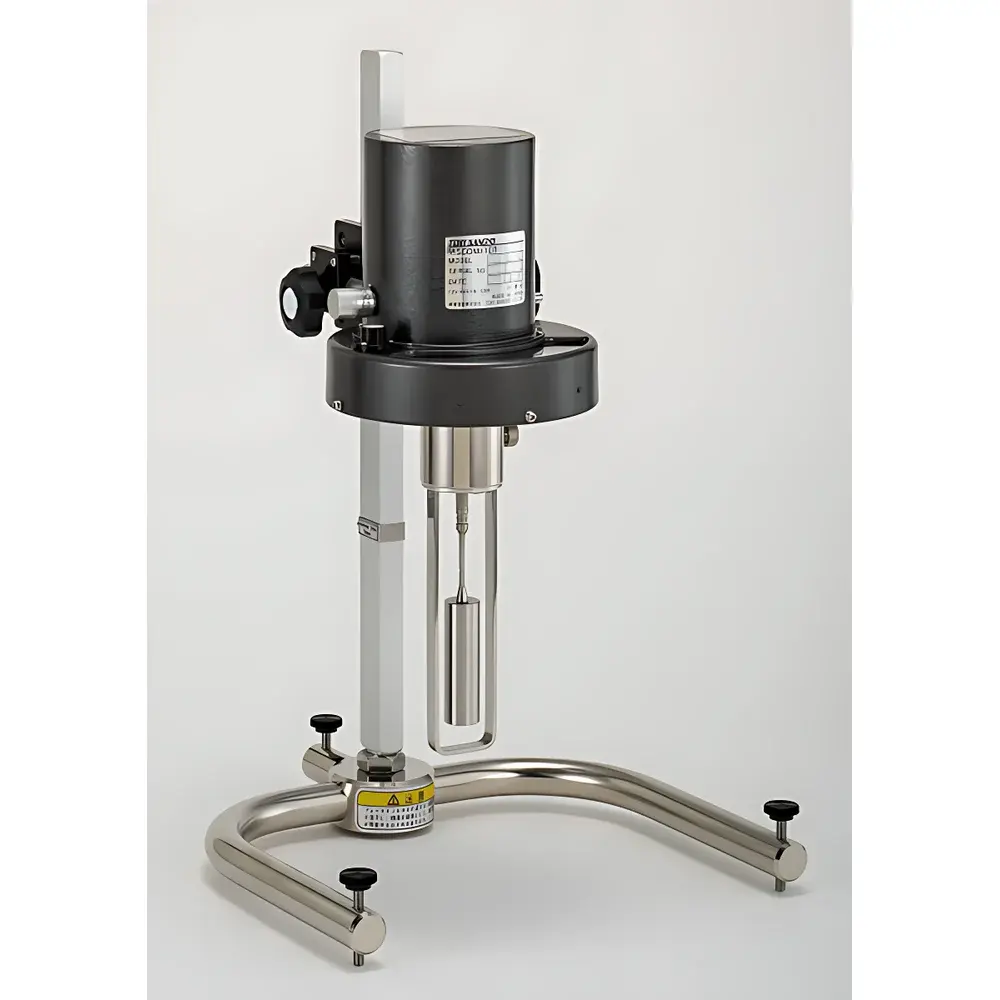
Tokisangyo BLII/BMII/BHII/BSII Dial-Type Rotational Viscometer
| Brand | Tokisangyo |
|---|---|
| Origin | Japan |
| Model | BLII / BMII / BHII / BSII |
| Instrument Type | Fixed-Base Rotational Viscometer |
| Viscosity Range | 1–12,000,000 mPa·s |
| Operating Environment | Ambient Temperature |
| Primary Unit | BII Viscometer Head |
| Distribution Status | Authorized Distributor (Imported) |
Overview
The Tokisangyo BLII, BMII, BHII, and BSII series are precision-engineered dial-type rotational viscometers designed for reliable, repeatable viscosity measurement of Newtonian and mildly non-Newtonian fluids under ambient laboratory or industrial QC conditions. Based on the classical Couette principle—where torque induced by fluid shear between a rotating spindle and stationary sample cup is mechanically transmitted to a calibrated torsion spring and displayed via analog dial—the BII-series instruments deliver direct, real-time viscosity readings without dependency on digital signal processing or external power for core measurement. This passive mechanical architecture ensures intrinsic stability, long-term calibration retention, and immunity to electromagnetic interference—critical attributes for environments where electrical noise, power instability, or validation traceability constrain electronic instrumentation.
Key Features
- Mechanically driven analog measurement system with no requirement for batteries or AC power during operation—ideal for field use, cleanrooms, or explosion-hazard zones.
- Four interchangeable spindle configurations (L, M, H, S) corresponding to BLII, BMII, BHII, and BSII models, each optimized for distinct viscosity ranges and sample volumes to maintain shear rate consistency across the full 1–12,000,000 mPa·s span.
- Robust aluminum alloy housing with precision-machined bearing assembly and temperature-stable brass torsion spring, engineered for minimal hysteresis and drift over extended service life.
- Dual-scale dial display (mPa·s and cP) with parallax-free mirrored scale and vernier pointer for ±1% full-scale readability per ASTM D2196 and ISO 2555 compliance protocols.
- Standardized DIN 53019-1 spindle geometry and cup dimensions ensure inter-laboratory comparability and compatibility with reference oil calibration standards.
- Fixed-base design eliminates leveling sensitivity and minimizes operator-induced vibration artifacts—particularly advantageous for high-viscosity measurements above 100,000 mPa·s.
Sample Compatibility & Compliance
The BII-series accommodates samples from low-shear paints and polymer solutions (BLII, 1–2000 mPa·s) to heavy-duty lubricants, bitumen emulsions, and uncured elastomer compounds (BSII, up to 12×10⁶ mPa·s). Sample volume requirements range from 15 mL (L-spindle) to 400 mL (S-spindle), supporting both small-batch R&D screening and bulk QC verification. All models conform to ISO 2555:2019 (Plastics — Determination of apparent viscosity of organic liquids using rotational viscometers), ASTM D1084 (Standard Test Method for Viscosity of Adhesives), and JIS K 6893 for Japanese industrial adhesives and coatings. The mechanical construction meets IP52 ingress protection rating for dust resistance and limited moisture exposure, supporting deployment in controlled manufacturing areas operating under ISO 9001 or IATF 16949 quality management systems.
Software & Data Management
While the BII-series operates independently of software, optional accessories—including analog-to-digital transducers (e.g., Tokisangyo VT-100), RS-232 interface modules, and PC-based logging software (ViscoLink Pro v3.2)—enable automated data capture, time-stamped trend analysis, and export to CSV or Excel formats. When integrated into validated environments, the system supports audit trail generation, user access control, and electronic signature functionality compliant with FDA 21 CFR Part 11 requirements. Calibration records—including spindle identification, standard oil lot numbers, and date-stamped verification reports—are maintained in accordance with GLP and GMP documentation practices.
Applications
- Quality control of industrial coatings, inks, and varnishes where batch-to-batch consistency must meet ISO 1514 or ASTM D5237 specifications.
- Rheological screening of food-grade starch slurries, dairy concentrates, and plant-based gels under non-sterile ambient conditions.
- Viscosity monitoring of transformer oils and hydraulic fluids per IEC 60296 and ASTM D341 viscosity-temperature correlation protocols.
- Pre-qualification testing of epoxy resins and casting compounds prior to rheometer-based thixotropy or cure kinetics analysis.
- Educational laboratories requiring demonstrable physical principles of shear stress, angular displacement, and Newtonian fluid behavior without computational abstraction.
FAQ
Is the BII-series suitable for non-Newtonian fluid characterization?
Yes—when used with standardized spindle rotation speeds and documented shear rates (calculated per spindle geometry and RPM), it provides comparative yield point estimation and flow curve approximation for weakly shear-thinning systems. However, full viscoelastic profiling requires a controlled-stress rheometer.
Can calibration be performed in-house?
Yes—using NIST-traceable mineral oil standards (e.g., Cannon N4700 series) and following Tokisangyo’s documented calibration procedure (TS-CAL-BII Rev. 4), labs may perform routine verification. Full recalibration requires factory service.
What maintenance intervals are recommended?
Biannual inspection of spindle coupling integrity, bearing lubrication, and dial zero alignment is advised. Spindles should be cleaned with solvent-compatible lint-free wipes after each use to prevent residue buildup affecting torque transmission.
Does the instrument comply with ISO/IEC 17025 requirements?
When operated within its specified environmental limits and supported by documented uncertainty budgets (±1.5% of reading at 23°C ±2°C), the BII-series meets metrological criteria for accredited testing laboratories per ISO/IEC 17025:2017 Clause 6.4.1.



