
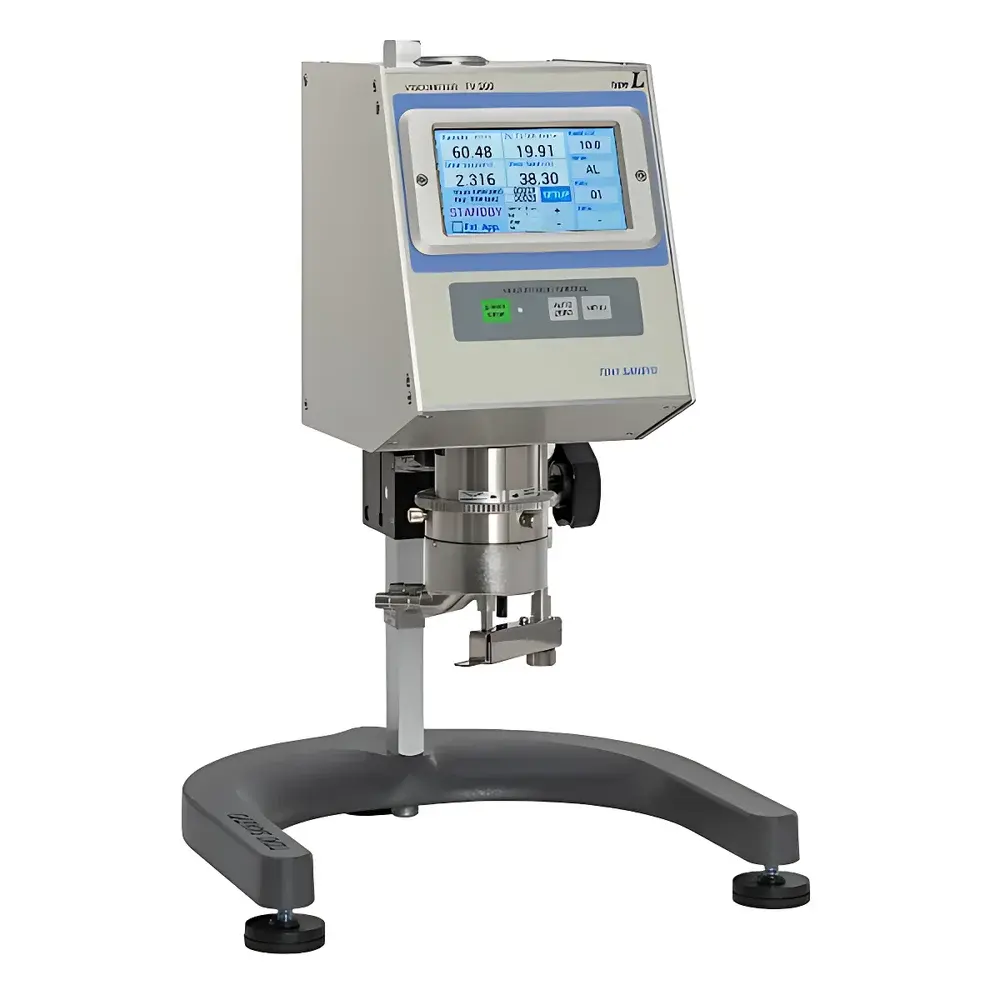
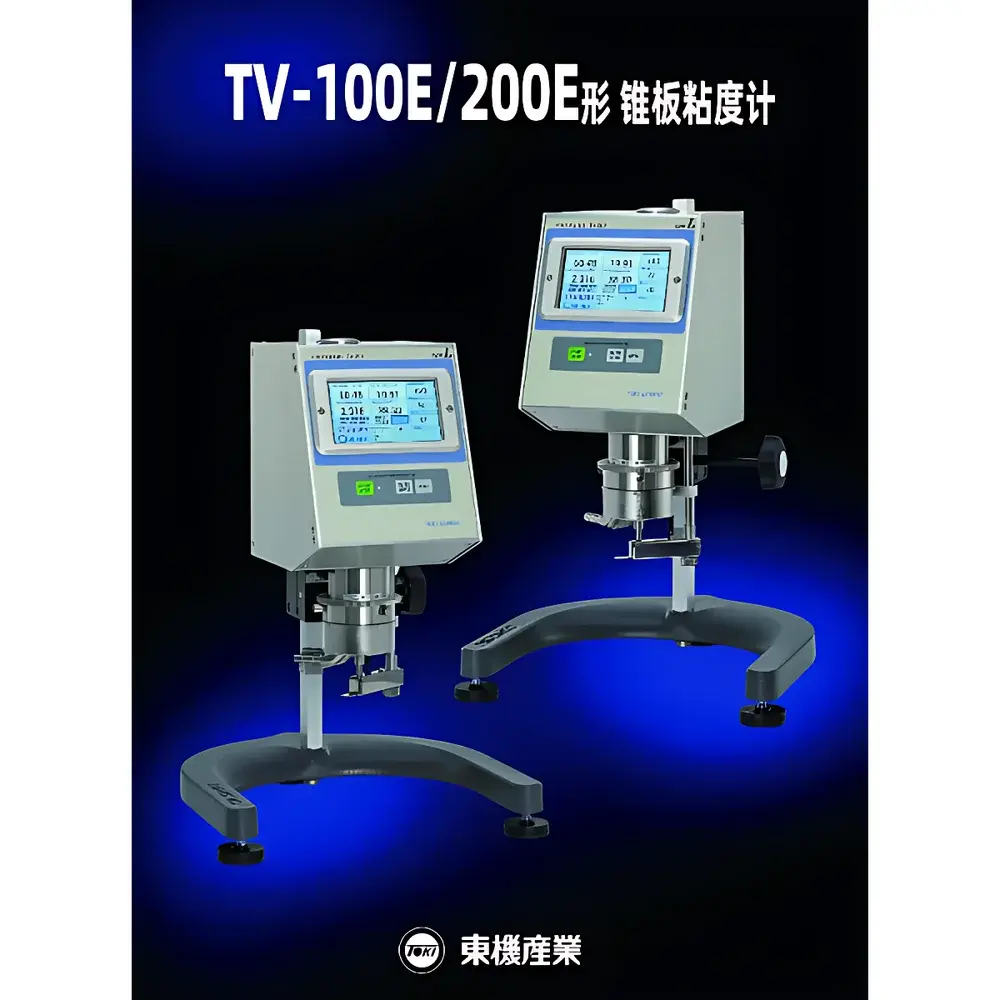
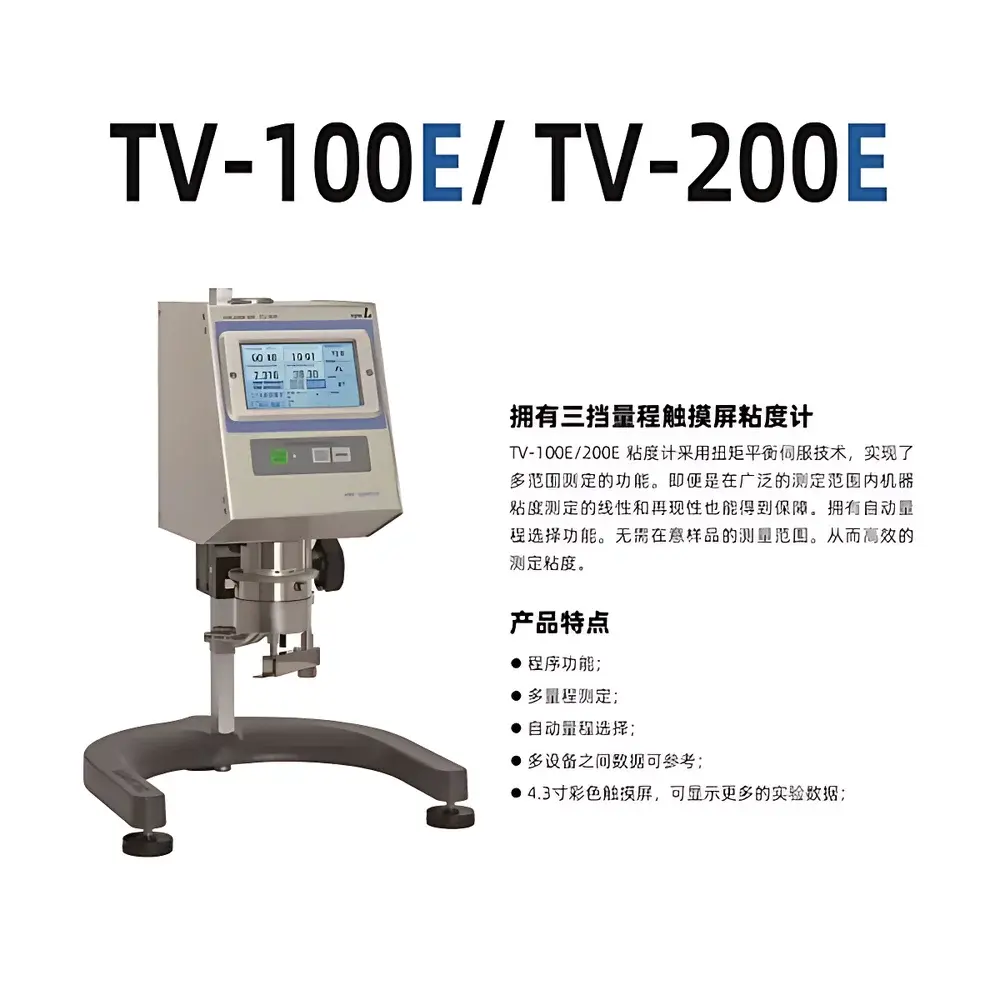
Tokisangyo TV-100EL Cone-and-Plate Viscometer
| Brand | Tokisangyo |
|---|---|
| Origin | Japan |
| Model | TV-100EL Cone-and-Plate Viscometer (Multi-Range) |
| Instrument Type | Rotational Viscometer |
| Mounting | Benchtop Fixed |
| Operating Environment | Ambient Temperature |
| Viscosity Range | 0.608–30,380 mPa·s (standard cone rotor 1°34′ × R24) |
| Torque Range | 7.37–336.9 μN·m |
| Rotational Speed | 0.1–100.0 rpm (0.1 rpm increments, 1001 steps) |
| Temperature Range | 10–60 °C (with optional thermostatic bath) |
| Temperature Resolution & Accuracy | 0.1 °C resolution, ±0.2 °C accuracy |
| Display | 4.3″ color TFT touchscreen |
| Data Interface | USB-B (PC), USB-A (printer), analog/temp sensor inputs |
| Compliance | JIS Z 8803, ISO 2555, ASTM D2196 |
| Accuracy | ±1% of full scale |
| Repeatability | ±0.2% of full scale |
| Power | AC 100–240 V, 15 VA |
| Dimensions (W×D×H) | 300 × 334 × 436 mm |
| Weight | ~6.5 kg |
Overview
The Tokisangyo TV-100EL is a high-precision benchtop cone-and-plate viscometer engineered for reproducible, traceable viscosity measurements across a broad dynamic range. It operates on the principle of controlled shear rate rheometry: a precisely ground conical rotor rotates at defined angular velocity over a flat, temperature-controlled plate, generating a uniform shear field in the sample gap. This geometry ensures well-defined shear stress and shear rate profiles—critical for Newtonian and non-Newtonian fluid characterization under ISO 2555 and ASTM D2196 compliant conditions. Unlike traditional spindle-based rotational viscometers, the cone-and-plate configuration eliminates end effects and provides intrinsic calibration traceability via geometric parameters (cone angle, radius, gap height), enabling direct calculation of shear stress (τ) and shear rate (γ̇) without empirical correction factors. The TV-100EL employs a torque-balance servo system with zero-point null measurement methodology—eliminating mechanical hysteresis and bearing drift—and integrates a pivot-free hinge mechanism that replaces conventional jewel bearings, thereby ensuring linearity and stability across its entire 8× dynamic range without rotor exchange.
Key Features
- Torque-balance servo drive with real-time null detection for high-fidelity torque measurement and minimal thermal drift
- Pivot-free hinge architecture eliminating mechanical play, wear, and calibration dependency on bearing integrity
- Multi-range dynamic torque sensing (7.37–336.9 μN·m) enabling seamless 8× viscosity span extension (0.608–30,380 mPa·s) without manual rotor change
- 4.3″ full-color capacitive touchscreen interface with intuitive navigation, real-time parameter visualization (viscosity, % torque, shear stress, shear rate, temperature), and unit toggle (mPa·s/cP)
- Programmable measurement modes: manual, time-triggered auto-stop, and viscosity-threshold auto-stop—each with 10 user-configurable memory slots
- Automated zero and offset calibration routines minimizing operator intervention and procedural variability
- Precise speed control from 0.1 to 100.0 rpm in 0.1-rpm increments (1001 discrete steps), supporting low-shear and transient flow analysis
- Preheat timer with countdown display and automatic assay initiation, enhancing protocol consistency in regulated environments
- Digital I/O support for remote start/stop triggering and status signaling (open-collector outputs for lamp/buzzer feedback)
- Upper/lower limit alarm function with audible alert for out-of-specification results during unattended operation
Sample Compatibility & Compliance
The TV-100EL accommodates small-volume samples (typically 0.5–1.0 mL) with minimal waste—ideal for precious or hazardous materials. Its stainless-steel wetted parts (cone, plate, guard ring) ensure chemical compatibility with aqueous, organic, and mildly corrosive fluids. Optional PTFE-coated or Hastelloy rotors extend usability to aggressive media. Temperature control is achieved via external circulation baths (e.g., Julabo or Thermo Fisher models), supporting ISO 2555-compliant thermal conditioning between 10 °C and 60 °C. The instrument meets JIS Z 8803 (Japanese Industrial Standard for rotational viscometers), ISO 2555 (plastics—determination of apparent viscosity), and ASTM D2196 (rheological properties of non-Newtonian materials). Its digital audit trail capabilities—including timestamped parameter logs, calibration history, and mode selection records—support GLP/GMP-aligned workflows where data integrity and 21 CFR Part 11 readiness are required (when paired with compliant PC software).
Software & Data Management
Data acquisition and reporting are facilitated through USB-B connectivity to Windows-based PCs running Tokisangyo’s proprietary TV-Link software (v3.x or later). The software enables real-time graphing of viscosity vs. time or shear rate, export of raw torque/speed/temperature arrays in CSV format, and generation of ASTM/ISO-formatted test reports. All measurement sessions are automatically time-stamped and tagged with operator ID, rotor ID, temperature setpoint, and calibration status—providing full traceability. USB-A port supports direct printing to ESC/P-compatible thermal printers for hard-copy documentation. Firmware updates and configuration backups are performed via the same interface. No cloud dependency or subscription model is required; all data remain under local institutional control.
Applications
The TV-100EL serves quality control and R&D laboratories in coatings, adhesives, pharmaceutical suspensions, cosmetic emulsions, food hydrocolloids, and polymer solutions. Its cone-and-plate geometry delivers reliable apparent viscosity at defined shear rates—essential for predicting pumpability, spray behavior, leveling, and film formation. The wide dynamic range supports single-instrument characterization of low-viscosity solvents (e.g., ethanol, acetone) and highly structured gels (e.g., carbomer dispersions, xanthan gum solutions) without hardware reconfiguration. In QC settings, its automated stop conditions and pass/fail alarms reduce subjective interpretation and accelerate release testing. In formulation development, the ability to sweep shear rate while maintaining constant temperature enables construction of flow curves and yield stress estimation via Herschel-Bulkley modeling.
FAQ
Does the TV-100EL require annual recalibration?
No mandatory annual recalibration is specified; however, Tokisangyo recommends verification using NIST-traceable silicone oil standards before critical assays and after any mechanical impact or environmental shift. Internal zero and offset checks should be performed daily.
Can the instrument operate without a temperature bath?
Yes—it functions at ambient lab temperature (0–40 °C), but temperature-sensitive samples require an external thermostatic bath for ISO/ASTM compliance and thermal stability.
Is the cone-and-plate geometry suitable for particulate-laden suspensions?
It is appropriate for homogeneous suspensions with particle sizes <5% of the nominal gap height (typically <20 µm for standard 1°34′ cones); larger particles may cause gap blockage or measurement artifacts.
What validation documentation is provided with shipment?
Each unit ships with a Factory Calibration Certificate referencing torque and speed traceability to JCSS-accredited standards, plus conformity statements to JIS Z 8803 and CE marking under EMC Directive 2014/30/EU.
How is data security maintained during transfer to a LIMS?
CSV exports contain no embedded macros or executable code; files are compatible with validated LIMS import modules when transferred via secure network protocols (SFTP, encrypted USB drives) per institutional IT policy.



