
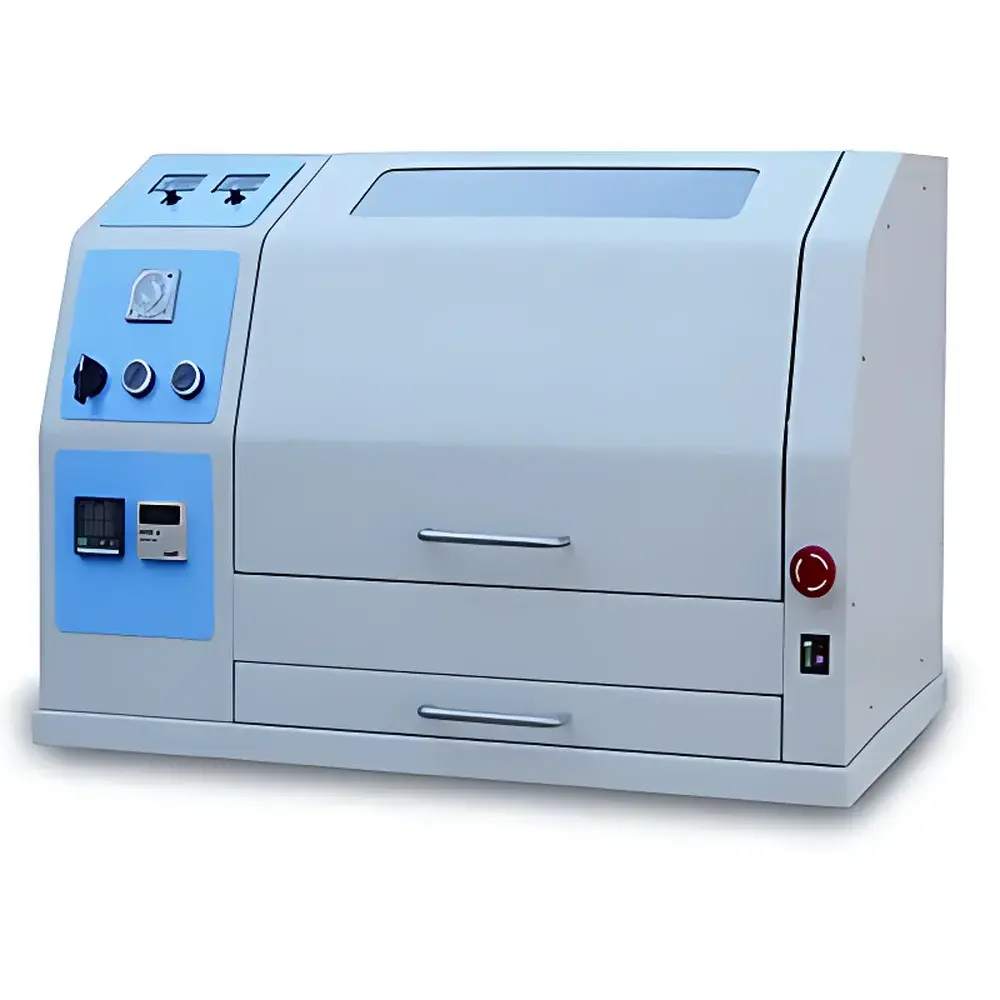
Tongtai Union TTL-860 Tumbling Oscillator
| Brand | Tongtai Union (TTL) |
|---|---|
| Origin | Beijing, China |
| Manufacturer Type | Direct Manufacturer |
| Model | TTL-860 |
| Sample Capacity | 4/6/8 bottles (selectable configuration) |
| Bottle Volume | 2000 mL |
| Tumbling Angle | 30° fixed tilt between bottle axis and rotation shaft |
| Rotation Speed Range | 0–100 ±0.2 rpm (infinitely variable, digital display) |
| Oscillation Frequency | 0–200 cycles/min (adjustable, amplitude 8 mm) |
| Pause Time Setting | 1 s – 99 h |
| Rotation Direction Control | Forward → Pause → Reverse (manual override available) |
| Temperature Range | Ambient to 50 °C (±0.5 °C accuracy at 30 rpm) |
| Safety Features | Interlocked door stop, leakage-proof drawer tray, overload/overheat/堵转 protection, emergency stop, soft-start/soft-stop ramping, integrated illumination, full stainless steel construction |
| Compliance | Designed per HJ/T 299–2007 and HJ/T 300–2007 (China Environmental Protection Standards for Solid Waste Leaching Toxicity Testing) |
Overview
The Tongtai Union TTL-860 Tumbling Oscillator is an engineered laboratory instrument specifically designed for standardized leaching toxicity testing of solid waste in accordance with the Chinese environmental regulatory protocols HJ/T 299–2007 (Sulfuric-Nitric Acid Method) and HJ/T 300–2007 (Acetic Acid Buffer Method). Its core operational principle combines controlled tumbling motion—achieved through a fixed 30° angular orientation of sample containers relative to the rotational axis—with superimposed vertical oscillation. This dual-mode agitation mechanism promotes enhanced particle–liquid interaction, maximizing mass transfer, dissolution kinetics, and extraction efficiency during static leaching procedures. Unlike conventional end-over-end rotators or shakers, the TTL-860’s patented container mounting geometry (ZL 2016 2 1363462.0) ensures continuous reorientation and intermittent impact-driven mixing, thereby improving reproducibility and representativeness of leachate composition across heterogeneous solid matrices.
Key Features
- Patented 30° Tilted Bottle Mounting: Optimized for laminar-to-turbulent transition within the leaching vessel; facilitates complete liquid displacement and repeated surface exposure of particulate matter during each revolution.
- Dual-Mode Agitation: Independent control of tumbling speed (0–100 ±0.2 rpm) and vertical oscillation frequency (0–200 cpm, 8 mm amplitude), both infinitely adjustable via digital interface.
- Configurable Sample Capacity: Modular rack design supports 4-, 6-, or 8-bottle configurations (TTL-864 / TTL-866 / TTL-868 variants), accommodating standard 2000 mL leaching vessels including borosilicate glass, PE, PTFE, and fluoropolymer-lined containers.
- Precision Thermal Management: Integrated heating system maintains chamber temperature from ambient to 50 °C with ±0.5 °C stability (verified at 30 rpm), critical for temperature-dependent leaching kinetics under regulatory protocols.
- Full-Safety Architecture: Includes door interlock shutdown, ground-fault circuit interruption (GFCI), thermal overload cutoff, stall detection, emergency stop button, slow-ramp acceleration/deceleration, and removable leak-proof drip tray.
- Ergonomic & Observational Design: Recessed rotating door minimizes footprint; large transparent viewing window with internal LED lighting enables real-time visual monitoring without process interruption.
Sample Compatibility & Compliance
The TTL-860 accommodates chemically inert sample containers up to 2000 mL in volume—including ASTM-compliant borosilicate glass jars, USP Class VI polyethylene (PE), and fluoropolymer-coated or lined vessels (e.g., PTFE, FEP, PFA)—ensuring compatibility with aggressive leaching media such as 0.11 M acetic acid buffer (HJ/T 300–2007) or mixed sulfuric/nitric acid solutions (HJ/T 299–2007). The instrument’s mechanical design meets structural requirements for ISO/IEC 17025-accredited environmental testing laboratories, and its operational parameters align with QA/QC expectations for method validation under GLP frameworks. While not certified to IEC 61000 or UL 61010 by default, its safety subsystems satisfy baseline electrical and mechanical risk mitigation criteria common to EPA SW-846 Method 1311 and related international leaching standards.
Software & Data Management
The TTL-860 operates via an embedded microcontroller-based interface with non-volatile parameter memory. All time-based settings—including forward/reverse duration (1 s to 99 h), pause intervals (1 s to 99 h), oscillation on/off timing (0–300 h cumulative), and temperature setpoints—are stored independently per test protocol. Though no external PC connectivity or LIMS integration is provided in base configuration, audit-ready operation logs (start time, total runtime, final status) are retained internally and accessible via front-panel navigation. For laboratories requiring electronic records compliance (e.g., FDA 21 CFR Part 11 or ISO 17025 traceability), optional RS-485 or USB-to-serial modules can be retrofitted to support timestamped data export to validated third-party acquisition software.
Applications
- Regulatory leaching tests for hazardous waste classification (e.g., TCLP analogues under Chinese EP standards)
- Soil and sediment contaminant mobility assessment (As, Cd, Cr, Pb, Hg, Ni, Zn, etc.)
- Leachate generation for subsequent analysis by ICP-MS, AAS, IC, or HPLC
- Stability testing of immobilized waste forms (e.g., cementitious or geopolymer-bound matrices)
- Method development and inter-laboratory comparison studies for solid-phase extraction efficiency
- Research on pH-dependent metal speciation and organic co-leaching behavior
FAQ
What leaching standards does the TTL-860 directly support?
It is explicitly engineered for HJ/T 299–2007 and HJ/T 300–2007, with mechanical performance validated for the prescribed rotation speeds, angles, durations, and temperature conditions.
Can the TTL-860 accommodate smaller bottles (e.g., 100 mL or 500 mL)?
Yes—the adjustable rack system allows secure fixation of various cylindrical containers; users must supply compatible clamping inserts or custom adapters for non-2000 mL formats.
Is the oscillation function mandatory during tumbling?
No—oscillation can be disabled independently while maintaining tumbling motion, enabling method-specific isolation of agitation variables.
Does the unit include calibration documentation?
Factory calibration certificates for rotational speed (traceable to national metrology institutes) and temperature uniformity are supplied with each unit; annual recalibration is recommended per ISO/IEC 17025 Clause 6.5.
What maintenance is required for long-term reliability?
Routine inspection of drive belt tension, door seal integrity, and drip tray cleanliness is advised every 200 operating hours; lubrication-free brushless DC motor eliminates scheduled bearing service.



