
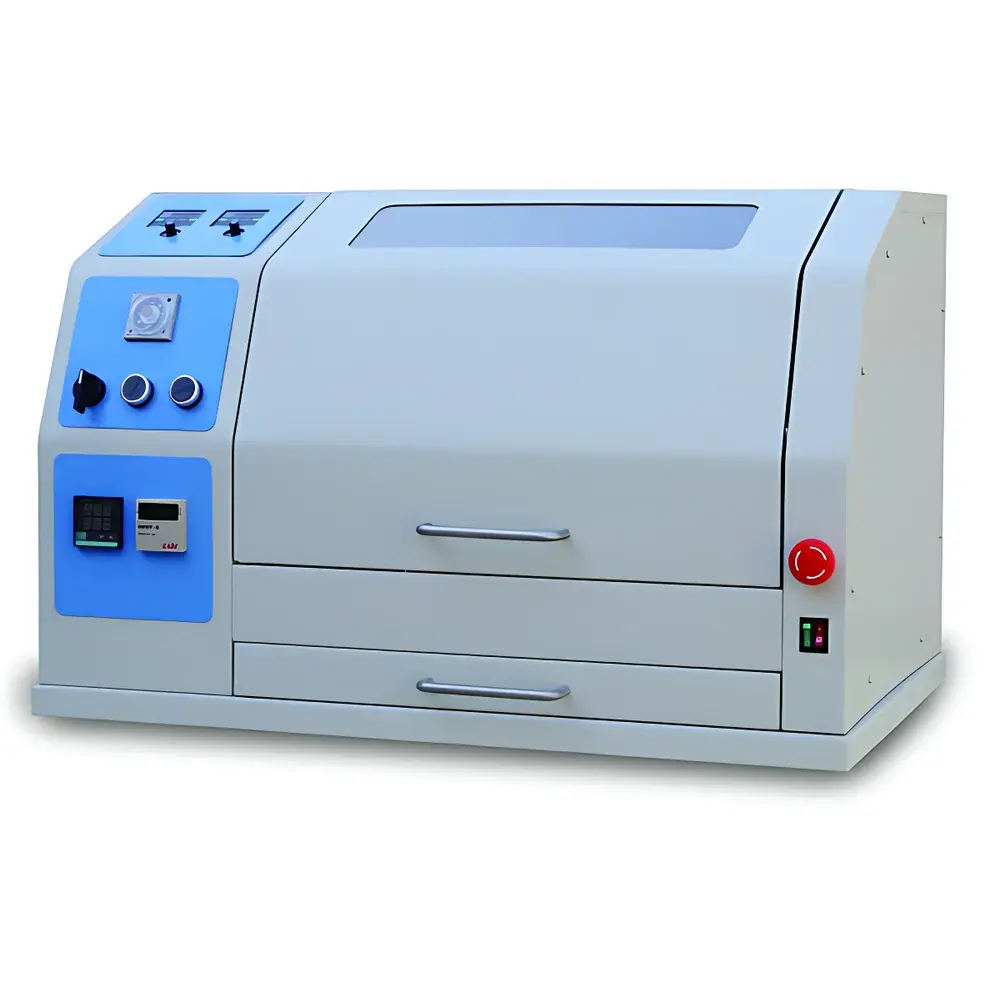
Tongtai Union TTL-868 Tilted-Axis Rotational Extraction Shaker
| Brand | Tongtai Union (TTL) |
|---|---|
| Origin | Beijing, China |
| Manufacturer Type | Direct Manufacturer |
| Region of Origin | Domestic (China) |
| Model | TTL-868 |
| Price Range | USD 7,000–14,000 |
| Instrument Type | Solid-Liquid Extraction System |
| Temperature Range | Ambient to 50 °C (±0.5 °C accuracy at 30 rpm) |
| Pressure Range | 0–5 MPa |
| Extraction Cell Volume | 2000 mL |
| Extraction Duration | 0–300 h |
| Dimensions (W×D×H) | 980 × 500 × 500 mm |
| Sample Capacity | 8 positions |
| Tilt Angle | 30° |
| Rotation Speed | 0–100 ±0.2 rpm (infinitely variable) |
| Oscillation Frequency | 0–200 cycles/min |
| Oscillation Amplitude | 8 mm |
| Pause Time Setting | 1 s–99 h |
| Forward/Reverse Cycle Timing | 1 s–99 h |
| Oscillation On/Off Timer | 0–30 min / 0–30 h / 0–300 h |
Overview
The Tongtai Union TTL-868 Tilted-Axis Rotational Extraction Shaker is an engineered solid-liquid extraction platform designed for regulatory-compliant leaching and solvent extraction of heterogeneous solid matrices. It operates on a dual-mechanism principle: controlled rotational inversion combined with synchronized mechanical oscillation—both applied to sample vessels mounted at a fixed 30° tilt relative to the rotation axis. This geometry, protected under Chinese Utility Model Patent ZL 2016 2 1363462.0, promotes continuous reorientation and gravitational shearing of particulate suspensions, significantly enhancing mass transfer kinetics between solid phase and extracting solvent. Unlike conventional horizontal shakers or static leaching systems, the TTL-868 ensures uniform wetting, dynamic particle collision, and minimized sedimentation—critical for reproducible recovery of trace metals, organic contaminants, and leachable fractions from soils, sludges, industrial residues, and municipal waste. Its operational envelope—ambient to 50 °C, up to 5 MPa internal pressure, and programmable cycle durations spanning seconds to 300 hours—supports both standardized regulatory protocols and method development under non-equilibrium conditions.
Key Features
- Patented 30° tilted-axis sample holder design enabling simultaneous tumbling, rolling, and gravitational mixing within 2000 mL extraction cells
- Infinitely variable rotational speed control (0–100 ±0.2 rpm) with digital display and high-torque DC motor drive
- Independent oscillation module: frequency adjustable from 0–200 cycles/min, amplitude fixed at 8 mm
- Precise thermal regulation: Peltier-assisted chamber heating with ±0.5 °C stability at 30 rpm (tested per IEC 61000-4-3)
- Programmable multi-stage timing logic: individual forward/reverse duration (1 s–99 h), pause interval (1 s–99 h), and total run time (0–300 h)
- Eight-position stainless-steel sample rack with reinforced clamping and pressure-rated vessel compatibility (up to 5 MPa)
- Full manual override mode for single-cycle inversion and emergency stop functionality compliant with EN 61000-6-2
Sample Compatibility & Compliance
The TTL-868 is validated for use with standard EPA SW-846 Method 1311 (TCLP), ASTM D3987 (Standard Test Method for Shake Extraction of Solid Waste with Water), and Chinese environmental standards HJ/T 299–2007 (Sulfuric-Nitric Acid Leaching Procedure) and HJ/T 300–2007 (Acetic Acid Buffer Leaching Procedure). It accommodates glass, polytetrafluoroethylene (PTFE), and high-density polyethylene (HDPE) extraction vessels rated for elevated temperature and pressure. The system meets ISO/IEC 17025 requirements for method validation when used with certified reference materials (CRMs) such as NIST SRM 2710a (Montana Soil) and BCR-701 (Contaminated River Sediment). All electrical components conform to CE marking directives (EMC Directive 2014/30/EU and Low Voltage Directive 2014/35/EU).
Software & Data Management
The TTL-868 operates via an embedded microcontroller with local LCD interface; optional RS-485/Modbus RTU output enables integration into laboratory information management systems (LIMS) or SCADA networks. Logged parameters—including actual rpm, real-time chamber temperature, elapsed time, and cycle count—are timestamped and exportable in CSV format via USB port. Audit trail functionality supports GLP and GMP environments: all parameter changes are recorded with user ID (if configured), timestamp, and pre-/post-value. Firmware complies with FDA 21 CFR Part 11 requirements for electronic records when paired with validated LIMS software and role-based access controls.
Applications
- Leaching toxicity assessment of landfill leachate precursors and incinerator ash per HJ/T 299 and HJ/T 300
- Accelerated solvent extraction (ASE) of PAHs, PCBs, and organochlorine pesticides from sediments and sludges
- Method development for metal speciation studies requiring kinetic dissolution profiling
- Preparation of aqueous extracts for subsequent ICP-MS, IC, or GC-MS analysis
- Validation of stabilization/solidification treatment efficacy in hazardous waste remediation
- Research on contaminant release mechanisms from construction and demolition debris
FAQ
Does the TTL-868 support automated pressure monitoring during extraction?
No. While the system is rated for operation up to 5 MPa, it does not include integrated pressure transducers or feedback control. Users must employ externally calibrated pressure-rated vessels with mechanical relief valves.
Can the 30° tilt angle be adjusted or disabled?
No. The 30° mounting geometry is fixed per patent design and cannot be modified without compromising mechanical integrity and regulatory alignment.
Is the temperature control active during high-speed rotation (e.g., >60 rpm)?
Temperature stability is specified only at ≤30 rpm. At higher speeds, convective heat loss increases; users should validate thermal performance empirically for applications requiring tight thermal control above this threshold.
What vessel materials are certified for use at 50 °C and 5 MPa?
Only PTFE-lined stainless-steel extraction cells with ISO-KF or Conflat flange seals are verified for full-spec operation. Glass vessels are limited to ambient-pressure protocols.
Does the system include validation documentation for ISO/IEC 17025 accreditation?
Yes—factory calibration certificates (temperature, speed, timer), mechanical safety test reports, and protocol-specific performance verification data (e.g., HJ/T 299 recovery rates using CRM 2710a) are provided with each unit.



