
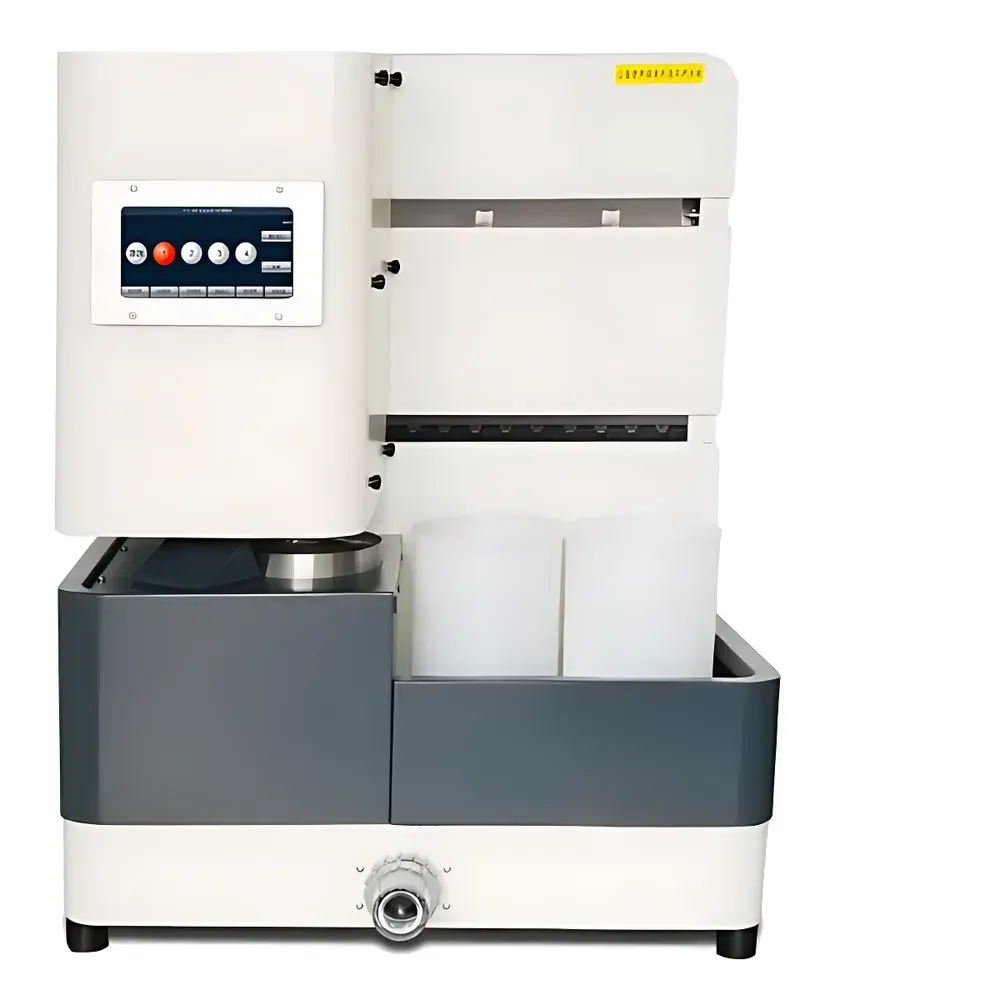
Tongtailian TTL-500E Fully Automated Knife Mill
| Brand | Tongtailian (TTL) |
|---|---|
| Origin | Beijing, China |
| Manufacturer Type | Direct Manufacturer |
| Product Category | Domestic |
| Model | TTL-500E |
| Instrument Type | Knife Mill |
| Sample Suitability | Hard, Semi-hard, Elastic, Moist/Fatty/Oily Materials |
| Output Particle Size | ≤ 300 µm |
| Feed Particle Size | 10–40 mm |
| Batch Processing Capacity | 500 g (for fruits/vegetables) |
| Motor Power | 2.2 kW |
| Max. Rotational Speed | 18,000 rpm |
| Grinding Principle | High-shear Cutting |
| Grinding Modes | Dry & Wet |
| Predefined Programs | 8 standard + 64 editable custom protocols |
| Rotor Types | Stainless Steel & Titanium Alloy |
| Rotor Configuration | Dual-blade, single-layer |
| Grinding Vessel Options | 1 L / 2.2 L / 3.2 L (stainless steel or PP) |
| Control Interface | 7-inch color touchscreen |
| Operating System | Embedded Linux |
| Cleaning System | Dedicated wash chamber with detergent auto-dosing, three-stage cleaning (tap water rinse, high-power ultrasonic, hot-air drying) |
| Safety Features | Dual interlock system, emergency stop, rotor misalignment detection, low-water-pressure and dry-run protection, motor overcurrent/overvoltage/overheat/overload protection |
Overview
The Tongtailian TTL-500E Fully Automated Knife Mill is an industrial-grade sample preparation instrument engineered for high-throughput, reproducible size reduction of heterogeneous biological and organic materials. It operates on the principle of high-shear mechanical cutting—utilizing precisely balanced rotating blades to generate controlled impact and shearing forces within a sealed grinding chamber. Unlike conventional jaw crushers or planetary ball mills, the TTL-500E delivers rapid, consistent particle size reduction without thermal degradation or cross-contamination, making it especially suitable for QC laboratories, food safety testing facilities, agricultural research centers, and herbal medicine quality control units requiring GLP-compliant sample homogenization.
Key Features
- Fully automated workflow: integrated control of grinding, multi-stage rotor cleaning (tap water rinse → ultrasonic cavitation → hot-air drying), and real-time process monitoring via a 7-inch color touchscreen interface.
- Dual-material rotor options: corrosion-resistant stainless steel and biocompatible titanium alloy rotors, each configured as a dual-blade, single-layer assembly optimized for uniform shear distribution.
- Intelligent grinding dynamics: programmable operation modes—including progressive, intermittent, and floating blade engagement—to accommodate variable sample rheology (e.g., fibrous plant tissue vs. fatty fish muscle).
- Independent cleaning chamber with automatic detergent dosing ensures complete decontamination of rotor, shaft, and pressure cap in one cycle—eliminating manual disassembly and mitigating carryover between batches.
- Robust safety architecture: dual hardware/software interlocks, emergency stop button, real-time rotor position verification, low-water-pressure cutoff, and comprehensive motor protection (overcurrent, overvoltage, thermal overload, mechanical stall).
- Modular vessel system: interchangeable grinding vessels (1 L, 2.2 L, 3.2 L) constructed from either electropolished stainless steel or chemical-resistant polypropylene—validated for both dry and wet milling applications.
Sample Compatibility & Compliance
The TTL-500E accommodates a broad spectrum of sample types including fresh/frozen fruits and vegetables, cereal grains, oilseeds, animal tissues (raw and cooked), aquatic products, traditional Chinese medicinal herbs, and compound feed formulations. Its ability to handle samples with high moisture, fat, or fiber content—without clogging or excessive heat buildup—aligns with ASTM D5198 (standard practice for sampling and handling of biomass), ISO 6497 (animal feeding stuffs — sampling), and USP (good laboratory practices for analytical instrumentation). The embedded Linux OS supports audit-trail logging and user-access-level configuration, facilitating compliance with FDA 21 CFR Part 11 requirements when deployed in regulated environments.
Software & Data Management
The instrument runs on a deterministic embedded Linux platform with non-volatile memory for persistent storage of up to 64 user-defined protocols. Each protocol records timestamped parameters—including rotational speed, duration, mode selection, vessel type, and cleaning sequence—enabling full traceability. Process data are exportable via USB or Ethernet (digital transmission protocol) in CSV format for integration into LIMS or ELN systems. Real-time status feedback includes elapsed time, remaining cycle duration, fault codes (e.g., “Rotor Stall Detected”, “Low Wash Fluid”), and visual progress indicators for both grinding and cleaning phases.
Applications
- Food safety labs: homogenization of pesticide residue test samples (e.g., leafy greens, berries) prior to QuEChERS extraction.
- Agricultural research: preparation of grain and seed samples for mycotoxin analysis (aflatoxin, deoxynivalenol) per AOAC 2005.02 and ISO 17025-accredited workflows.
- Pharmaceutical QC: uniform comminution of herbal powders for HPLC fingerprinting and marker compound quantification.
- Environmental testing: size reduction of soil-embedded plant roots or composted feedstock for heavy metal leaching assays (TCLP, SPLP).
- Meat inspection: rapid, sterile homogenization of poultry or pork tissue for pathogen enrichment (Salmonella, Listeria) in ISO 6579-compliant protocols.
FAQ
What is the maximum recommended feed size for optimal grinding efficiency?
Feed particles should be limited to 10–40 mm; oversized material may cause uneven load distribution and premature rotor wear.
Can the TTL-500E process samples containing >20% fat or oil content?
Yes—its sealed chamber design and low-temperature cutting action prevent smearing; however, use of the 2.2 L PP vessel and titanium rotor is advised for long-term corrosion resistance.
Is validation documentation available for GMP/GLP environments?
Instrument qualification packages (IQ/OQ/PQ templates), calibration certificates for motor speed and timer accuracy, and software validation summaries are provided upon request.
How frequently must the ultrasonic cleaning bath be serviced?
The integrated ultrasonic transducer requires no scheduled maintenance; periodic inspection of tank fluid level and detergent concentration is recommended every 200 cycles.
Does the system support remote diagnostics or firmware updates?
Firmware updates are performed locally via USB; remote diagnostic access is not enabled by default but can be configured under secure IT-administered network policies.



