
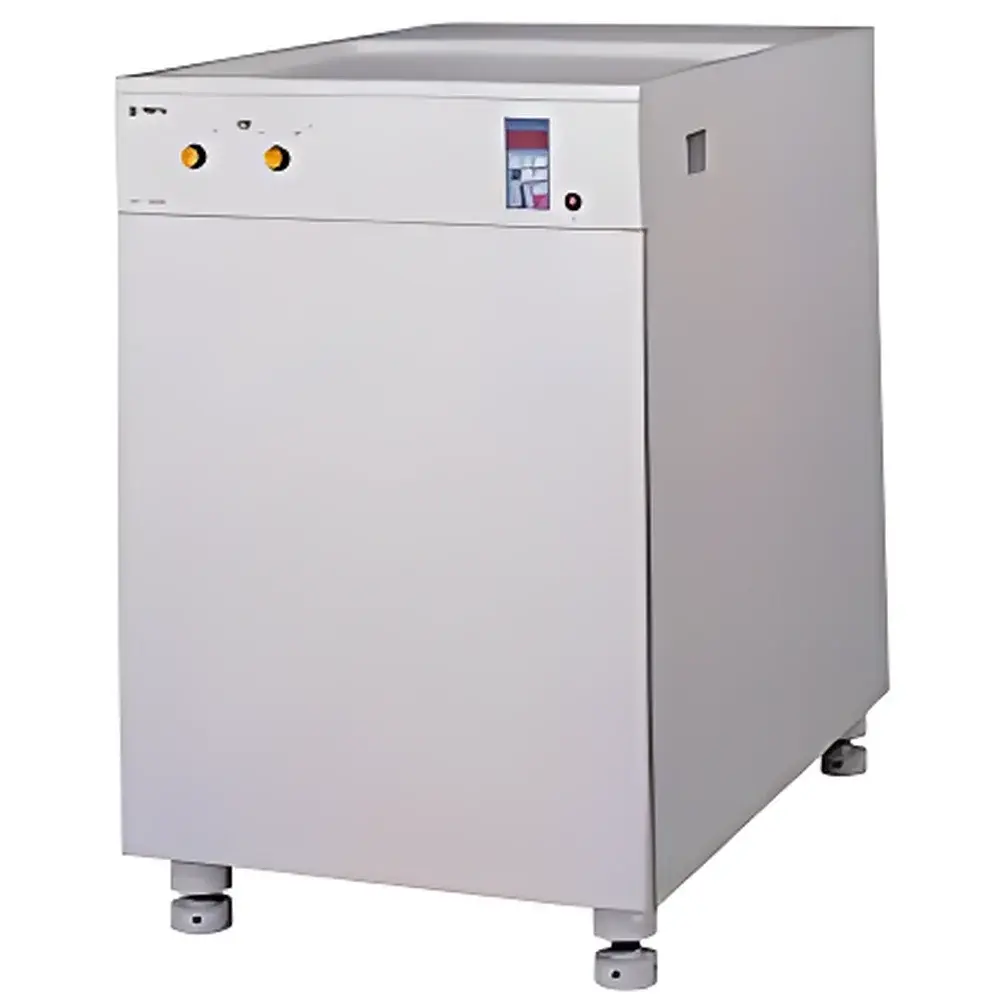
Tongtian TBE-1000A High-Speed Counter-Current Chromatography (HSCCC) System
| Brand | Tongtian |
|---|---|
| Origin | Shanghai, China |
| Model | TBE-1000A |
| Column Capacity | 1000 mL |
| Sample Injection Volume | 80 mL |
| Dimensions (W×D×H) | 628 × 918 × 1048 mm |
| Rotation Speed Range | 0–600 rpm |
| Separation Speed | 400–550 rpm (stepless frequency-controlled) |
| Flow Rate Range | 0.1–90 mL/min |
| Separation Flow Rate | 5.0–10 mL/min |
| Maximum System Pressure | 2 MPa |
| UV Detector Wavelengths | 254 nm, 280 nm |
| Temperature Control Module (external water bath interface) | 15–40 °C, ±0.5 °C accuracy, coolant flow rate 1–20 L/min |
Overview
The Tongtian TBE-1000A High-Speed Counter-Current Chromatography (HSCCC) System is a preparative-scale liquid–liquid partition chromatography instrument engineered for high-fidelity, carrier-free separation of thermally labile, polar, or structurally complex natural products and synthetic compounds. Unlike solid-phase chromatographic techniques, HSCCC operates on the principle of partition equilibrium between two immiscible liquid phases—stationary and mobile—within a rotating spiral column assembly. The TBE-1000A employs a triple-spiral column configuration mounted on a precisely balanced rotor, enabling stable high-speed rotation (up to 600 rpm) with minimal mechanical vibration and acoustic noise. This architecture ensures robust retention of the stationary phase (>70% under optimized conditions) without solid support, eliminating irreversible adsorption, sample denaturation, or active-site loss. As a result, the system delivers quantitative recovery (>98% typical), exceptional reproducibility (RSD < 2% for retention time and peak area across consecutive runs), and scalability from analytical method development to pilot-scale purification (gram-level per run).
Key Features
- Triple-spiral column design with dynamic mechanical balancing for enhanced rotational stability and extended operational lifetime at 400–550 rpm separation speeds.
- Stepless frequency-controlled motor drive enabling precise, repeatable control of centrifugal force—critical for tuning phase retention and resolution across diverse solvent systems (e.g., hexane/ethyl acetate/methanol/water, chloroform/methanol/water).
- Integrated temperature regulation module compatible with external recirculating chillers or water baths; maintains column environment within ±0.5 °C over 15–40 °C range—essential for stabilizing partition coefficients of heat-sensitive biomolecules (e.g., glycosides, peptides, polyphenols).
- Dual-wavelength UV detector (254 nm and 280 nm) with analog output and TTL-compatible fraction collector trigger signal for synchronized collection.
- Full-system pressure monitoring up to 2 MPa, supporting high-viscosity solvent systems and elevated flow rates without compromising phase stability.
- No consumable columns or silica-based media—eliminates batch-to-batch variability, reduces long-term operating cost, and avoids silanol-induced degradation of basic or chelating analytes.
Sample Compatibility & Compliance
The TBE-1000A is routinely applied to the isolation of alkaloids, flavonoids, terpenoids, saponins, anthraquinones, and marine natural products from crude plant extracts, fermentation broths, and synthetic reaction mixtures. Its carrier-free mechanism preserves structural integrity of labile compounds that degrade under silica surface catalysis or high backpressure. The system supports Good Laboratory Practice (GLP)-aligned workflows: all operational parameters—including rotation speed, flow rate, UV absorbance, temperature setpoint, and elapsed time—are digitally logged via optional RS232/USB interface. Data files comply with common laboratory informatics requirements and may be archived in CSV or ASCII format for audit readiness. While not pre-certified to FDA 21 CFR Part 11, the system’s deterministic control logic and non-volatile parameter storage facilitate validation under internal SOPs aligned with ISO/IEC 17025 and USP <1058> guidelines for analytical instrument qualification.
Software & Data Management
The TBE-1000A operates via front-panel membrane keypad with real-time LED display of rotation speed, flow rate, UV absorbance, and temperature. For advanced protocol automation and data capture, optional PC-based control software (Windows 10/11 compatible) provides scheduled method execution, multi-parameter trend logging, baseline correction tools, and export-ready chromatogram overlays. All detector signals are sampled at ≥10 Hz with 12-bit ADC resolution. Fraction collection can be triggered by time, peak threshold, or UV slope—enabling intelligent pooling of target zones. Raw data files include embedded metadata (date/time, operator ID, method name, hardware configuration), supporting traceability in regulated environments.
Applications
- Gram-scale purification of reference standards for pharmacopoeial compliance (e.g., Chinese Pharmacopoeia, EP, USP).
- Isolation of unstable intermediates in asymmetric synthesis where silica gel chromatography induces racemization or decomposition.
- Preparative separation of enantiomers using chiral aqueous two-phase systems (ATPS).
- Downstream processing of bioactive compounds from microalgal or fungal extracts under mild, non-denaturing conditions.
- Bridging tool for process development: analytical HSCCC methods transfer directly to TBE-1000A without re-optimization due to identical fluid dynamics and phase behavior scaling.
FAQ
Does the TBE-1000A require column packing or column regeneration?
No. It uses a support-free liquid stationary phase retained by centripetal force—no packing, no conditioning, no column aging.
Can it handle viscous solvent systems such as DMSO/water or glycerol-containing phases?
Yes, provided flow rates are adjusted to maintain stable phase retention; maximum system pressure rating (2 MPa) accommodates viscosities up to ~25 cP at 10 mL/min.
What is the typical stationary phase retention at 500 rpm with n-hexane/ethyl acetate/methanol/water (1:1:1:1)?
Approximately 72–78%, verified by post-run solvent volume measurement and confirmed via retention time consistency across repeated injections.
Is the UV detector compliant with pharmacopeial absorbance linearity requirements?
The detector meets USP <857> photometric accuracy specifications when calibrated with potassium dichromate standard solutions; linearity R² > 0.999 over 0.1–2.0 AU range.
How is system cleaning performed between runs?
Flush with miscible solvents (e.g., methanol → acetonitrile → hexane) at low flow (1–2 mL/min) and 300 rpm; no column disassembly required.



