
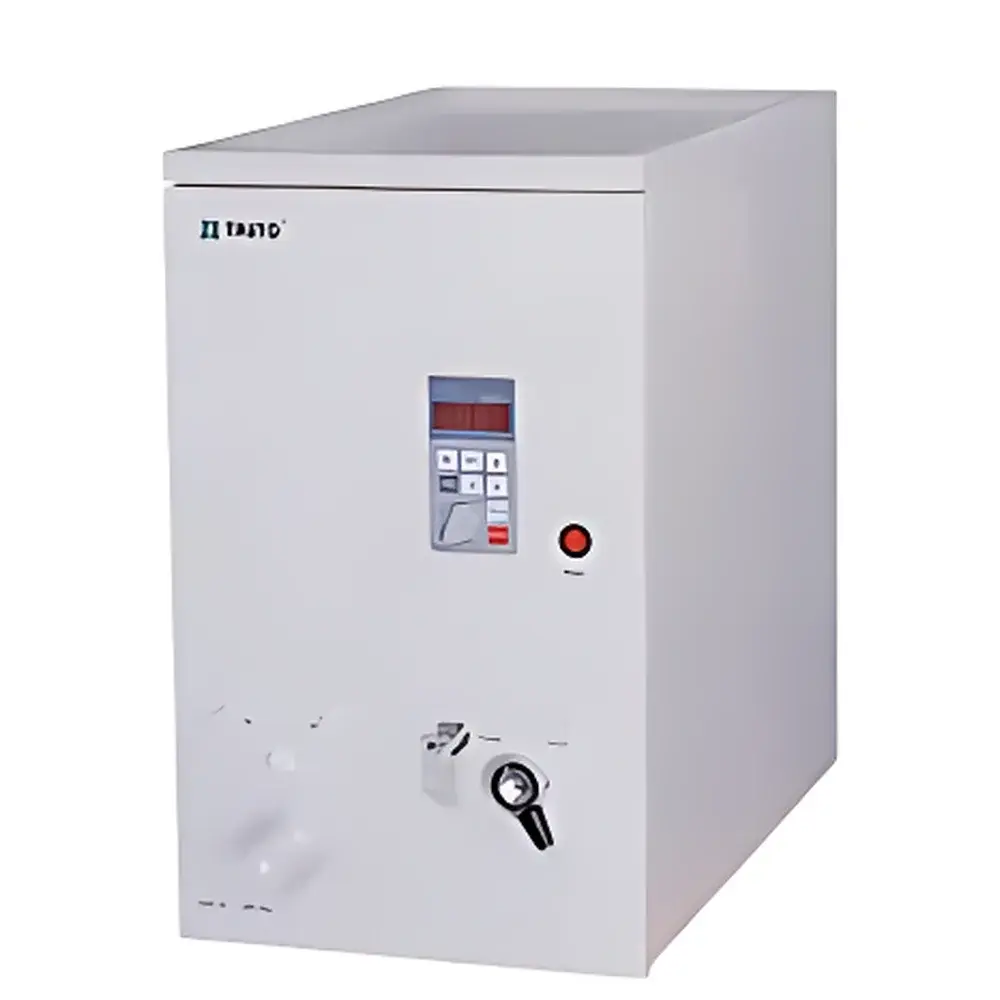
Tongtian TBE-20A Analytical High-Speed Counter-Current Chromatograph (HSCCC)
| Brand | Tongtian |
|---|---|
| Origin | Shanghai, China |
| Model | TBE-20A |
| Separation Capacity | µg–mg scale |
| Column Capacity | 20 mL |
| Injection Volume | 20 µL (standard), optional loops: 5 µL–2 mL |
| Injector Valve | Rheodyne 7725i |
| Rotation Speed Range | 0–2000 rpm |
| Operational Separation Speed | 1400–2000 rpm (stepless frequency-controlled) |
| Flow Rate Range | 0.1–5.0 mL/min |
| Recommended Separation Flow Rate | 0.5–1.5 mL/min |
| System Pressure Rating | 0–2 MPa |
| UV Detector Wavelengths | 254 nm & 280 nm (optional full-spectrum detector) |
| Temperature Control Range | 15–40 °C (via external recirculating chiller), accuracy ±0.5 °C, coolant flow rate 1–10 L/min |
| Power Supply | 220 V ±10%, 50/60 Hz, 300 W |
| Dimensions (W×D×H) | 330 × 600 × 550 mm |
Overview
The Tongtian TBE-20A Analytical High-Speed Counter-Current Chromatograph (HSCCC) is a liquid–liquid partition chromatographic system engineered for high-resolution, carrier-free separation of thermally labile and structurally complex compounds—particularly natural products, pharmaceutical intermediates, and bioactive metabolites. Unlike solid-phase chromatographic methods, HSCCC operates without a stationary phase support matrix; instead, it relies on the differential partitioning of analytes between two immiscible liquid phases under centrifugal force in a precisely balanced coil column assembly. The TBE-20A implements a patented three-separation-column rotor design that maintains dynamic mechanical equilibrium at rotational speeds up to 2000 rpm, ensuring stable retention of the stationary phase (>70% retention ratio under optimized conditions), minimal vibration-induced noise, and reproducible hydrodynamic performance across repeated runs.
Key Features
- Patented triple-coil rotor architecture: Enhances phase retention and mechanical stability during high-speed rotation, reducing baseline drift and improving peak shape reproducibility.
- Carrier-free separation mechanism: Eliminates irreversible adsorption, active-site degradation, or sample denaturation associated with silica- or polymer-based stationary phases—enabling near-theoretical recovery (>98%) of sensitive biomolecules.
- Integrated temperature control interface: Compatible with external recirculating chillers for precise thermal regulation (15–40 °C, ±0.5 °C), allowing systematic optimization of partition coefficients and solvent system selectivity.
- Modular injection system: Standard Rheodyne 7725i six-port injection valve with 20 µL fixed loop; optional selectable loops (5 µL to 2 mL) support both trace analytical and semi-preparative workflows.
- Dual six-port valve configuration: Enables online solvent exchange, multi-step elution gradients, and real-time fraction collection without system interruption.
- UV detection at dual fixed wavelengths (254 nm and 280 nm): Optimized for aromatic and peptide bond absorbance; upgrade path available to diode-array detection (DAD) for spectral confirmation and peak purity assessment.
Sample Compatibility & Compliance
The TBE-20A accommodates a broad range of polarities and molecular weights—from low-MW alkaloids and flavonoids to high-MW glycosides and saponins—provided appropriate biphasic solvent systems (e.g., n-hexane–ethyl acetate–methanol–water, or chloroform–methanol–water variants) are selected. Its absence of solid-phase interactions renders it especially suitable for isolating unstable compounds prone to decomposition on silica gel (e.g., terpenoid lactones, polyphenol oligomers). The instrument’s mechanical design and operational parameters comply with ISO 17025-relevant requirements for method validation in analytical laboratories. Data acquisition and instrument control support audit-trail-enabled software configurations compatible with GLP and GMP environments when paired with 21 CFR Part 11-compliant electronic record systems.
Software & Data Management
The TBE-20A interfaces with vendor-supplied chromatography control software supporting real-time monitoring of rotation speed, mobile phase flow rate, UV absorbance, and column temperature. All parameters are logged with timestamps and user identifiers, enabling full traceability per ICH Q2(R2) guidelines. Raw chromatograms are saved in standard .cdf format for post-run integration using third-party tools (e.g., Chromeleon, OpenChrom). Optional modules include automated method sequencing, peak tracking across solvent system screens, and retention time alignment algorithms for fingerprint profiling applications.
Applications
- Preparative isolation of reference standards from plant extracts (e.g., ginsenosides, curcuminoids, paclitaxel analogues).
- Fingerprint profiling of herbal medicines in accordance with Chinese Pharmacopoeia monographs and WHO guidelines.
- Process development for solvent system screening in early-stage purification workflows.
- Metabolite isolation from microbial fermentation broths or cell lysates without protein precipitation artifacts.
- Stability-indicating analysis of degradation products where column fouling compromises HPLC reliability.
FAQ
Does the TBE-20A require column packing or column replacement?
No—HSCCC eliminates solid stationary phases entirely; the “column” consists of PTFE tubing coiled within the rotor. No packing, conditioning, or replacement is necessary.
What solvent systems are compatible with this instrument?
Any pair of immiscible liquids meeting density and interfacial tension criteria for stable phase retention can be used. Common systems include hexane–ethyl acetate–methanol–water (HEMWat) and chloroform–methanol–water variants.
Can the system be validated for regulated environments?
Yes—when integrated with compliant data systems and operated under documented SOPs, the TBE-20A supports IQ/OQ/PQ protocols aligned with ISO/IEC 17025 and FDA expectations for analytical instrumentation.
Is gradient elution possible?
Gradient delivery is achieved via dual-pump systems coupled externally; the TBE-20A’s dual six-port valves facilitate automated solvent switching and step-gradient implementation.
What maintenance is required beyond routine pump seal checks?
Primary maintenance involves periodic verification of rotor balance, UV lamp intensity calibration, and chiller fluid quality—no column regeneration or frit cleaning is needed.





