
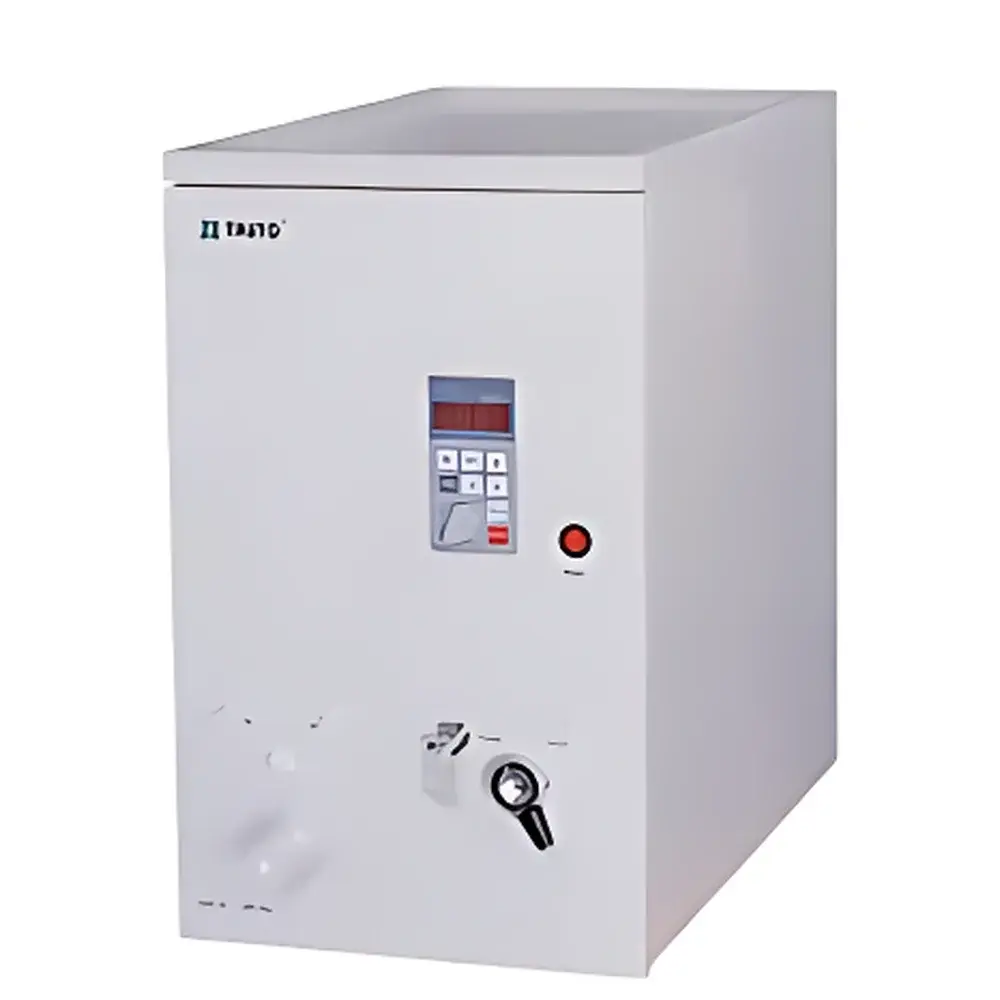
Tongtian TBE-30A High-Speed Counter-Current Chromatograph
| Brand | Tongtian |
|---|---|
| Origin | Shanghai, China |
| Model | TBE-30A |
| Column Capacity | 30 mL |
| Injection Loop Volume | 1 mL |
| Rotational Speed Range | 0–1400 rpm (infinitely variable frequency control) |
| Recommended Operating Speed | 1300 rpm |
| Flow Rate Range | 0.1–10.0 mL/min |
| Separation Flow Rate | 0.5–5.0 mL/min |
| Maximum System Pressure | 2 MPa |
| UV Detection Wavelengths | 214, 254, 280, 340, 365, 405 nm (optional full-spectrum detector available) |
| Temperature Control Range (via external circulator) | 15–40 °C (±0.5 °C accuracy) |
| Circulating Fluid Flow Rate | 1–10 L/min |
| Dimensions (W×D×H) | 330 × 600 × 550 mm |
| Power Supply | 220 V ±20 V, 50 ±0.5 Hz |
| Power Consumption | 200 W |
Overview
The Tongtian TBE-30A High-Speed Counter-Current Chromatograph (HSCCC) is a precision-engineered preparative and analytical liquid-liquid partition chromatography system operating on the principle of centrifugal partition chromatography (CPC). Unlike solid-phase chromatographic techniques, HSCCC employs a support-free liquid stationary phase retained by centrifugal force within a specially designed multilayer coil column—eliminating irreversible adsorption, sample degradation, and column fouling commonly associated with silica-based systems. The TBE-30A integrates a triple-column architecture with dual six-port switching valves to enable sequential or parallel elution modes, significantly enhancing peak resolution, recovery yield, and method development throughput. Its modular design supports seamless integration with external UV-Vis detectors, fraction collectors, and temperature-controlled recirculating baths—making it suitable for reproducible isolation of thermolabile natural products, alkaloids, glycosides, and other bioactive compounds from complex matrices such as plant extracts, fermentation broths, and biological fluids.
Key Features
- Triple-coil column assembly (total capacity: 30 mL) enabling multi-step or multi-solvent gradient separations without column replacement
- Dual high-precision six-port switching valves (compatible with standard HPLC 7725i interface) for automated in-line sample introduction, solvent recycling, and fraction routing
- Infinitely variable frequency-controlled rotor drive (0–1400 rpm), optimized at 1300 rpm for stable phase retention and efficient mass transfer
- Wide flow rate range (0.1–10.0 mL/min) with dedicated separation mode (0.5–5.0 mL/min) for method scouting and scalable purification
- Multi-wavelength UV-Vis detection (214, 254, 280, 340, 365, 405 nm) with optional diode-array detector (DAD) upgrade for spectral confirmation and peak purity assessment
- External temperature regulation via circulating water bath (15–40 °C, ±0.5 °C stability) to maintain consistent partition coefficients and retention times across runs
- Robust mechanical architecture compliant with ISO 9001:2000 quality management standards and CE-marked per EU Directive 2014/30/EU (EMC) and 2014/35/EU (LVD)
Sample Compatibility & Compliance
The TBE-30A is validated for use with biphasic solvent systems meeting IUPAC-recommended partition coefficient (K) ranges (0.1–10) and low interfacial tension (<5 mN/m). It accommodates samples dissolved in common organic-aqueous phases including n-hexane/ethyl acetate/methanol/water (HEMWat), chloroform/methanol/water, and tert-butyl methyl ether/acetonitrile/water systems. The instrument’s fluidic pathway is constructed from chemically inert PTFE and stainless steel components rated for continuous operation up to 2 MPa. All operational parameters—including rotational speed, flow rate, detector wavelength, and temperature setpoints—are logged with timestamped metadata to support GLP-compliant documentation. While not pre-certified for FDA 21 CFR Part 11, the system architecture permits integration with third-party electronic lab notebook (ELN) platforms supporting audit trails, user access controls, and electronic signatures.
Software & Data Management
The TBE-30A operates via a dedicated Windows-based control interface that synchronizes pump, detector, valve actuation, and rotational speed modules in real time. Raw chromatographic data are exported in ASCII-compatible .csv format for post-processing in industry-standard tools (e.g., Chromeleon, OpenChrom, MATLAB). Method files include complete solvent system definitions, gradient profiles, and valve sequencing logic—ensuring full traceability and inter-laboratory reproducibility. Optional software modules support automated peak integration using second-derivative baseline correction, K-value calculation from retention time ratios, and solvent system optimization based on Hansen solubility parameters. Data integrity is reinforced through local encrypted storage and configurable auto-backup to network drives.
Applications
- Isolation of high-purity (>99%) reference standards for pharmacopeial validation (e.g., huperzine A, ginkgolides, soy isoflavones)
- Fingerprint profiling of herbal medicines per Chinese Pharmacopoeia (ChP) and WHO guidelines for traditional medicine quality control
- Process development of natural product APIs under GMP-aligned workflows, including scale-up from analytical (1 mL loop) to semi-preparative (30 mL coil) conditions
- Metabolite purification from cell culture supernatants and microbial extracts where silica adsorption compromises recovery
- Method development for orthogonal separation strategies complementing reversed-phase HPLC and supercritical fluid chromatography (SFC)
- Academic research in phytochemistry, marine natural products, and synthetic biology metabolite characterization
FAQ
What solvent systems are compatible with the TBE-30A?
The system supports any immiscible biphasic solvent pair meeting minimum density difference (≥0.1 g/cm³) and interfacial tension criteria. Common systems include HEMWat, EtOAc/MeOH/H₂O, and MTBE/ACN/H₂O.
Can the TBE-30A be used for GMP manufacturing?
While the hardware meets mechanical and electrical safety standards (CE), formal GMP qualification requires site-specific IQ/OQ/PQ protocols and integration with validated data management systems.
Is column regeneration required between runs?
No—since no solid stationary phase is used, the coil column is cleaned in situ by flushing with fresh mobile phase; typical equilibration time is <15 minutes.
How is phase retention measured and controlled?
Stationary phase retention ratio (Sf) is calculated from coil volume displacement during rotation and is monitored via real-time pressure and flow feedback; optimal Sf ranges from 50–85% depending on solvent system viscosity.
Does the system support automated fraction collection?
Yes—via TTL-triggered external fraction collectors synchronized to UV peak thresholds or time-based intervals.




