
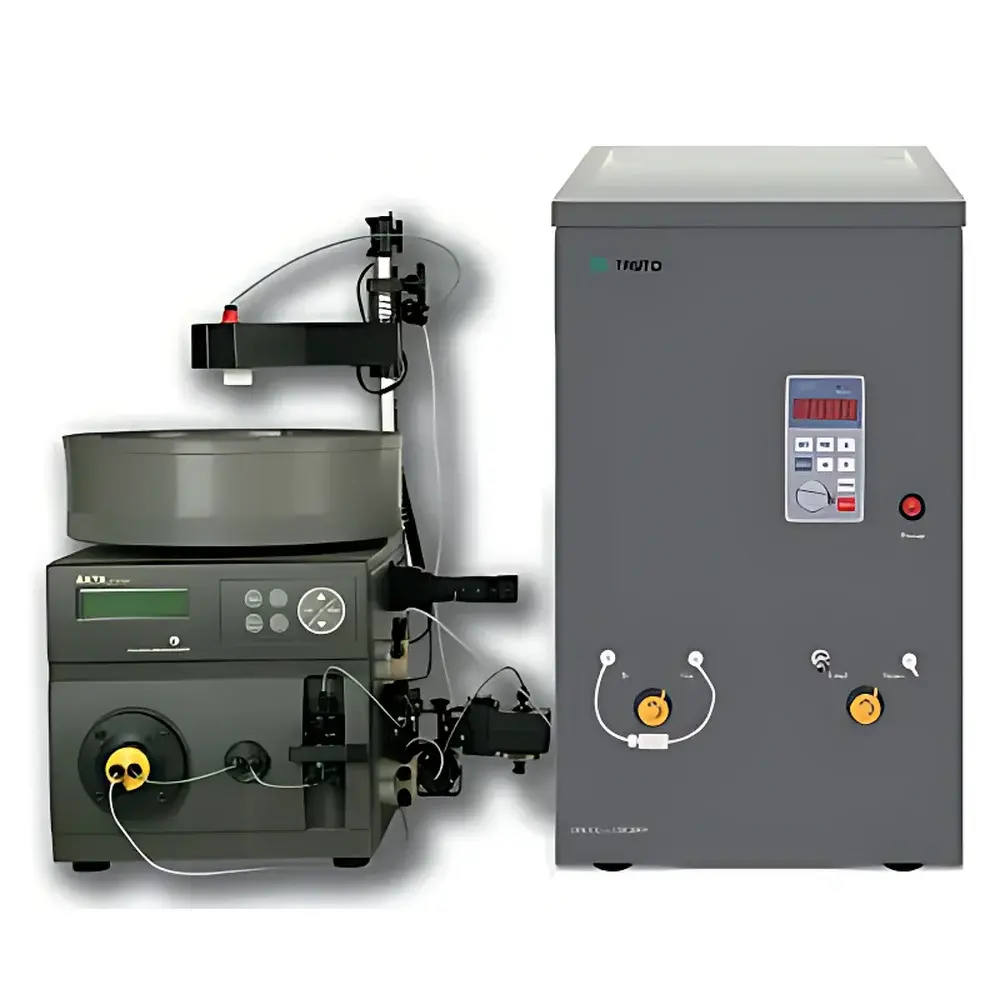
Tongtian TBE300B + Cytiva AKTA Prime High-Speed Counter-Current Chromatography System
| Brand | Tongtian |
|---|---|
| Origin | Shanghai, China |
| Model | TBE300B + AKTA Prime |
| Power Supply | 220 V ± 20 V, 50 Hz ± 0.5 Hz |
| Motor Power | 200 W |
| Total Column Capacity | 260 mL |
| Sample Loop Volume | 20 mL |
| Dimensions (W×D×H) | 563 × 638 × 368 mm |
| Rotation Speed Range | 0–1000 rpm |
| Optimal Separation Speed | 700–900 rpm (stepless frequency-controlled) |
| Flow Rate Range | 0.1–30 mL/min |
| Typical Separation Flow Rate | 1.5–2.0 mL/min |
| Maximum System Pressure | 2 MPa |
| UV Detection Wavelengths | 254 nm & 280 nm (Hg lamp + fixed filters) |
| optional filters | 313, 365, 405, 436, 546 nm |
| Temperature Control Module | 15–40 °C (±0.5 °C accuracy), external recirculating water bath required (flow rate: 1–10 L/min) |
Overview
The Tongtian TBE300B + Cytiva AKTA Prime High-Speed Counter-Current Chromatography (HSCCC) System is a fully integrated preparative liquid–liquid partition chromatography platform engineered for high-resolution, carrier-free separation of thermolabile and structurally complex natural products. Unlike conventional solid-phase chromatographic methods, HSCCC relies on the differential partitioning of analytes between two immiscible liquid phases under centrifugal force—eliminating irreversible adsorption, silanol activity, and sample degradation commonly associated with silica-based media. The system combines Tongtian’s patented triple-spiral column architecture with Cytiva’s industry-standard AKTA Prime peristaltic pump and control interface, enabling precise gradient elution, real-time UV monitoring, and automated fraction collection. Its design conforms to core principles of partition coefficient-driven separation (K = Cstationary/Cmobile), making it especially suitable for isolating glycosides, alkaloids, flavonoids, terpenoids, and other polar or amphiphilic compounds from plant extracts, fermentation broths, and marine-derived samples.
Key Features
- Triple-spiral column assembly (260 mL total capacity) optimized for mechanical stability at high rotational speeds (700–900 rpm), minimizing vibration and acoustic noise during extended runs;
- Dual-channel, pulse-free peristaltic pump (AKTA Prime) supporting linear, step, and multi-segment gradient profiles with flow precision of ±2% across 0.1–30 mL/min range;
- Integrated dual six-port switching valve manifold enabling solvent system reconfiguration, column backflushing, and multi-step elution protocols without manual tubing reconnection;
- Real-time UV absorbance detection at 254 nm and 280 nm (Hg lamp source with interference filters); optional wavelength extension via user-replaceable filter sets (313, 365, 405, 436, 546 nm);
- External temperature-controlled recirculation module (15–40 °C, ±0.5 °C stability) compatible with standard laboratory chillers or water baths (1–10 L/min flow requirement);
- Zero-solid-phase architecture ensures quantitative recovery (>95% typical), absence of column fouling, and full compatibility with aggressive solvent systems (e.g., chloroform/methanol/water, ethyl acetate/n-butanol/water);
- Modular design supports GLP-compliant operation when paired with validated fraction collectors and audit-trail-enabled software (see Software & Data Management section).
Sample Compatibility & Compliance
The system accommodates crude extracts, partially purified fractions, and synthetic intermediates with molecular weights ranging from ~100 Da to >2,000 Da. It is routinely applied to botanical matrices (e.g., Salvia miltiorrhiza, Ginkgo biloba, Camellia sinensis), microbial metabolites, and protein hydrolysates. All wetted components are chemically resistant to common HSCCC solvents—including halogenated organics, alcohols, esters, and aqueous buffers—ensuring long-term system integrity. While not certified to ISO/IEC 17025 or FDA 21 CFR Part 11 out-of-the-box, the platform meets essential hardware prerequisites for method validation under ICH Q2(R2), USP , and ASTM D7551 (standard practice for liquid–liquid partition chromatography). Full compliance requires integration with third-party electronic lab notebook (ELN) systems and instrument qualification documentation (IQ/OQ/PQ) performed by end-user laboratories.
Software & Data Management
The AKTA Prime control software (UNICORN v5.3 or later) provides method editor, real-time chromatogram display, peak integration, and fraction trigger logic. Raw data files (.chm, .xml) are stored in vendor-neutral formats compliant with ASTM E1957 and NIH FAIR data principles. When deployed in regulated environments, UNICORN supports user access levels, electronic signatures, and audit trail generation—meeting baseline requirements for 21 CFR Part 11 if configured with time-stamped server logging and backup redundancy. Data export to CSV, PDF, or ChemDraw-compatible formats enables seamless integration with LIMS and statistical analysis platforms (e.g., SIMCA, R, Python pandas). Method templates for common solvent systems (e.g., hexane/ethyl acetate/methanol/water, dichloromethane/methanol/water) are available upon request from Tongtian Technical Support.
Applications
- Preparative isolation of bioactive constituents from traditional Chinese medicine (TCM) and ethnopharmacological sources;
- Purification of unstable natural products prior to NMR or HRMS structural elucidation;
- Scale-up of lead compound libraries for early-stage drug discovery;
- Removal of residual solvents or catalysts from synthetic reaction mixtures;
- Separation of enantiomeric pairs using chiral aqueous two-phase systems (ATPS);
- Downstream processing of monoclonal antibody fragments and peptide conjugates where silica-induced aggregation must be avoided.
FAQ
Is this system suitable for GMP manufacturing environments?
The TBE300B+AKTA Prime is designed for research, development, and pilot-scale purification—not commercial GMP production. For cGMP applications, additional validation, change control procedures, and integration with MES/QMS systems are required.
Can I use corrosive solvents like trifluoroacetic acid (TFA) or hydrochloric acid in the mobile phase?
Yes—provided all fluidic pathways (tubing, valves, detectors) are confirmed compatible with low-pH aqueous acids. Standard PEEK and FEP components tolerate ≤0.1% TFA; prolonged exposure to strong mineral acids requires custom wetted part selection.
What is the minimum detectable absorbance for the UV detector?
At 254 nm with 10 mm pathlength flow cell, the system achieves a signal-to-noise ratio ≥3 at 0.005 AU, corresponding to ~0.5 µg/mL for typical aromatic natural products.
Does the system support method transfer to analytical HSCCC or other CCC platforms?
Yes—scaling rules based on column volume, flow rate, and rotation speed enable robust transfer between preparative (TBE300B) and analytical (e.g., J-Flow, DEGASYS) HSCCC instruments, provided partition coefficients (K values) remain consistent across scales.
How often does the spiral column require cleaning or replacement?
Under normal usage with filtered solvents, the stainless-steel spiral column requires no routine replacement. Cleaning-in-place (CIP) with sequential solvent flushes (e.g., methanol → acetone → hexane) every 5–10 runs maintains performance; column lifetime exceeds 500 operational hours.






