
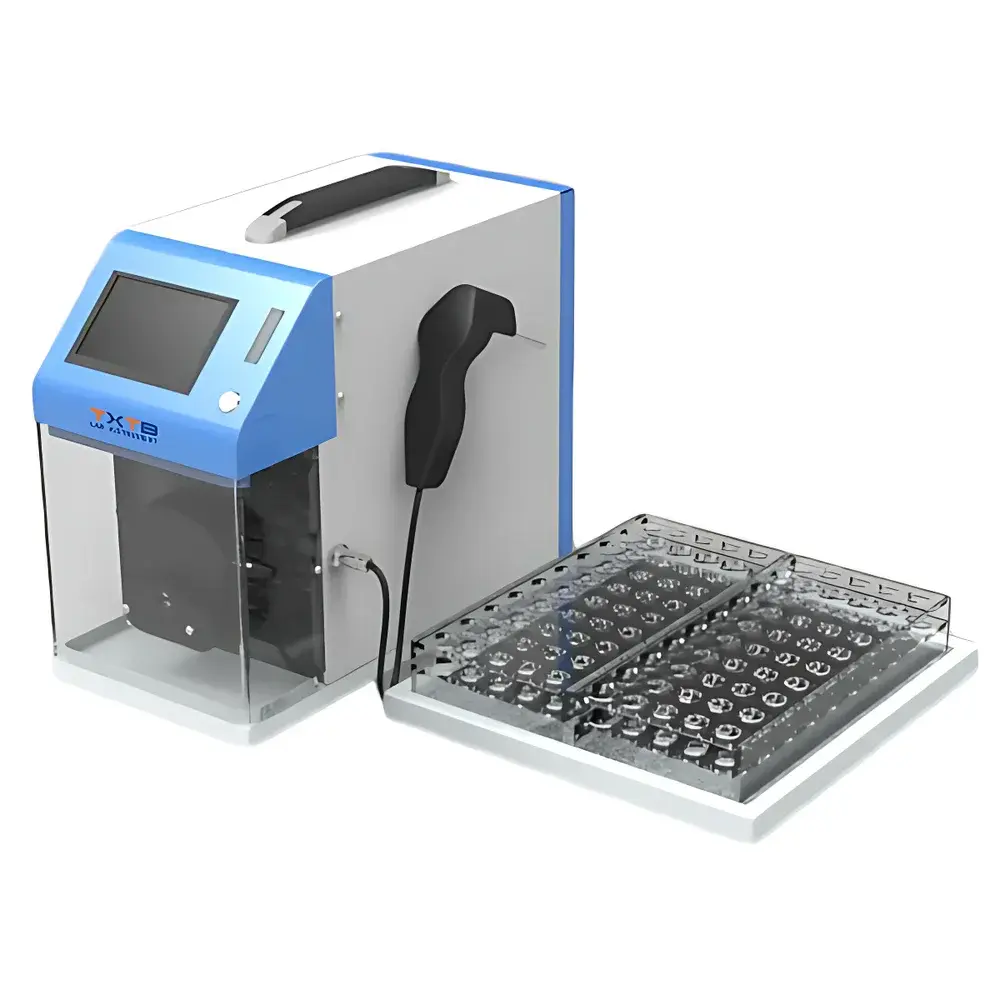
Tongxintianbo BFP Portable Electronic Bottle Top Dispenser
| Brand | Tongxintianbo |
|---|---|
| Model | BFP |
| Type | Electronic Bottle Top Dispenser |
| Volume Range | 0.1–5000 mL (adjustable) |
| Minimum Setting Increment | 0.1 mL |
| Accuracy | ±0.5–2% (dependent on tubing ID) |
| Dispensing Speed | 0–300 mL/min |
| Dispensing Duration | 0–100 min (adjustable) |
| Power Supply | 220 V / 50 Hz |
| Battery | Rechargeable Li-ion, >3 h runtime |
| Operating Temperature | –10 to +45 °C |
| Dimensions | 410 × 200 × 335 mm |
| Housing Material | ABS |
| Control Interface | High-sensitivity capacitive touchscreen + ergonomic keypad handle |
| Flow Path Configuration | Single-channel standard |
| Compliance | Designed for ISO/IEC 17025-aligned lab environments, compatible with GLP documentation workflows |
Overview
The Tongxintianbo BFP Portable Electronic Bottle Top Dispenser is an engineered solution for precise, repeatable, and operator-independent liquid handling in dynamic laboratory settings. Unlike mechanical or spring-loaded dispensers, the BFP employs a microprocessor-controlled peristaltic pump system, enabling programmable volumetric delivery based on time, flow rate, and user-defined volume targets. Its core architecture integrates closed-loop motor feedback and real-time pressure monitoring to maintain consistent aspiration and dispensing performance across variable viscosity ranges—from aqueous buffers to glycerol-based reagents (up to 500 cP). Designed for field-deployable applications—including mobile environmental testing labs, clinical sample preparation vans, and bioprocess support stations—the BFP eliminates dependency on fixed benchtop infrastructure while retaining metrological traceability essential for QC/QA protocols.
Key Features
- Integrated rechargeable lithium-ion battery supporting ≥3 hours of continuous operation without AC power—ideal for off-grid sampling, emergency response units, or satellite lab deployments.
- Ergonomic handheld control module with tactile keypad and responsive capacitive touchscreen, enabling glove-compatible operation and intuitive parameter navigation.
- Peristaltic pumping mechanism with chemically resistant silicone tubing (standard ID: 3.2 mm; optional IDs: 1.6 mm, 4.8 mm), minimizing cross-contamination risk and eliminating need for valve maintenance.
- Programmable dispensing logic: users define total volume, increment size, interval timing, and pause duration—enabling automated serial dilutions, multi-well plate filling, or timed aliquoting into collection vials.
- Rugged ABS housing rated IP42 for dust resistance and incidental splash protection, validated for stable performance across –10 °C to +45 °C ambient conditions.
- Calibration-ready architecture: supports two-point volumetric verification using certified Class A glassware and NIST-traceable gravimetric methods per ASTM E542 and ISO 8655-3.
Sample Compatibility & Compliance
The BFP accommodates a broad range of liquid types, including aqueous solutions, organic solvents (e.g., ethanol, acetone, DMSO), mild acids/bases (pH 2–12), and viscous media such as agarose solutions (≤2% w/v) and cell culture media with serum. Tubing selection determines chemical compatibility—silicone tubing is standard; Viton® or Tygon® alternatives are available upon request for aggressive solvents. The device meets mechanical safety requirements per IEC 61010-1 and electromagnetic compatibility standards (EN 61326-1). While not intrinsically safe, it is suitable for use in non-hazardous laboratory zones. Documentation packages include factory calibration certificates, traceable to national metrology institutes, and support audit readiness for ISO/IEC 17025, CLIA, and FDA 21 CFR Part 11-compliant data integrity frameworks when paired with optional timestamped log export.
Software & Data Management
The BFP operates via embedded firmware with no external PC dependency. All dispensing programs—including volume, speed, interval, and repeat count—are stored locally in non-volatile memory (retains settings after power loss). Touchscreen interface logs timestamps for each dispense event and displays real-time flow rate, cumulative volume, and battery status. Optional USB-C port enables CSV-formatted session export (date/time, program ID, actual delivered volume, deviation from setpoint) for integration into LIMS or ELN systems. Audit trail functionality records user-initiated parameter changes with timestamp and session ID, satisfying GLP/GMP record-keeping expectations for method validation and equipment qualification.
Applications
- Environmental field labs: Precise subsampling of water, wastewater, or soil leachates into preservation vials per EPA Method 500 series protocols.
- Pharmaceutical QC: Reproducible dispensing of dissolution media or buffer stocks into USP Apparatus II vessels.
- Microbiology: Sterile transfer of molten agar or selective media into Petri dishes under laminar flow hoods.
- Academic teaching labs: Student-safe, programmable liquid handling for titration practice, serial dilution exercises, and assay setup.
- Veterinary diagnostics: On-site preparation of PCR master mixes or ELISA reagent plates during farm visits or outbreak investigations.
FAQ
What tubing sizes are supported, and how do they affect accuracy?
The BFP ships with 3.2 mm ID silicone tubing. Optional 1.6 mm and 4.8 mm ID tubing kits are available. Smaller IDs improve low-volume precision (<1 mL); larger IDs enable higher flow rates but reduce resolution below 5 mL. Accuracy specifications (±0.5–2%) reflect worst-case variability across the full 0.1–5000 mL range and are verified per ISO 8655-3 using calibrated gravimetric reference standards.
Can the BFP be used with corrosive or high-viscosity liquids?
Yes—with appropriate tubing selection. Standard silicone tubing is compatible with most aqueous and polar organics. For strong oxidizers (e.g., concentrated HNO₃) or halogenated solvents, Viton® or C-Flex® tubing must be specified. Viscosity limits are 500 cP at 25 °C using 3.2 mm ID tubing; lower speeds and larger IDs extend capability to ~1500 cP.
Is firmware upgradable, and how is calibration maintained?
Firmware updates are delivered via USB-C and preserve all user programs. Calibration is performed at the factory using gravimetric verification at three points (1%, 50%, and 100% of max range). Users may perform field verification using certified cylinders or analytical balances; recalibration services are available through Tongxintianbo’s authorized service centers.



