
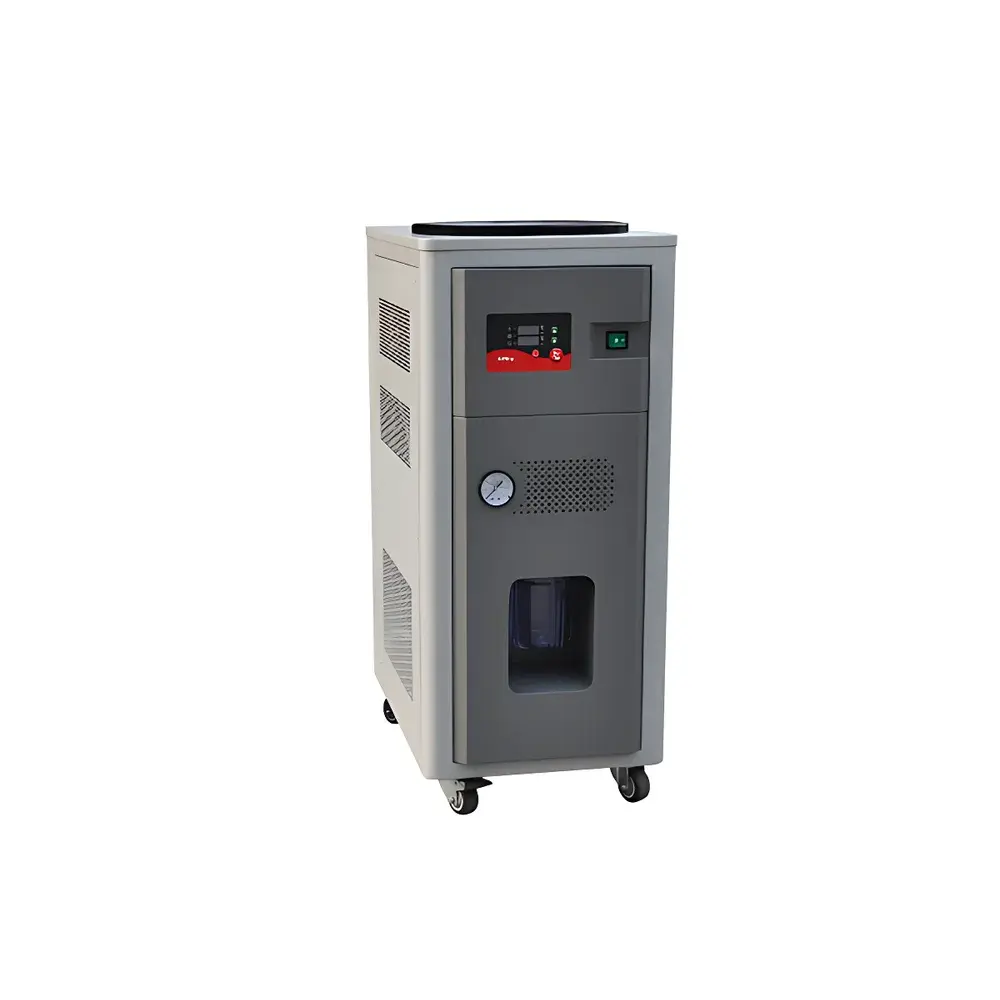
Tongzhou Weipu Ice Peak H Series High-Low Temperature Circulating Chiller
| Brand | Tongzhou Weipu |
|---|---|
| Origin | Beijing, China |
| Manufacturer Type | Direct Manufacturer |
| Regional Classification | Domestic (China) |
| Model | Ice Peak H |
| Instrument Type | Integrated Circulating Chiller |
| Cooling Method | Water-Cooled |
| Temperature Control Range | 5–35 °C |
| Refrigeration Capacity | 1000 W |
| Temperature Stability | ±0.1 °C |
| Circulation Pump Pressure | 2.0 bar |
| Circulation Flow Rate | 30 L/min |
| Reservoir Volume | 20 L |
| Operating Mode | Continuous Duty |
Overview
The Tongzhou Weipu Ice Peak H Series High-Low Temperature Circulating Chiller is an engineered thermal management solution designed specifically for precision cooling of analytical and materials characterization instruments in research, quality control, and production laboratories. Based on vapor-compression refrigeration with a water-cooled condenser configuration, the system delivers stable, continuous coolant circulation across a tightly regulated temperature range (5–35 °C), with high reproducibility and low thermal drift. Its compact vertical architecture minimizes footprint while maintaining robust heat exchange performance—critical when integrating with space-constrained instrumentation such as ICP-MS, AAS, SEM, and laser-based systems. The chiller employs R-410A or R-134a refrigerant (EU-certified, ozone-depletion potential < 0.05), compliant with international environmental directives including EU F-Gas Regulation (No. 517/2014). CE marking confirms conformity with essential health, safety, and electromagnetic compatibility requirements under the EU Machinery Directive and Low Voltage Directive.
Key Features
- Intelligent PID-controlled hot-gas bypass regulation ensures precise temperature setpoint maintenance (±0.1 °C stability) under dynamic thermal loads typical of plasma sources and high-power lasers.
- Vertical integrated design with front-accessible service panels and modular component layout facilitates installation in instrument cabinets or benchtop configurations.
- Dual-stage filtration system: standard particulate pre-filter (PP cotton) plus optional mixed-bed ion-exchange resin cartridge; transparent front-mounted filter housing enables real-time visual inspection and rapid cartridge replacement without system shutdown.
- Low-noise thermal management: large-diameter, variable-speed axial fan (≤52 dBA at 1 m) coupled with high-efficiency centrifugal circulation pump (30 L/min @ 2.0 bar) reduces acoustic interference in acoustically sensitive environments (e.g., cleanrooms, microscopy suites).
- Industrial-grade communication interfaces: RS232/RS485 serial ports support Modbus RTU protocol for integration into centralized lab automation platforms; dry-contact I/O enables external start/stop triggering and alarm interlocking per IEC 61508 functional safety guidelines.
- Expandable thermal envelope: factory-configurable variants support extended operation from –40 °C to +95 °C using dual-refrigerant circuits and auxiliary electric heating modules—validated per ASTM E2877-22 for thermal stability testing applications.
Sample Compatibility & Compliance
The Ice Peak H Series is validated for continuous-duty thermal coupling with high-heat-flux laboratory instruments requiring stable coolant supply, including but not limited to: atomic absorption spectrometers (ASTM D3370), inductively coupled plasma optical emission spectrometers (ICP-OES per ISO 17294-2), ICP-mass spectrometers (ICP-MS per EPA Method 200.8), scanning electron microscopes (SEM per ISO 16700), gloveboxes (ISO 10648-2), plasma etch systems, and laser ablation units. All models comply with EN 61000-6-2 (immunity) and EN 61000-6-4 (emissions), carry CE marking, and meet RoHS 2011/65/EU material restrictions. Optional room-temperature sensor integration supports dew-point avoidance protocols aligned with ISO 8502-9 surface conditioning standards for moisture-sensitive instrumentation enclosures.
Software & Data Management
Local operation is managed via a backlit 4.3-inch TFT touchscreen interface supporting multilingual UI (English, German, French, Chinese). Embedded firmware logs all operational parameters—including inlet/outlet temperatures, pump status, compressor cycles, and alarm history—with timestamped records retained for ≥30 days. For GLP/GMP environments, optional data export via USB or serial port enables traceable audit trails compatible with 21 CFR Part 11-compliant electronic record systems when paired with validated third-party data acquisition software. Firmware updates are performed via secure signed binary upload to prevent unauthorized modification.
Applications
- Cooling of plasma torches and RF generators in ICP-OES/ICP-MS systems to maintain plasma stability and reduce spectral drift.
- Thermal regulation of X-ray detectors and electron optics in SEM/TEM installations to minimize thermal noise and improve signal-to-noise ratio.
- Stabilization of laser cavity temperatures in Raman, LIBS, and ultrafast laser systems to preserve wavelength accuracy and beam pointing stability.
- Heat extraction from high-frequency induction furnaces and automated fusion bead preparation units used in geochemical and metallurgical analysis.
- Environmental chamber support for accelerated aging tests requiring controlled coolant loop interaction with test specimens (per ISO 4892-2).
FAQ
What is the maximum allowable ambient temperature for continuous operation?
The unit is rated for continuous operation at ambient temperatures up to 35 °C (95 °F) with relative humidity ≤80% non-condensing, per IEC 60068-2-14.
Can the chiller be integrated into a building management system (BMS)?
Yes—via optional RS485 Modbus RTU interface, enabling read/write access to temperature setpoints, flow status, fault codes, and energy consumption metrics.
Is deionized water required for operation?
While not mandatory, use of deionized or softened water is strongly recommended to extend filter life and prevent scaling in high-purity applications; conductivity should remain below 5 µS/cm.
Does the system support remote monitoring via Ethernet or Wi-Fi?
Ethernet and Wi-Fi connectivity are not standard; however, third-party industrial gateways (e.g., Moxa EDS-G205A) can bridge RS485 output to TCP/IP networks under IT security review.
What maintenance intervals are recommended for optimal long-term reliability?
Filter cartridges require replacement every 6 months under continuous use; refrigerant charge integrity and pump seal integrity should be verified annually by certified service personnel per ISO 5149-2.



