
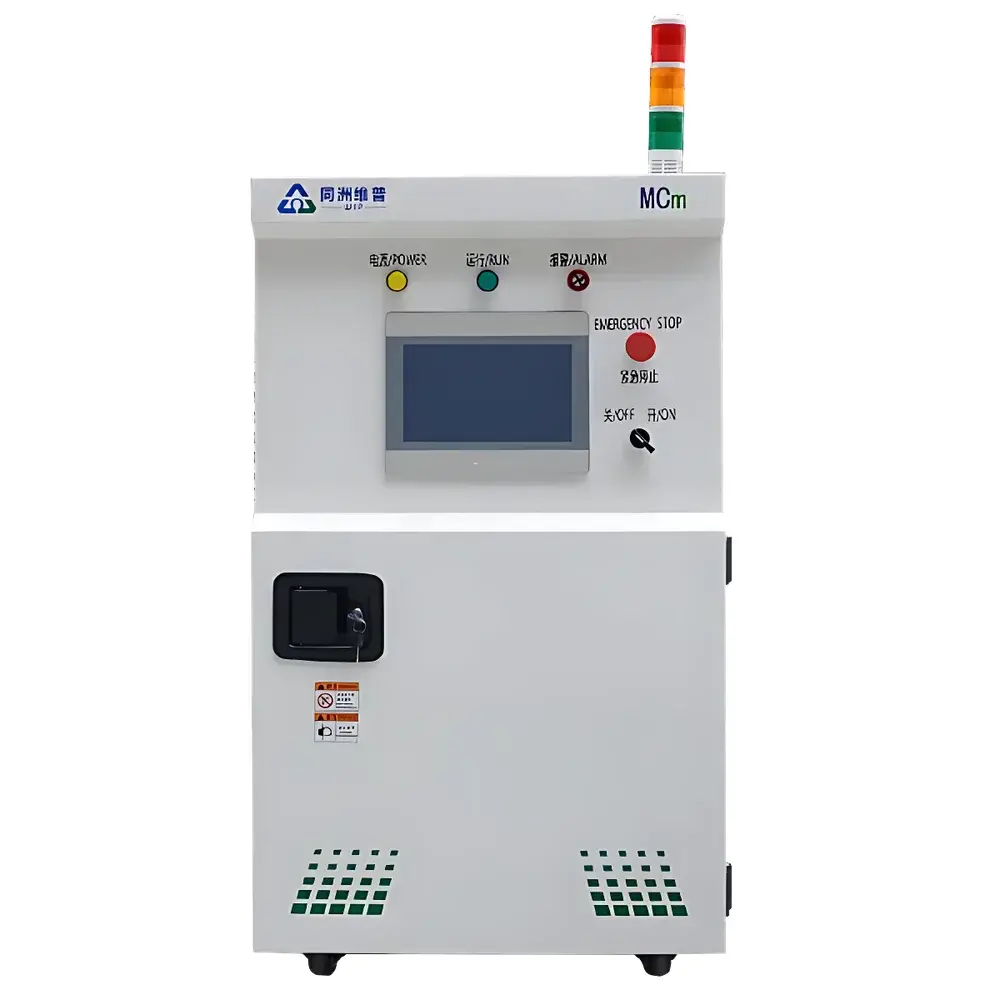
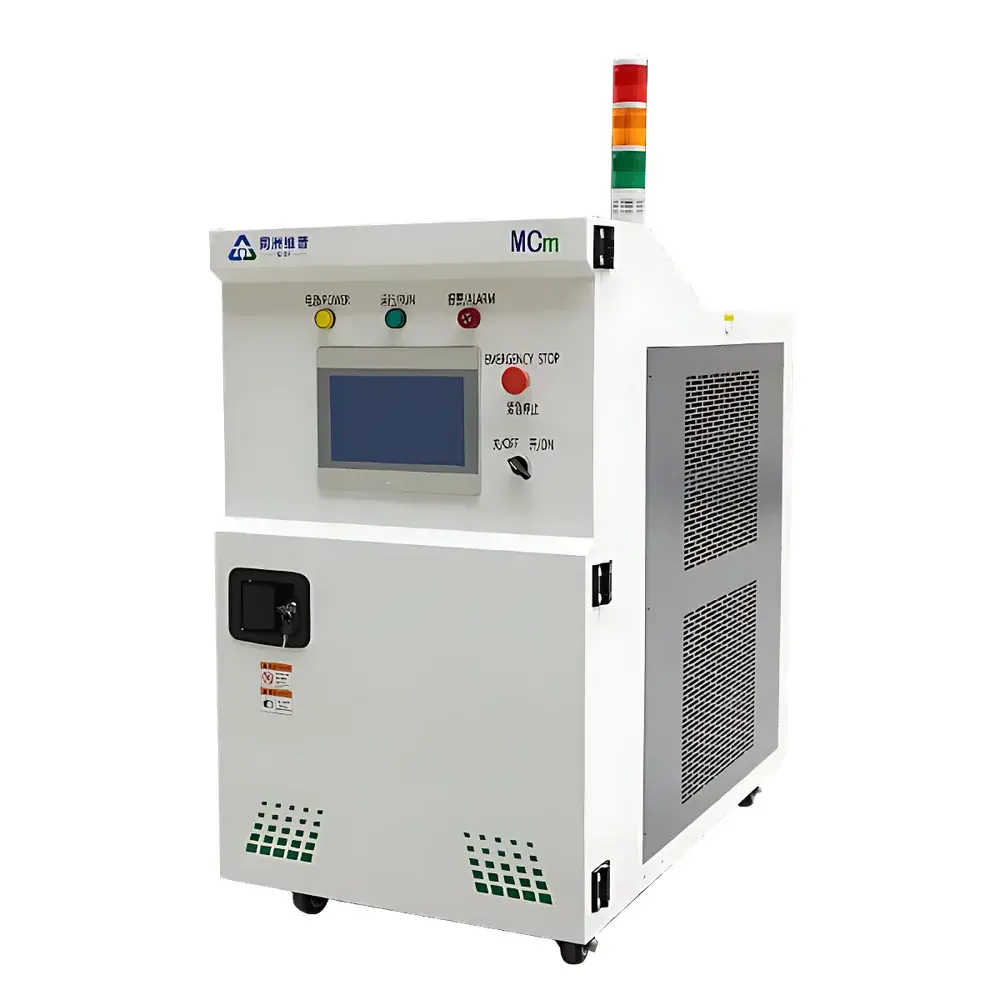
Tongzhou Weipu MCm Integrated Circulating Chiller for EV Battery Cell Testing
| Brand | Tongzhou Weipu |
|---|---|
| Origin | Beijing, China |
| Manufacturer Type | Direct Manufacturer |
| Regional Classification | Domestic (China) |
| Model | MCm Integrated Circulating Chiller |
| Instrument Type | Integrated (All-in-One) |
| Temperature Control Range | –20 °C to 95 °C |
| Cooling Capacity | 3 kW to 15 kW |
| Temperature Stability | ±0.5 °C |
Overview
The Tongzhou Weipu MCm Integrated Circulating Chiller is an engineered thermal management solution specifically designed for electrochemical testing of lithium-ion battery components—including individual cells, modules, and full battery packs—under controlled, dynamic temperature conditions. Operating on a closed-loop refrigeration cycle with integrated heating and cooling capability, the MCm system delivers precise, bidirectional thermal regulation across a wide operational range (–20 °C to 95 °C). Its compact all-in-one architecture eliminates the need for external heat exchangers or auxiliary fluid reservoirs, enabling direct integration into automated battery test benches and environmental simulation chambers. The system employs a dual-stage refrigerant circuit combined with PID-controlled electric heating elements to achieve rapid thermal ramping, stable setpoint maintenance (±0.5 °C), and seamless transition between heating and cooling modes—critical for simulating real-world thermal stress profiles during abuse testing, cycle life validation, and safety qualification per UN 38.3, IEC 62660, and GB/T 31485.
Key Features
- Integrated design with built-in refrigeration compressor, expansion valve, heater, circulation pump, and PID controller—all housed in a single industrial-grade enclosure
- Wide operational temperature span (–20 °C to 95 °C) supporting both cryogenic characterization and high-temperature aging protocols
- Adjustable cooling capacity from 3 kW to 15 kW (at 25 °C ambient), scalable via modular refrigerant charge and pump flow optimization
- High-precision temperature stability of ±0.5 °C under steady-state load, verified per ISO/IEC 17025-accredited calibration procedures
- Stainless steel fluid reservoir and corrosion-resistant internal wetted parts compatible with common heat transfer fluids (e.g., water-glycol mixtures)
- Programmable ramp-soak profiles supporting cold/heat shock sequences, constant-power dissipation tests, and multi-step thermal cycling
- Front-panel touchscreen interface with real-time monitoring of outlet temperature, flow rate, pressure differential, and system fault codes
Sample Compatibility & Compliance
The MCm chiller interfaces directly with standard battery test fixtures using 1/2″–3/4″ NPT or G-threaded ports and supports both internal recirculation (for thermal conditioning of sealed test chambers) and external open-loop configurations (for direct immersion or jacketed cell testing). It complies with CE marking requirements for electromagnetic compatibility (EMC Directive 2014/30/EU) and low-voltage safety (LVD Directive 2014/35/EU). Fluid-side construction meets ISO 8502-3 cleanliness standards for non-contaminating thermal systems. When deployed in regulated R&D environments, the MCm supports GLP-compliant data logging when paired with optional analog/digital I/O modules for traceable temperature and flow records.
Software & Data Management
The MCm includes native Modbus RTU and Ethernet/IP communication protocols for integration into LabVIEW, Python-based test automation frameworks, or commercial battery cyclers (e.g., Arbin, Bio-Logic, MACCOR). Optional firmware upgrade enables time-stamped CSV export of temperature, flow, and power consumption data at user-defined intervals (100 ms to 5 s resolution). Audit trail functionality—aligned with FDA 21 CFR Part 11 principles—can be enabled via external SCADA systems to record operator actions, parameter changes, and alarm events with electronic signature support.
Applications
- Dynamic thermal cycling of prismatic, cylindrical, and pouch cells under variable SOC/SOH conditions
- Calorimetric evaluation of heat generation during charge/discharge pulses (e.g., for ΔH estimation)
- Cold-start performance validation at –20 °C and high-rate discharge at 60–85 °C
- Thermal runaway propagation studies requiring rapid cooldown intervention post-trigger
- Environmental stress screening (ESS) of battery management systems (BMS) and cell interconnects
- Validation of thermal interface materials (TIMs) and cold plate designs under realistic thermal loads
FAQ
What types of heat transfer fluids are compatible with the MCm system?
Water-glycol mixtures (typically 20–30% propylene glycol by volume) are recommended for freeze protection and corrosion inhibition; deionized water may be used above 5 °C.
Can the MCm operate continuously at its maximum cooling capacity?
Yes—the system is rated for continuous duty at full 15 kW output under ambient conditions ≤30 °C and adequate ventilation (min. 500 m³/h airflow around condenser).
Does the MCm support remote control via Ethernet or USB?
Standard configuration includes RS-485 (Modbus RTU); Ethernet/IP and USB-to-serial adapters are available as factory-installed options.
Is NIST-traceable calibration documentation provided?
A factory calibration certificate (per ISO/IEC 17025) is included; full NIST-traceable calibration services are available upon request through Tongzhou Weipu’s authorized metrology partner network.
How is thermal uniformity ensured across multiple parallel test channels?
The MCm features a balanced manifold design with individual flow meters and proportional valves per outlet—enabling independent flow tuning to maintain ±1.0 °C inter-channel deviation under matched load conditions.
Related Products



